Author: Amiel Pineda

  • Utang Na Loob: the Filipino Concept of Debt of Gratitude

    Utang Na Loob: the Filipino Concept of Debt of Gratitude

    Utang Na Loob: A Filipino Concept of Debt of Gratitude

    Filipino culture values strong social bonds and loyalty, which is reflected in the concept of Utang Na Loob, or debt of gratitude. This concept emphasizes the importance of reciprocity and gratitude in relationships.

    Failing to reciprocate kindness can lead to social stigma and loss of respect.

    Utang Na Loob recognizes the emotional aspects of relationships. It encourages people to foster deeper connections through practices like pakikisama, which means adjusting to the norms and values of a group to maintain harmony, and pasalubong, which involves bringing gifts or souvenirs to show appreciation for others.

    These practices help build meaningful relationships and strengthen social bonds.

    Understanding Utang Na Loob is essential to navigating obligations and embracing Filipino cultural heritage. By recognizing the importance of gratitude and reciprocity, individuals can build stronger, more meaningful relationships and contribute to the rich cultural tapestry of the Filipino identity.

    Understanding Utang Na Loob

    cultural concept of indebtedness

    Utang Na Loob: A Guiding Principle of Filipino Culture

    Utang na loob is a fundamental concept in Filipino culture that emphasizes the importance of reciprocity and gratitude in interpersonal relationships. This concept, also known as "debt of the heart," highlights the obligation to repay acts of kindness and generosity received from others.

    The Term's Origins and Meaning

    The term utang na loob is derived from Tagalog, where utang means debt, na is a connective particle, and loob refers to one's inner self or heart.

    Cultural Significance

    Utang na loob is deeply rooted in Filipino culture, reflecting values of loyalty, reciprocity, and the importance of maintaining strong social bonds within families and communities.

    Failing to acknowledge or reciprocate acts of kindness can lead to social stigma, as utang na loob is considered a vital aspect of respect and honor in Filipino society.

    Practical Applications

    Understanding utang na loob provides insight into the intricate web of relationships and social dynamics that shape Filipino culture.

    For example, if a friend helps you move into a new apartment, you'd be expected to return the favor in the future, such as by helping them with a task or providing emotional support.

    This reciprocal relationship strengthens social bonds and demonstrates respect for one another.

    Cultural Significance and Impact

    Utang na Loob: The Cultural Significance

    Utang na loob has a profound impact on Filipino culture and society, reflecting values of loyalty and reciprocity that are integral to interpersonal relationships and community cohesion.

    Cultural Expressions of Utang na Loob

    Utang na loob is expressed through various cultural practices that foster strong social bonds within communities.

    Pakikisama, or getting along with others to maintain harmony and avoid conflict, is a key aspect of utang na loob.

    Additionally, pasalubong, or bringing gifts to show appreciation and strengthen relationships, is a common practice.

    Community involvement, such as participating in community events and activities to demonstrate gratitude and support, is also a vital expression of utang na loob.

    Influence on Social Relationships

    Through these cultural expressions, utang na loob promotes a sense of mutual support and cooperation within communities.

    While it can create complex dynamics, utang na loob remains a vital aspect of Filipino culture, influencing how individuals interact with one another and navigate their social relationships.

    It shapes values and behavior, particularly for Filipino-Americans as they navigate their cultural identity.

    Navigating Obligations and Expectations

    balancing duties and responsibilities

    Understanding Utang Na Loob Relationships

    Balancing Obligations and Expectations

    In utang na loob relationships, a delicate balance of obligations and expectations exists.

    You must consider the weight of your obligations to return kindness and favors, while also being cautious not to let others take advantage of your goodwill.

    Open Communication is Key

    Open communication is crucial in utang na loob relationships.

    Discuss your expectations regarding help and support with your loved ones to avoid feelings of helplessness or dependency. This understanding helps maintain healthy relationships built on mutual respect and reciprocity.

    Finding a Balance

    Failure to reciprocate can lead to social stigma, so it's essential to find a balance between honoring your commitments and protecting your own interests.

    Interpersonal Dynamics and Justice

    Navigating the complexities of utang na loob relationships requires balancing obligations and expectations, which intersects with notions of justice. Utang na loob promotes social cohesion and builds trust within communities, going beyond mere reciprocity.

    Understanding utang na loob is crucial for interpersonal justice because it distinguishes between debts of good will and debts of ill will. In utang na loob relationships, authentic connections are fostered where the expectation of reciprocity is self-imposed by the beneficiary, rather than demanded by the benefactor.

    For instance, when a friend helps you move into a new apartment, you feel obligated to return the favor because you value the friendship, not because they demanded it.

    In contrast, true benefactors act without expecting compensation, whereas manipulative circumstances can lead to exploitative relationships. Recognizing the relational dynamics involved in utang na loob helps you navigate complex social situations, promoting justice and fairness in your interactions.

    This awareness enables you to identify when someone is genuinely helping you or trying to manipulate you into a debt of ill will.

    Embracing Filipino Cultural Values

    celebrating filipino heritage together

    Filipino Cultural Values Emphasize Reciprocity and Appreciation

    In Filipino culture, utang na loob is a vital concept that revolves around reciprocity and appreciation, maintaining social bonds through acts of kindness and gratitude. This cultural value is essential for building strong relationships, as it fosters a sense of harmony and strengthens community ties.

    Cultural Practices Reflect Utang na Loob

    Filipino cultural practices, such as pakikisama (getting along) and pasalubong (bringing gifts from trips), demonstrate the importance of reciprocity and appreciation. These practices show that demonstrating respect for family and community is paramount, where acts of kindness are expected to be reciprocated to uphold harmony and strengthen relationships.

    Embracing Utang na Loob Fosters Deeper Connections

    By actively participating in cultural traditions and openly communicating about values, individuals can foster a deeper connection and empathy, especially in intercultural relationships.

    Recognizing and honoring the emotional aspects tied to utang na loob enhances interpersonal relationships and encourages a supportive and cohesive community environment.

    How does the concept of “hiya” in Filipino culture relate to the concept of “utang na loob?”

    In Filipino culture, the concept of “hiya” and “utang na loob” are deeply interconnected. “Hiya” refers to the Filipino sense of shame when one fails to fulfill an obligation, while “utang na loob” revolves around the feeling of debt and gratitude. Both concepts play a vital role in shaping interpersonal relationships.

    Building Meaningful Relationships

    Harmony is the foundation of Filipino relationships, where the concept of utang na loob (debt of gratitude) plays a significant role in building strong bonds. This concept is demonstrated through shared acts of kindness, such as giving pasalubong (gifts) when returning from trips, which strengthens relationships among family and friends.

    To build meaningful relationships in the Filipino context, it's essential to:

    Respect authority figures through pakikisama (the spirit of getting along), especially towards elders and those in positions of authority. This helps maintain harmony and avoid conflicts.

    Open communication is key to understanding cultural practices and expectations, which helps navigate potential conflicts and fosters respect.

    Participate in communal activities to express gratitude and reinforce the utang na loob principle, enhancing interpersonal relationships within the community.

    Frequently Asked Questions

    What Is the Filipino Concept of "Utang Na Loob"?

    Utang Na Loob: A Deep Sense of Gratitude and Obligation

    Utang na loob is a Filipino concept that translates to "debt of the heart." It's a deep sense of gratitude and obligation to repay kindness received from others. This concept is rooted in cultural significance and emphasizes the emotional connection involved.

    Unlike a transactional obligation, utang na loob is a moral duty that fosters loyalty and reciprocity among family, friends, and community. It reflects the importance of interpersonal relationships and community bonds in Filipino culture.

    For example, if a family member helps you financially in a difficult time, you may feel utang na loob towards them, motivating you to return the favor in the future. This concept promotes a sense of responsibility and appreciation for the kindness received.

    What Is the Debt of Gratitude of Filipinos?

    Filipinos value reciprocity and loyalty, which are deeply ingrained in their cultural context. This means that when someone shows kindness, Filipinos feel a strong obligation to repay kindness with kindness. This debt of gratitude isn't just a moral duty, but an emotional connection that resonates deeply.

    Helping others is a two-way street in Filipino culture. When someone helps you, you're expected to return the favor in some way. This fosters strong bonds and a sense of mutual assistance within the community. For example, if a neighbor helps you with a task, you might return the favor by helping them with a similar task in the future.

    Upholding this cultural norm is essential, even if it means navigating complexities in relationships. Filipinos understand that maintaining strong relationships is crucial, and they're committed to repaying debts of gratitude to ensure these relationships remain strong.

    What Is the Difference Between Gratitude and Utang Na Loob?

    Gratitude vs. Utang Na Loob: Understanding the Difference

    Gratitude is a feeling of appreciation for a kindness received. When you express gratitude, you're showing thanks for something someone has done for you. For example, saying "thank you" to a friend who helped you move into a new apartment is an expression of gratitude.

    Utang Na Loob, on the other hand, is a deep-seated moral obligation to reciprocate. This Filipino concept goes beyond mere gratitude and involves a sense of indebtedness to repay the favor.

    Utang Na Loob is rooted in communal values, emphasizing the importance of building strong relationships through mutual support and reciprocity. For instance, if a neighbor helps you in a time of need, you may feel utang na loob and make it a point to return the favor in the future.

    This sense of obligation isn't just about feeling thankful, but about making a conscious effort to repay the kindness.

    What Is the Theory of Debt of Gratitude?

    The Theory of Debt of Gratitude Explained

    The theory of debt of gratitude is a concept that highlights the moral obligation to repay kindness through Cultural Reciprocity. This means that when someone does you a favor, you feel an emotional bond and sense of loyalty to return the favor in the future.

    Why Reciprocity Matters

    In this framework, reciprocity is key. It's not just about saying thanks; it's about recognizing the importance of mutual support and interconnectedness. When you receive help, you're expected to return the favor, fostering a culture of give-and-take.

    This promotes a sense of community and cooperation, where individuals feel responsible for one another.

    How It Works

    For example, if a friend helps you move into a new apartment, you might feel inclined to help them with a task in the future. This exchange creates a sense of mutual obligation, where both parties feel invested in each other's well-being.

    The theory of debt of gratitude emphasizes the importance of this reciprocal relationship, encouraging individuals to recognize the value of kindness and repay it in meaningful ways.

  • Respect for Elders: A Deeply Ingrained Filipino Value

    Respect for Elders: A Deeply Ingrained Filipino Value

    Respect for Elders is a Core Filipino Value

    Respect for elders is a deeply ingrained value in Filipino culture, shaping daily life, traditions, and social interactions. This value is demonstrated through gestures like pagmamano, which symbolize deference and honor.

    Elders are Revered in Filipino Families

    In Filipino families, elders are considered vital sources of wisdom and guidance.

    Children are expected to care for their aging parents as a sign of familial responsibility. This expectation is rooted in the culture's emphasis on intergenerational respect and reciprocity.

    Respect for Elders Influences Business and Society

    This value also shapes business leadership styles, workplace dynamics, and negotiation strategies.

    It influences how Filipino culture balances tradition and modernity, with elders often serving as bridges between the two.

    Cultural Roots of Respect

    respect s cultural foundations explored

    Filipino culture is built on a strong foundation of respect for elders, which is deeply ingrained in everyday interactions and traditions. This respect is demonstrated through traditional gestures like *pagmamano*, where you take an elder's hand and place it on your forehead, symbolizing deference and honor.

    For example, when greeting an elder, a Filipino child might perform *pagmamano* as a sign of respect.

    Elders are highly valued in Filipino families, viewed as vital sources of wisdom and guidance. Their experiences are highly valued and often sought in decision-making processes.

    Children are expected to care for their aging parents, reflecting a deep-rooted belief in familial responsibility and highlighting the sanctity of family ties in Filipino society.

    The cultural emphasis on respect and care for elders is reinforced through celebrations, such as Elderly Filipino Week, which fosters awareness and community engagement towards the elderly.

    Impact on Business and Leadership

    Respect for Elders Shapes Leadership Styles

    In a business setting, respect for elders significantly influences leadership styles. Filipino leaders often adopt paternalistic styles, prioritizing employee welfare while maintaining authority. This approach fosters employee loyalty, as younger team members are hesitant to challenge ideas presented by elder colleagues.

    Ethical Decision-Making and Respect for Elders

    Ethical decision-making in Filipino businesses is deeply intertwined with respect for elders. Leaders are expected to uphold traditional values while navigating modern business challenges.

    In business negotiations, relationship-building is key, and approval from senior figures is often required, reflecting the significance of respect in achieving trust and successful outcomes.

    Understanding Respect for Elders in Filipino Business

    Understanding the impact of respect for elders on leadership styles and organizational structures is crucial for building strong relationships and achieving success in the Philippines.

    Hierarchical Structures and Relationships

    organizational hierarchies and dynamics

    Understanding Hierarchical Structures in Filipino Business Culture

    In Filipino business culture, respect for elders is deeply ingrained in organizational structures, with decision-making authority often centralized around senior figures.

    Deference to Elders

    • Younger employees are expected to show respect to their elders, fostering strong loyalty and commitment within the workplace.
    • This expectation promotes a sense of hierarchy, where junior employees look up to senior colleagues for guidance and mentorship.

    Mentorship and Career Development

    • Mentorship relationships thrive in this context, as senior employees guide and support junior employees in their career development.
    • Elders significantly impact team dynamics and morale by providing wisdom, guidance, and support to younger colleagues.

    Stability and Loyalty

    • The cultural expectation of respect for elders promotes stability within organizations, reinforcing loyalty from subordinates and enhancing intergenerational collaboration.
    • This leads to a sense of community and strong relationships within the workplace.

    Impact on Communication and Innovation

    • While this cultural dynamic can lead to strong relationships, it may also limit open communication and innovation.
    • Understanding these hierarchical structures and relationships is crucial for effective collaboration and building strong, lasting relationships in Filipino business culture.

    Negotiation Dynamics and Cultural Nuances

    Respect for Elders Shapes Negotiation Dynamics

    In the Philippines, respect for elders significantly influences the dynamics of business negotiations.

    Senior figures hold the final say, leading to longer negotiation timelines due to the need for their approval. This emphasis on respect for elders is deeply intertwined with the importance of relationship-building, where a formal approach reflects respect for counterparts.

    Cultural Nuances Can Create Misunderstandings

    Cultural nuances in respect can lead to misunderstandings in international negotiations.

    Foreign counterparts may not understand the importance of hierarchical dynamics prevalent in Filipino culture, which can lead to unintended offense or miscommunication.

    Involving elders in negotiations not only validates their authority but also enhances trust and goodwill.

    Demonstrating Respect through Traditional Gestures

    Traditional gestures, such as the "mano po," may be employed to demonstrate respect, reinforcing the value placed on interpersonal relationships within the business context.

    By recognizing and adapting to these cultural nuances, you can navigate negotiations more effectively and build stronger relationships with your Filipino counterparts.

    Balancing Tradition and Modernity

    harmonizing heritage with innovation

    Respecting Tradition and Embracing Modernity in Filipino Culture

    In the Philippines, respect for elders is a deeply rooted cultural practice that emphasizes deference and obedience. The "mano po" gesture, where the younger person takes the elder's hand and places it on their forehead, is a traditional sign of respect.

    However, this tradition can sometimes clash with modern egalitarian values in the workplace.

    Younger generations are pushing for change, advocating for more inclusive and participatory decision-making processes that challenge traditional hierarchical structures. For instance, they want a say in business decisions, rather than simply following orders from their elders.

    This shift towards modernity can lead to conflicts between innovation and adherence to established customs.

    To address this challenge, organizations in the Philippines are integrating modern business practices while maintaining respect for authority.

    Training programs are being implemented to promote collaboration and inclusivity, aiming to bridge the gap between traditional respect for elders and the need for innovative ideas in contemporary business practices.

    Finding a balance between respect for elders and modernity requires continuous dialogue and adaptability.

    By acknowledging the importance of cultural heritage and embracing the need for innovation, businesses can create an environment that honors traditional values while embracing modern demands for flexibility and inclusivity.

    Preserving Respect in a Changing World

    Preserving Respect for Elders in Filipino Culture

    In today's rapidly changing world, respect for elders is a vital aspect of Filipino culture that needs to be preserved. This value has been deeply ingrained in the cultural identity, and it's essential to hold onto it as modern life becomes more complex.

    The Significance of "Pagmamano"

    The traditional gesture of "pagmamano," where younger individuals place an elder's hand to their forehead, is a symbol of respect that must be preserved. This gesture is crucial in today's egalitarian society, where younger generations may prioritize equality over hierarchy.

    Respect in Family Life

    Maintaining respect for elders in family life fosters loyalty and commitment, ensuring that family bonds remain strong. This respect is essential for the well-being of both the younger and older generations.

    Blending Tradition with Innovation

    Organizations in the Philippines are adapting to the changing landscape by blending traditional respect with innovative practices. This approach encourages collaboration and inclusivity, while preserving the value of respect for elders.

    Community initiatives like Elderly Filipino Week promote awareness and appreciation of the elderly's contributions to society.

    Training Programs for Younger Generations

    Training programs focus on instilling respect for elders in younger generations, recognizing this value as vital for preserving cultural identity amidst rapid societal changes.

    These programs ensure that the next generation understands the importance of respecting their elders.

    How is the concept of respect for elders reflected in Filipino funeral rites?

    In the funeral traditions in philippines, the concept of respect for elders is deeply reflected. Families show reverence for their elders by following traditional customs and rituals during funeral ceremonies. They prioritize honoring and paying tribute to the departed elders, emphasizing the importance of respect within the culture.

    Embracing Intergenerational Wisdom

    honoring generations shared knowledge

    Elders are a valuable resource in Filipino culture, and embracing intergenerational wisdom is essential for personal and collective growth. By seeking guidance from family members who've come before, individuals can tap into a wealth of knowledge and experience that can help them make informed decisions.

    In Filipino society, elders are viewed as repositories of knowledge and experience. Their advice and guidance are considered invaluable in personal and professional decision-making. For instance, in Filipino families, older relatives often share their life experiences and wisdom with younger generations, providing valuable insights and lessons learned.

    The cultural value of intergenerational wisdom is deeply ingrained in Filipino traditions. One such tradition is the practice of "pagmamano," where younger individuals show respect by taking an elder's hand and placing it on their forehead. This symbolizes the deep reverence for intergenerational wisdom and the importance of seeking guidance from those who've come before.

    Mentorship relationships are also an essential part of Filipino workplaces. Elder leaders guide younger employees in career development, enhancing team dynamics and organizational loyalty. This not only benefits the individual but also contributes to the organization's overall success.

    Frequently Asked Questions

    What Is Respect for Elders in Filipino Values?

    Respect for elders is a fundamental value in Filipino culture. This value is deeply rooted in cultural traditions, where younger generations are expected to show deference to their older family members.

    This respect is demonstrated through polite language, physical gestures, and a deep sense of reverence and appreciation for the elderly. For example, in daily interactions, Filipinos use honorific titles such as "Lolo" or "Lola" (grandfather or grandmother) to address their elderly relatives.

    They also show respect through physical gestures like bowing their heads or taking the elder's hand as a sign of respect. This value fosters strong intergenerational relationships, where younger individuals seek guidance and wisdom from their elders.

    What Is the Moral Value of Respect to Elders?

    The moral value of respect to elders lies in nurturing intergenerational relationships. This value recognizes the wisdom and experience that comes with age, which shapes our moral upbringing. Honoring those who've come before us fosters a sense of gratitude and responsibility. By doing so, we reap the benefits of their guidance, ensuring a stronger, more compassionate community.

    For example, in many cultures, elderly individuals are revered for their life experiences and knowledge. They've lived through significant historical events, overcome challenges, and developed valuable insights.

    By respecting and listening to them, we can learn from their experiences and gain a deeper understanding of our heritage. This, in turn, helps us develop a sense of responsibility to carry on cultural traditions and values.

    Respecting elders also promotes social cohesion and collaboration. When we value the wisdom of our elders, we're more likely to work together to address community challenges.

    By combining the experience of older generations with the energy and creativity of younger ones, we can build a more harmonious and thriving community.

    What Is the Filipino Culture for the Elderly?

    The Filipino culture highly regards its elderly citizens. In this culture, family dynamics prioritize caring for aging parents, which is considered a sacred duty. Children are expected to provide physical and emotional support to their elderly parents, ensuring their well-being and comfort.

    Cultural rituals showcase profound respect for the elderly. One such ritual is pagmamano, where younger family members show respect by taking the elder's hand and placing it on their forehead as a sign of reverence. Additionally, using respectful language when addressing elderly individuals is an essential aspect of Filipino culture.

    Community involvement is crucial in promoting the health and well-being of the elderly. Events like Elderly Filipino Week raise awareness about the importance of caring for the elderly and provide opportunities for the community to come together and celebrate their contributions.

    By honoring the experiences and wisdom of the elderly, individuals demonstrate their value in Filipino culture. This emphasis on respect and care for the elderly is a cornerstone of Filipino values, highlighting the importance of intergenerational relationships and community involvement.

    What Is the Importance of Elder Respect?

    Respect for elders is vital in many cultures because it allows for the exchange of valuable life experiences and wisdom.

    This cultural significance is rooted in the understanding that elderly individuals have accumulated knowledge and insights that can benefit younger generations. By valuing their experiences, we can tap into their wisdom and avoid repeating mistakes of the past. For instance, elders can share their experiences during times of war, economic hardship, or social change, providing younger generations with a unique perspective on how to navigate similar challenges.

    This intergenerational knowledge transfer strengthens family bonds and community ties. When younger generations show respect and appreciation for their elders, it fosters a sense of closeness and understanding within families and communities.

    In turn, this leads to a more harmonious society where everyone's voice is heard and valued. By recognizing the importance of elder respect, we can create a society that values the contributions of all its members, regardless of age.

  • Family: The Cornerstone of Filipino Society

    Family: The Cornerstone of Filipino Society

    Family is the foundation of Filipino society, with a strong focus on loyalty, obligation, and interdependence among family members. This sense of interconnectedness is captured in the concept of "kapamilya," which prioritizes family ties over individualism.

    Filial piety is deeply ingrained, instilling respect and care for elders, who are revered for their wisdom and guidance.

    Family gatherings and celebrations, such as Noche Buena, are an integral part of Filipino culture, strengthening family bonds and preserving cultural traditions. These events bring together extended families, foster a sense of community, and pass down customs from one generation to the next.

    The influence of the family extends beyond the household, shaping social structures, community cohesion, and cultural values.

    The family's role in Filipino society is multifaceted, with far-reaching implications for social norms, education, and economic development.

    Understanding the dynamics of Filipino families is essential to uncovering the complexities of this vital institution and its profound impact on society.

    Foundations of Filipino Family

    cultural roots of filipino family

    The foundation of a Filipino family is built on a strong sense of loyalty and obligation to one another. This emphasis on interconnectedness over individualism is reflected in the term "kapamilya," which highlights the importance of family ties.

    As a member of a Filipino family, you're expected to prioritize the needs of your family members, particularly your elders, as a sign of respect and gratitude. This is rooted in the cultural value of filial piety, where younger generations are expected to care for and show respect to their elders.

    The concept of Utang na loob, or repaying kindness and support, further reinforces this sense of mutual obligation among family members. For example, if a family member helps you with a problem, you're expected to return the favor in the future. This sense of reciprocity strengthens family bonds and encourages cooperation.

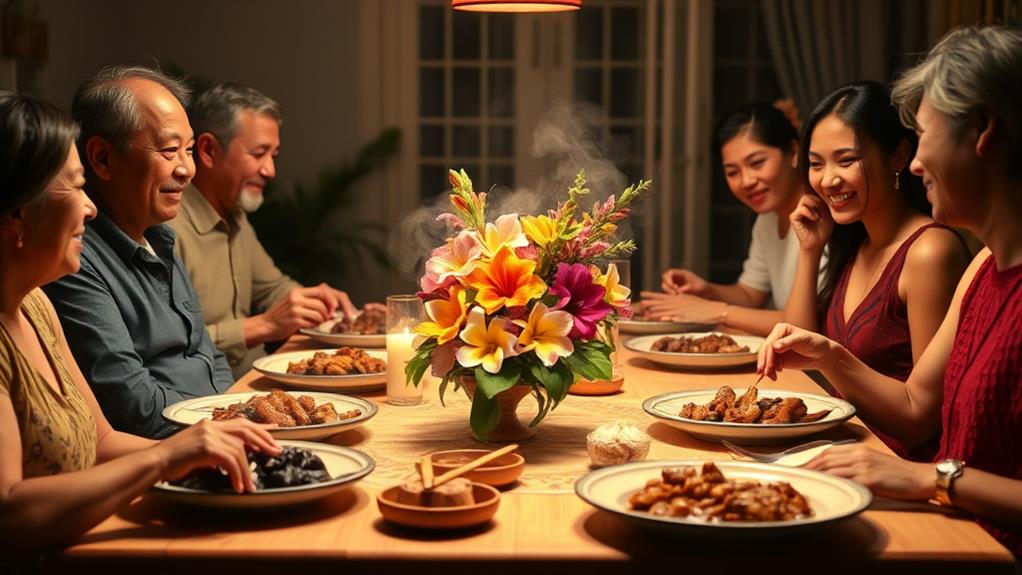
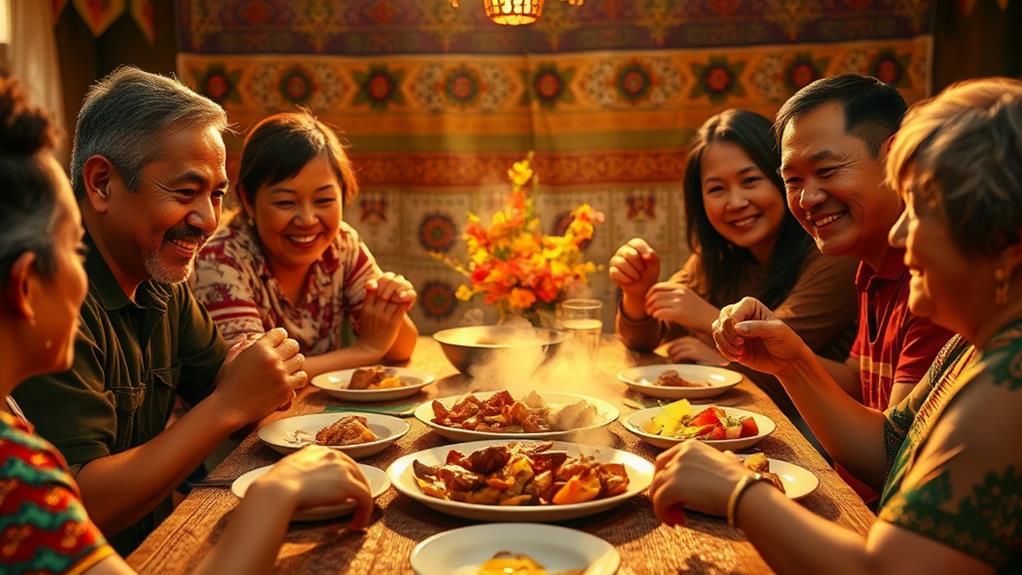
    Family gatherings and celebrations, such as birthdays and holidays, are crucial in strengthening family bonds and traditions. During these events, families come together to share meals and experiences, fostering a sense of closeness and togetherness.

    For instance, during holidays like Christmas, Filipino families often gather together for a meal called "Noche Buena," which is a time to bond and create lasting memories.

    Extended Family and Kinship

    In Filipino culture, family extends beyond the nuclear unit to include a vast network of relatives. This concept of "kapamilya" encompasses grandparents, aunts, uncles, cousins, and even distant relatives, fostering a strong sense of belonging and solidarity. Family relationships are deeply valued and nurtured, with loyalty and obligation towards extended family members being paramount.

    Three generations often live together in Filipino households. Grandparents play a significant role in raising their grandchildren and providing support to the family unit. This setup allows for shared experiences and collective identity within the extended family network.

    For example, grandparents may help with childcare, cooking, and household chores, while also passing down cultural traditions and values to younger generations.

    Extended family members are a crucial support system in times of need. Filipino families often rely on one another for emotional support and financial assistance. In times of crisis, extended family members may provide temporary housing, food, or financial aid.

    This support system is critical in Filipino society, where family ties are deeply valued and nurtured.

    Respect and Filial Piety

    honor and family duty

    Respect and Filial Piety Strengthen Filipino Family Bonds

    In Filipino culture, respect and filial piety are essential values that fortify family relationships. Filial piety, or respect for one's parents and elders, is a core value that emphasizes the duty and obligation of younger family members to care for their aging relatives.

    This value is reinforced through cultural practices, such as celebrations that honor parental figures and ancestors. For example, the Filipino tradition of "Araw ng mga Ama" (Father's Day) and "Araw ng mga Ina" (Mother's Day) highlight the importance of gratitude and reverence for family lineage.

    The concept of Utang na loob, or the debt of gratitude, also underscores the expectation to repay good deeds within the family. This showcases the interconnectedness and loyalty inherent in familial relationships.

    For instance, children are expected to care for their aging parents in return for the sacrifices their parents made for them.

    Respect for elders is deeply ingrained in Filipino society, leading younger generations to prioritize the well-being and care of their grandparents and parents as a sign of honor.

    This emphasis on filial piety ultimately reinforces the importance of family ties, solidifying the role of family as the cornerstone of Filipino society.

    Family Roles and Dynamics

    In Filipino households, a complex web of relationships and roles shapes family dynamics.

    Three generations often live together, with grandparents playing a significant role in raising their grandchildren. This emphasizes the importance of extended family dynamics, where grandparents are involved in childcare and decision-making.

    The eldest male typically holds authority, while matriarchs manage household income and decision-making. This blend of traditional and modern gender roles showcases the evolving nature of family dynamics in Filipino culture.

    Filial piety, a core cultural value, expects younger family members to show respect and care for their elders. This reinforces interdependence within family units, where family members rely on each other for emotional and financial support.

    Family gatherings are frequent and significant, serving as opportunities to strengthen bonds and reinforce cultural traditions. These gatherings often involve large family meals, celebrations, and storytelling, which help to pass down cultural values and traditions to younger generations.

    The concept of Utang na loob, or debt of gratitude, fosters mutual support and loyalty among family members, creating a system of accountability and interconnectedness within familial relationships. This concept emphasizes the importance of reciprocity and gratitude in family relationships, where family members feel a sense of obligation to support and care for one another.

    Celebrations and Gatherings

    festive events and socializing

    Celebrations and Gatherings Reinforce Family Ties and Cultural Heritage

    In the Philippines, frequent family gatherings and celebrations play a vital role in strengthening kinship ties and preserving cultural heritage. Birthdays, holidays, and milestones are significant events that bring families together, fostering a sense of unity and togetherness. During these gatherings, food is a central element, symbolizing the bond between family members as they share meals and celebrate their connections.

    Extended family members often participate in celebrations, emphasizing the importance of collective identity and the interconnectedness of all relatives. Traditional Filipino celebrations may include cultural rituals and practices that honor ancestors and parental figures, reflecting gratitude and respect within the family lineage.

    For example, the "Pagluluksa" ritual is a traditional Filipino mourning practice that honors the deceased and provides comfort to the grieving family.

    These gatherings not only strengthen family ties but also serve as opportunities for cultural transmission, ensuring that values and traditions are passed down through generations. By participating in these celebrations, individuals actively reinforce familial bonds and perpetuate Filipino culture.

    How does the Filipino value of respect for elders contribute to the importance of family in Filipino society?

    In Filipino society, the Filipino value of respecting elders plays a crucial role in upholding the importance of family. This value fosters strong family bonds, promotes intergenerational harmony, and instills a sense of responsibility in caring for elderly family members. It ultimately contributes to a cohesive and supportive family unit.

    Impact on Society and Culture

    Family Ties Shape Filipino Society and Culture

    The strong familial bonds in Filipino families have a profound impact on social structures, fostering cooperation, mutual aid, and community cohesion.

    The family serves as a cornerstone, shaping cultural values and norms.

    Cultural Values and Their Impact

    Pakikisama and Bayanihan, which emphasize social harmony and collective support, demonstrate the family's influence on community dynamics.

    These values promote unity and cooperation among family members and the community.

    Utang na loob and Hiya, which cultivate a sense of accountability and social responsibility, reflect the family's significant impact on societal behavior and norms.

    These values encourage family members to take responsibility for their actions and respect others.

    Close family relationships contribute to social stability and resilience, as families often serve as primary support systems during times of need.

    This close-knit structure provides emotional and financial support, helping individuals cope with challenges.

    In Filipino society, relationships are highly valued, and a deep sense of family is instilled from a young age.

    This close-knit family structure plays a significant role in shaping social norms and cultural identity.

    Frequently Asked Questions

    Why Is Family so Important in Filipino Culture?

    Family is the core unit of Filipino society, and its importance stems from cultural values that prioritize filial piety, respect for traditions, and strong community ties.

    In the Philippines, extended households are common, where multiple generations live together, emphasizing interconnectedness and closeness among family members.

    Regular family gatherings, such as Sunday lunches and fiestas, reinforce generational bonds and provide opportunities for socialization and cultural transmission.

    Filipino families serve as a support system, offering essential care and guidance to their members.

    Elderly relatives are often cared for by their children and grandchildren, rather than relying on government support.

    By honoring family lineage, Filipinos demonstrate loyalty and a sense of belonging, which ultimately strengthens their cultural identity.

    This strong sense of family ties is a defining characteristic of Filipino culture.

    What Is Meant by the Family Is the Cornerstone of Society?

    The family is the cornerstone of society because it provides the foundation for social structures to thrive. This means that strong family bonds and cultural values are essential for fostering social support and communal responsibility.

    For instance, family traditions such as regular dinner gatherings and resilience strategies like open communication help promote social cohesion.

    In essence, a strong family unit serves as the bedrock for a stable and harmonious society, where individual and collective well-being are interconnected.

    Who Is the Cornerstone of the Family?

    The Matriarch: The Cornerstone of the Family

    She holds key family roles and exerts significant parental influence. The matriarch, typically the grandmother, takes on crucial responsibilities within the family structure. For instance, she often provides guidance and support to younger generations, helping to shape their values and beliefs.

    She is the hub of sibling dynamics and extended family relationships. The matriarch plays a vital role in maintaining harmony among siblings and uniting extended relatives. Her efforts help to strengthen family bonds and resolve conflicts.

    She upholds cultural traditions and provides emotional support. By preserving cultural heritage, the matriarch offers a sense of continuity and belonging.

    Her wisdom and care also create a sense of security, making her the epicenter of the family's support system.

    What Is the Family Structure of the Philippines?

    The typical family structure in the Philippines is a blend of nuclear and extended families. This bilaterally extended family system often includes three generations living together, with a clear family hierarchy.

    The family hierarchy is characterized by a strong sense of respect for elders, with traditional cultural traditions emphasizing their authority and wisdom.

    Strong kinship ties extend to aunts, uncles, and cousins, creating a close-knit support network. For instance, it's common for cousins to be considered as close as siblings, and aunts and uncles to take on a parental role when needed.

    Family gatherings are an essential part of this structure, fostering unity and cooperation among members. These gatherings often involve large family reunions, celebrations, and special events, which help to strengthen family bonds and reinforce the importance of family relationships.

  • The Evolution of Philippine Democracy

    The Evolution of Philippine Democracy

    The Philippines has a complex democratic history shaped by centuries of colonial rule, revolution, and ongoing struggles for self-governance.

    In 1946, the country gained independence from the United States, marking a significant milestone in its democratic evolution. During the American colonial period, democratic principles were introduced, and the 1935 Constitution reflected U.S. democratic ideals.

    Post-war developments saw social movements advocating for economic nationalism and resisting foreign dominance.

    To develop a more democratic government, electoral reforms were implemented, including single-term limits for presidents.

    Despite ongoing challenges like corruption, electoral fraud, and dynastic politics, the Philippines continues to grapple with its democratic identity.

    Historical Foundations of Democracy

    The American colonial period laid the groundwork for democracy in the Philippines. During this time, the Philippine Organic Act of 1902 established a national government and legislative body, introducing democratic principles to the islands.

    This foundation was further solidified with the 1935 Constitution, which reflected U.S. democratic ideals and inaugurated the Commonwealth of the Philippines.

    Political parties emerged between 1917 and 1935, marking the acceptance of opposition in the political system. The Nacionalista and Liberal parties dominated the landscape during this period.

    The Tydings-McDuffie Act of 1934 set a timeline for Philippine independence. This act established a Commonwealth government and paved the way for a ten-year transition to full sovereignty.

    The Philippines gained independence on July 4, 1946. This historical groundwork ultimately led to the Philippines achieving independence, although significant U.S. influence continued to shape the country's political and economic structures.

    Colonial Legacy and Governance

    The Legacy of Colonial Governance in the Philippines

    Colonial Rule Shaped the Country's Political Landscape

    When the Philippines gained independence, the legacy of colonial governance had a lasting impact on the country's political landscape. The transition from pre-colonial governance structures to a centralized Spanish colonial administration significantly altered local power dynamics and introduced Catholicism.

    For example, the Spanish colonization led to the replacement of traditional Filipino leaders with Spanish governors and the establishment of a hierarchical system of government.

    American Colonization Introduced New Governance Models

    Under American colonization, the Philippine Organic Act of 1902 established a national government and legislative body, mirroring U.S. governance models. This expanded political participation among local elites, who were mostly educated in American-style schools and adopted American political ideologies.

    The 1935 Commonwealth inaugurated a U.S.-style constitution, emphasizing limited state power and facilitating the establishment of a two-party system dominated by elite interests and ongoing colonial influences.

    The Lasting Impact of Colonial Legacy on Philippine Democracy

    The colonial legacy has had a lasting impact on Philippine democracy, as political institutions and practices often favor elite control and hinder equitable wealth distribution.

    This has contributed to ongoing social and political challenges, such as poverty, inequality, and political instability.

    Today, the Philippine Government still grapples with the consequences of colonial rule, striving to establish a truly representative democracy that benefits the entire nation, not just a select few.

    National Identity and Revolution

    revolutionary national identity formation

    National Identity and Revolution

    In the late 19th century, Filipinos sought national identity and self-governance, challenging Spanish colonial rule. The Propaganda Movement, led by the Ilustrados, advocated for reform and greater autonomy within the Spanish colonial system. This movement fostered a sense of national identity among Filipinos, laying the groundwork for future revolutionary efforts.

    Key Events:

    Event Description
    Propaganda Movement (1880s) Advocated for reform and greater autonomy within the Spanish colonial system
    Katipunan Formation (1892) Sought complete independence from Spanish rule
    José Rizal's Execution (1896) Intensified anti-Spanish sentiments and catalyzed revolutionary efforts
    Declaration of Philippine Independence (1898) Marked a pivotal moment in the establishment of a national identity
    Philippine-American War (1899-1902) Highlighted the complexities of national identity and self-governance

    The Philippine Revolution, led by Emilio Aguinaldo, transitioned from fighting Spanish colonial rule to resisting American colonial rule in the Philippine-American War. This complex and tumultuous era shaped the country's quest for national identity and self-governance, setting the stage for the country's future democratic developments.

    Post-War Developments and Challenges

    The Philippines gained independence in 1946, but it was followed by a period of significant political instability and economic challenges.

    The country required extensive rehabilitation aid from the United States to rebuild after the war. The Bell Act established a free trade agreement for eight years, followed by 20 years of increasing tariffs, which highlighted the continued economic influence of the U.S. in the Philippines.

    During this time, social movements emerged, advocating for economic nationalism and resistance against foreign dominance. This led to a growing sense of Filipino identity.

    In 1953, Ramon Magsaysay was elected, marking a shift towards charismatic leadership. He aimed to implement social and economic reforms, despite facing opposition from the legislature.

    However, the political landscape remained unstable after Magsaysay's death in 1957, with ongoing issues of land reform and poverty persisting despite changes in leadership and governance.

    Throughout this period, the Philippines' democratic government faced numerous challenges in establishing a stable and independent political system.

    Electoral Dynamics and Evolution

    voting patterns and changes

    The Evolution of Electoral Dynamics in the Philippines

    The transition to American rule in 1898 marked the beginning of electoral dynamics in the Philippines, introducing local elections and establishing a political framework. This framework was further developed through the Philippine Organic Act of 1902, which facilitated the first provincial elections and allowed for increased participation of local elites in governance.

    Key Milestones in Electoral Evolution

    The 1916 Jones Law replaced the Philippine Commission with a Senate and expanded the voting franchise by removing property ownership requirements, increasing the electorate to 6-7% of the population.

    Between 1917 and 1935, political parties formed, with the Nacionalista and Liberal parties dominating the landscape, reflecting elite interests and the increasing acceptance of opposition.

    Significant Electoral Reforms

    The 1987 Constitution introduced significant electoral reforms, including a single-term limit for presidents and a multi-party system, aiming to enhance democratic participation amidst political instability.

    These events have collectively contributed to the development of a democratic government, paving the way for national elections that reflect the will of the people.

    Contemporary Political Landscape

    The Philippines' political landscape is complex and multifaceted. It features a multi-party system, with the Liberal Party and Nacionalista Party being the most prominent, reflecting the enduring influence of the political elite.

    The 1986 People Power Revolution led to significant changes. A new constitution was established, introducing a single-term limit for presidents to prevent the concentration of power.

    Despite these reforms, political instability persists. Corruption, electoral fraud, and dynastic politics continue to affect democratic processes.

    Examples include the manipulation of votes and the dominance of political families in government positions.

    Security challenges also exist. The ongoing presence of armed groups, such as Muslim separatists and communist insurgents, complicates governance and stability in the region.

    These groups have been involved in violent conflicts and kidnappings.

    Recent administrations have faced criticism. President Rodrigo Duterte's controversial war on drugs has drawn international scrutiny over human rights violations, including extrajudicial killings and enforced disappearances.

    The country's democratic processes are still grappling with these challenges. Addressing these issues is crucial to ensuring the stability and development of the Philippines.

    Questions and Answers

    What Are the Stages of the Evolution of Politics and Governance in the Philippines?

    The Philippines' evolution of politics and governance unfolded in distinct stages.

    Pre-colonial governance structures existed in the Philippines before the arrival of Spanish colonizers. These structures were replaced by a centralized system under Spanish rule, which lasted from 1521 to 1898.

    American colonization introduced a national government framework from 1898 to 1935. This period saw the establishment of a formal government structure, including a senate and a house of representatives.

    The Commonwealth period, from 1935 to 1946, marked a significant shift towards self-governance. The Philippines was granted greater autonomy, with a president, vice president, and a unicameral national assembly.

    Post-World War II, the country faced instability and power struggles. This period saw the rise and fall of various governments, including the regime of President Ferdinand Marcos.

    The 1986 People Power Revolution marked a significant turning point towards democracy. This event led to the ousting of President Marcos and the restoration of democratic institutions.

    Throughout these stages, foreign powers and elite control have shaped the country's governance, influencing its political development.

    When Was the Restoration of Democracy in the Philippines?

    The restoration of democracy in the Philippines took place on February 25, 1986.

    This significant event followed the People Power Revolution, a peaceful uprising that led to the ousting of President Ferdinand Marcos.

    During this time, millions of Filipinos gathered on EDSA to demand an end to his authoritarian regime.

    This marked a turning point in the country's history, paving the way for a new era of democracy.

    What Is the Democracy Movement in the Philippines?

    The democracy movement in the Philippines is a collective effort to establish and maintain a government that represents the people's interests.

    This movement encompasses various groups and events that have fought for reforms, independence, and self-governance.

    One notable example is the Propaganda Movement, which emerged in the late 19th century and sought to reform the Spanish colonial government.

    Filipinos have tirelessly pushed for democratic values, facing challenges along the way.

    The People Power Revolution in 1986 is a prime example, where millions of Filipinos gathered to protest the Marcos regime, ultimately leading to its downfall and the restoration of democracy.

    Today, the Philippines is still striving for a more perfect democracy.

    Despite ongoing challenges, the country continues to work towards strengthening its democratic institutions and upholding the principles of freedom, equality, and justice.

    What Is the Current State of Democracy in the Philippines?

    The Philippines operates under a presidential system, where the president serves as both head of state and head of government. However, power remains concentrated among elite families, limiting genuine representation and perpetuating social inequality.

    Despite high voter turnout, the country faces challenges to its democratic governance. Corruption is a significant issue, with the Philippines ranking 113th out of 180 countries in the 2020 Corruption Perceptions Index.

    Human rights violations also persist, with reports of extrajudicial killings, enforced disappearances, and torture.

    Additionally, insurgent groups pose a threat to national security, with the communist New People's Army and the Islamist Abu Sayyaf Group being among the most prominent.

    The country also experiences a mix of populist leaders and authoritarian tendencies, which can undermine democratic institutions and principles.

    To ensure a more effective and inclusive democracy, it's essential to address these underlying problems. This includes promoting transparency and accountability, protecting human rights, and addressing the root causes of insurgency and social unrest.

  • Martial Law and the People Power Revolution

    Martial Law and the People Power Revolution

    Ferdinand Marcos declared Martial Law in 1972, marking the beginning of a 14-year authoritarian regime in the Philippines. This period was characterized by civil unrest, electoral fraud, and human rights abuses.

    The 1983 assassination of Benigno Aquino Jr. sparked widespread outrage and fueled activism. The 1986 snap elections, marred by fraud claims, further intensified the protests.

    Cardinal Jaime Sin mobilized millions of Filipinos, leading to the People Power Revolution. This revolution ultimately toppled Marcos' regime and installed Corazon Aquino as president.

    Marcos' Rise to Power

    Ferdinand Marcos' Rise to Power in the Philippines

    In 1965, Ferdinand Marcos won his first presidential term, securing 52% of the vote and defeating incumbent Diosdado Macapagal, who received 43%. This election marked the beginning of Marcos' rise to power in the Philippines.

    Marcos' popularity continued to grow, and he was reelected in 1969 with 61% of the votes. However, his victory was marred by allegations of vote-buying and electoral fraud.

    During this time, civil unrest was on the rise, fueled by the emergence of the New People's Army in 1969 and the Moro National Liberation Front in 1972.

    In response to the growing civil unrest, Marcos declared Martial Law on September 23, 1972, citing the need to suppress civil liberties and dissolve Congress. This marked the beginning of the Martial Law Era, which would have far-reaching consequences for the country.

    The ratification of a new constitution in 1973 further solidified Marcos' grip on power, transitioning the government from presidential to parliamentary and earning him a reported 95% voter approval.

    Assassination and Outrage

    Assassination and Outrage

    As Marcos' grip on power tightened, a dramatic event shook the nation. The assassination of Benigno Aquino Jr. on August 21, 1983, upon his return to the Philippines sparked widespread outrage and protests against Ferdinand Marcos' regime.

    Key Events and Their Impact

    Event Date Impact
    Assassination of Benigno Aquino Jr. August 21, 1983 Widespread outrage and protests
    Formation of JAJA and KAAKBAY 1983 Galvanized opposition against Marcos' regime
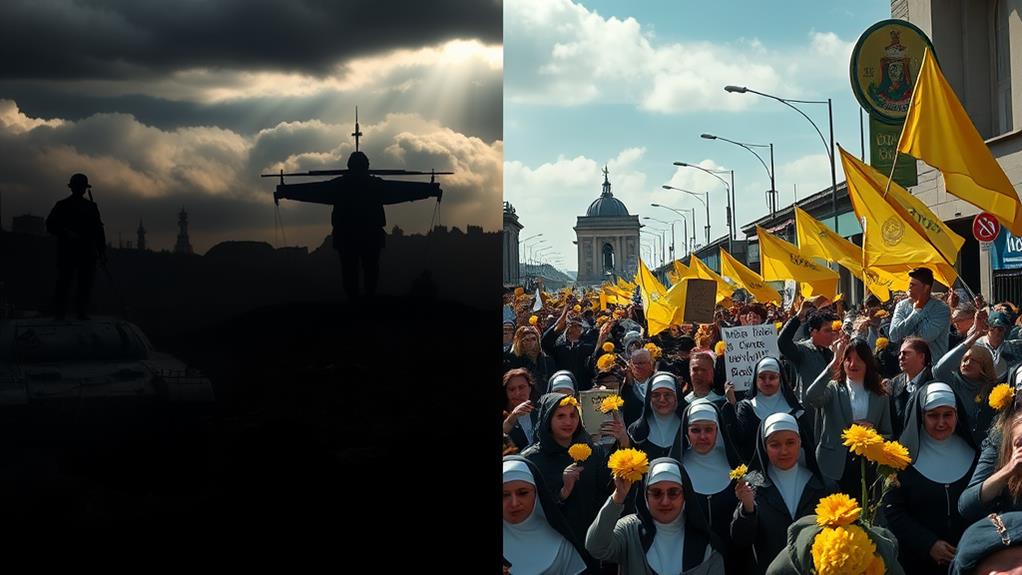
    Public mourning and yellow ribbons 1983 Symbolized collective protest against the dictatorship
    Surge in activism and mobilization 1983-1986 Led to the People Power Revolution

    The outrage over the assassination led to a surge in activism and the eventual mobilization of the People Power Revolution, which aimed to challenge the Marcos regime. The assassination is often cited as a catalyst for the subsequent snap elections in 1986, which were marred by allegations of fraud and corruption, further fueling public discontent.

    Election Fraud and Protests

    fraudulent elections ignite protests

    The assassination of Benigno Aquino Jr. set the stage for a tumultuous 1986, marked by election fraud and protests that would ultimately bring down the Marcos regime.

    The 1986 snap presidential election was highly contested, with Ferdinand Marcos declared the winner despite allegations of widespread electoral fraud and vote manipulation. Marcos was proclaimed the winner on February 15, 1986. However, significant discrepancies were found between the official count and the tally reported by NAMFREL, an election watchdog.

    To further fuel the accusations of tampering, the Commission on Elections (COMELEC) technicians walked out in protest.

    The election results sparked widespread protests demanding Marcos' resignation. Cardinal Jaime Sin played a pivotal role in mobilizing support for the opposition, calling on the public to join mass protests against the fraudulent election results and oppressive regime.

    The protests escalated, with the people demanding an end to martial law and the Marcos regime. The fraudulent election results were seen as the final straw, leading to the People Power Revolution.

    This revolution would eventually bring down the Marcos regime and pave the way for a new era of democracy.

    The People Power Uprising

    The People Power Uprising

    From February 22 to 25, 1986, nearly two million Filipinos gathered on Epifanio de los Santos Avenue (EDSA) to protest against Ferdinand Marcos' regime, demanding an end to his 21-year rule and the restoration of democracy in the Philippines.

    The Spark of the Revolution

    The protests were sparked by allegations of electoral fraud in the snap elections, which fueled widespread discontent against Marcos' martial law and dictatorship.

    This discontent was further fueled by the influence of Cardinal Jaime Sin, who mobilized the public and encouraged peaceful demonstrations.

    Widespread Support

    Various political, military, and religious groups lent their support to the movement, further galvanizing the crowds.

    The nonviolent protests along EDSA ultimately led to the defection of military factions from Marcos, who refused to suppress the protests.

    The End of Marcos' Rule

    In the end, Marcos and his family, including his son Bongbong, fled to Hawaii on February 25, 1986, marking the end of his rule and the dawn of a new era for the Philippines.

    Corazon Aquino's subsequent inauguration as the 11th President of the Philippines symbolized the triumph of the people's will against dictatorship.

    Economic Crisis and International Response

    global economic crisis response

    The Philippine economy plummeted in the mid-1980s, with a contraction rate of 6.8% by the end of 1983. This crisis was largely caused by Ferdinand Marcos' mismanagement of the economy, which led to a national debt of approximately $28 billion by 1986, making the country vulnerable to the global recession.

    Corruption and crony capitalism were key factors that contributed to the economic crisis. These practices led to a decline in agricultural productivity and an economic crisis in the late 1970s.

    The assassination of Benigno Aquino Jr. in 1983 sparked widespread protests, highlighting the economic crisis and pushing for political reform.

    The international community criticized Marcos' regime, with the U.S. Senate passing a resolution in February 1986 that condemned the electoral process and fraud in the snap elections. This criticism added pressure on the government to reform, ultimately contributing to the collapse of Marcos' rule.

    The People Power Revolution in 1986 was a direct response to the economic crisis and human rights violations under Marcos' martial law.

    How Did the American Colonial Period Influence the Implementation of Martial Law in the Philippines?

    The american colonial period shaping modern philippines had a significant impact on the implementation of martial law in the country. The legal structure and policies established during this era influenced the way martial law was enforced, leading to long-term implications for the Philippines’ political and social landscape.

    Legacy of Martial Law

    The Marcos regime's downfall in 1986 didn't erase the legacy of Martial Law in the Philippines. This period of authoritarian rule has left a lasting impact on the country's politics and governance.

    During Martial Law, approximately 70,000 individuals were imprisoned, and thousands were subjected to torture or extrajudicial killings. The EDSA Revolution in 1986 was a direct response to these oppressive conditions, symbolizing the people's fight for democracy and justice against tyranny.

    The legacy of Martial Law continues to affect contemporary politics. Debates about accountability for past abuses persist, and many victims still seek justice decades later.

    The dictatorship's legacy remains a hurdle to achieving genuine democracy. The economic mismanagement during Martial Law contributed to a national debt crisis, which has had lasting effects on the Philippines' economic landscape and governance challenges in subsequent administrations.

    The struggle for accountability and justice is far from over. As the Philippines continues to grapple with the remnants of Martial Law, it's essential to acknowledge the past and work towards a more just and equitable future.

    Questions and Answers

    What Caused the People Power Revolution?

    What sparked the People Power Revolution was a combination of factors.

    The assassination of opposition leader Benigno Aquino Jr. in 1983 outraged the public and marked a turning point in the movement against the regime. This event was followed by the fraudulent snap presidential election in 1986, which further fueled the discontent and galvanized the opposition.

    Years of suppressed civil liberties and human rights abuses created a culture of resistance.

    The regime's restrictive policies and brutal suppression of dissent had been building up resentment among the population for years. This created an environment in which the opposition could unite and mobilize against the government, ultimately culminating in the toppling of the regime.

    How Many Were Killed During Martial Law?

    3,240 individuals lost their lives due to political violence and human rights abuses during the dark period of Martial Law in the Philippines.

    This number is a sobering reminder of the atrocities committed during that time.

    The deaths were part of a broader campaign of repression that had far-reaching consequences for the country.

    What Happened During the Martial Law Era?

    Suspension of Civil Liberties

    During the martial law era, civil liberties were suspended, leading to widespread human rights violations. This resulted in approximately 70,000 individuals being imprisoned, with thousands subjected to torture or extrajudicial killings.

    Media Censorship

    The government censored media, suppressing freedom of the press, and controlled broadcasts. This restricted the flow of information and heavily influenced what the public knew.

    Economic Consequences

    Initially, the era saw some infrastructure development.

    However, this was offset by severe mismanagement, resulting in rising national debt, inflation, and a decline in agricultural productivity. This led to widespread economic hardship and instability.

    Opposition and Dissent

    The restrictive regime sparked opposition and dissent among the population.

    As the government's grip tightened, people began to resist and challenge the authorities, seeking greater freedom and democracy.

    Why Was the Martial Law Important?

    Martial Law was a pivotal event in the Philippines' political history. It drastically altered the country's political landscape by granting the president sweeping powers.

    This led to the suppression of civil liberties, allowing the government to restrict citizens' freedoms and rights. For instance, the government dissolved Congress, eliminating the legislative branch and concentrating power in the executive branch.

    Additionally, the president arrested political opponents, silencing opposition voices and consolidating control.

    These actions resulted in a proliferation of human rights violations. The government's newfound powers led to widespread abuse, including arbitrary arrests, torture, and forced disappearances.

    Economic mismanagement also ensued, as the government's focus on maintaining power led to neglect of the economy. This, in turn, led to widespread disillusionment among citizens, who felt their rights and freedoms were being eroded.

  • Post-War Philippines: Rebuilding a Nation

    Post-War Philippines: Rebuilding a Nation

    The Philippines faced significant challenges after World War II. The country was ravaged by the Japanese occupation, which resulted in nearly one million civilian deaths and widespread destruction. This devastation set the stage for a daunting nation-building process.

    The country gained formal independence from the US in 1946, but it was marred by corruption, unemployment, and economic hardship. The US provided insufficient aid to support rehabilitation efforts, making it difficult for the Philippines to rebuild.

    The nation's population of 18 million struggled to recover from the loss of over a million Filipinos during the war.

    Ongoing US influence, social unrest, and agrarian discontent further complicated the path towards true independence and self-determination. The complexities of the past continue to shape the nation's future.

    For example, the US retained significant control over the Philippines' economy and politics, limiting the country's ability to make its own decisions. Additionally, social unrest and agrarian discontent led to the formation of the Hukbalahap, a communist guerrilla movement that sought to overthrow the government.

    Historical Context of Liberation

    The Philippines suffered greatly under Japanese occupation during World War II. This occupation lasted nearly four years and resulted in approximately one million civilian deaths. The Japanese occupation was marked by widespread destruction, suffering, and loss of life, which had a devastating impact on the country and its people.

    The initial defense against the Japanese invasion was led by General Douglas MacArthur. He commanded US and Philippine forces in significant battles at Bataan and Corregidor.

    As the war turned in favor of the Allies, General MacArthur's landing in Leyte on October 20, 1944, marked the beginning of the liberation of the Philippines. The subsequent military campaigns were intense, resulting in substantial civilian casualties and the devastation of major cities.

    Despite the challenges, the Philippine Commonwealth government was reinstated after the war. However, the country faced significant economic challenges, including rampant unemployment and corruption, as it transitioned to independence.

    The path to Philippine independence was paved, and on July 4, 1946, the nation formally gained independence, marking the end of U.S. colonial rule. Understanding the historical context of liberation is essential to recognizing the challenges that lay ahead for the Philippines.

    Rebuilding a Nation Amidst Ruin

    Rebuilding a Nation Amidst Ruin

    After World War II, the Philippines faced the daunting task of rebuilding a nation amidst ruin. Manila lay in ruins, and unemployment and corruption were rampant. The Philippine War Damage Commission was established to address claims for war-related property losses, highlighting the extensive damage that left the country in need of substantial rehabilitation funds.

    Rebuilding required a massive influx of resources. The initial U.S. aid of $620 million sought through Senator Tydings' rehabilitation bill seemed like a lifeline. However, mismanagement and corruption hindered the effective distribution of emergency food aid and resources, further exacerbating the challenges.

    The sheer scale of human loss was staggering. Over 1 million Filipinos died during the war, leaving a population of approximately 18 million struggling to come to terms with the devastation.

    As the country navigated the complexities of rebuilding, it also had to contend with the continued influence of foreign powers, as seen in the Philippine Trade Act of 1946, which formalized U.S. economic dominance.

    Independence and Its Challenges

    struggles of self governance

    The Philippines gained independence from the United States on July 4, 1946, ending over 400 years of colonial rule.

    This significant milestone was marked by severe post-war challenges, including widespread destruction, economic hardship, and the loss of approximately one million Filipino lives during World War II.

    The country's independence was tempered by ongoing American influence, as evidenced by the U.S.-Philippines Military Bases Agreement, which raised concerns about Philippine security.

    To revitalize the national identity and heritage, preserving traditional crafts became essential. This effort was crucial for community cohesion and pride, reflecting the country's diverse cultural influences and traditions.

    Reviving craftsmanship initiatives supported local economies through artisan livelihoods and enhanced tourism through unique, handcrafted products.

    The Philippines urgently needed to rebuild and revitalize its economy, but the road to recovery was fraught with obstacles.

    Post-War Rehabilitation Efforts

    Rebuilding a nation required a multifaceted approach, and post-war rehabilitation efforts were crucial.

    The Philippine War Damage Commission played a vital role in addressing claims for war-related property losses, with initial estimates for damages reaching $1.2 billion.

    The U.S. Congress allocated $520 million for rehabilitation, but this fell short of the estimated needs. This led to:

    • Widespread unemployment, which exacerbated social unrest.
    • Rampant corruption in government, hindering the recovery process.
    • Dire economic conditions, with essential services in disarray and black markets thriving.
    • The Philippine Trade Act of 1946, which formalized U.S. economic dominance and established provisions for peso stability and extended duty-free trade with the United States.

    Despite the influx of U.S. aid, the economic and social reforms necessary for long-term recovery were inadequately addressed. This led to:

    • Increased public discontent and the rise of movements like the Hukbalahap insurrection.
    • Corruption and inadequate recovery efforts hindering the nation's ability to rebuild and move forward.

    Nation-Building and Its Obstacles

    challenges in nation building efforts

    Rebuilding a Nation: Challenges and Obstacles

    After World War II, the Philippines was left with the daunting task of rebuilding from the ruins. Nation-building wasn't just about reconstructing physical infrastructure, but also addressing deep-seated social and economic issues. The cultural identity of various ethnic groups, such as the Gaddang people and their traditional Bendian dance, played a vital role in fostering community connections and resilience during this challenging period.

    Corruption in government and land reform were two significant obstacles to nation-building. The Hukbalahap movement, which emerged post-WWII, highlighted the discontent among peasants due to agrarian issues and the government's failure to implement effective land reform policies.

    This led to increased social unrest, further complicating nation-building efforts.

    U.S. policy in the post-war period prioritized the restoration of pre-war conditions and economic dominance, often sidelining the political and economic demands of ordinary Filipinos.

    As a result, the nation-building process was slow and arduous, with the country struggling to break free from colonial legacies that benefited elites over ordinary citizens.

    Social Order Vs Social Justice

    As the Philippines rebuilt from the devastating effects of war, a pressing concern emerged: balancing the need for social order with the imperative for social justice. The government's inaction on ordinary citizens' demands led to widespread discontent, threatening social order.

    Four key areas highlighted the tension between social order and social justice:

    Agrarian issues: The government consistently rejected genuine land reform initiatives, perpetuating Agrarian issues and disconnecting the government from the majority of the population. For instance, the landlords retained control over vast tracts of land, leaving many farmers without access to arable land.

    Political processes: The establishment of a formal nation-state in the Philippines occurred without true representation of citizens' will, leaving many feeling alienated from political processes. The lack of representation led to a sense of disconnection among citizens, who felt their voices weren't heard.

    Economic inequality: Economic policies favored elites over the broader populace, perpetuating social inequalities and limiting access to resources for many Filipinos. The post-war era's economic policies, for example, allowed the wealthy to accumulate more wealth, widening the gap between the rich and the poor.

    Social discontent: The government's inaction on ordinary citizens' demands led to widespread discontent, threatening social order. This discontent manifested in various forms, including protests and demonstrations, as citizens demanded change.

    The question remained: how to balance the need for social order with the imperative for social justice to create a more equitable society.

    Political Dynamics and Governance

    evolving political landscape analysis

    The post-war Philippines faced a delicate political situation, where the central authority struggled to balance local autonomy with citizens' demands for representation and social justice.

    The government's inability to address the legacy of colonial rule led to weak institutions and democratic deficits.

    The emergence of political parties and movements, such as the Hukbalahap movement, demonstrated the people's desire for genuine governance.

    However, the system was flawed, and the government failed to address key issues like agrarian reform.

    Despite attempts at land reform, corruption and mismanagement persisted, driving citizens away from the government and fuelling revolutionary movements.

    To overcome these challenges, the Philippine government must confront its governance issues head-on.

    This requires strengthening institutions and addressing the people's demands for representation and social justice.

    Economic and Social Movements

    The roots of economic and social movements in the Philippines can be traced back to the pre-war era. In 1930, the Partido Komunista ng Pilipinas was formed to advocate for social reform in response to colonial exploitation and inequality.

    The post-war period saw the rise of peasant-led insurgencies. The Hukbalahap movement, for instance, was driven by agrarian discontent and demands for land reform. This was a response to the failure of President Quezon's social welfare plans, which left significant economic issues unaddressed.

    Economic policies heavily influenced by U.S. funding and interests often benefited the elite while neglecting the broader population's needs for genuine reform. Widespread discontent with the government's failure to implement meaningful land and economic reforms led to the emergence of resistance movements.

    These factors ultimately led to the rise of economic and social movements in the post-war Philippines. People sought to address the country's deep-seated issues, including the need for land reform, social welfare, and economic reform that benefited the broader population.

    How Did the Concept of Bayanihan Influence the Rebuilding of the Post-War Philippines?

    The concept of Bayanihan, deeply ingrained in the filipino spirit cooperation, played a crucial role in the rebuilding of post-war Philippines. The collective effort and communal cooperation helped communities come together to rebuild homes, infrastructure, and livelihoods, showcasing the strength and resilience of the Filipino people.

    Rebuilding a Nation's Identity

    restoring national identity together

    Rebuilding a Nation's Identity

    After a devastating war, a nation's identity is often put to the test. The Philippines, for instance, struggled to establish a stable government and a sense of self in the post-war era. This was due to the influence of the U.S. on its governance and economy, which left many Filipinos feeling disconnected from the nation-state.

    The quest for social justice was a response to foreign domination and internal struggles against systemic inequalities. This is reflected in the works of Lualhati Bautista, who wrote about the impact of human rights violations on Filipino lives in her novels.

    The Hukbalahap insurgency, for example, highlighted issues of agrarian reform, resonating with the populace's aspirations for equity and representation.

    Education and cultural initiatives emerged as vital tools for fostering a cohesive national identity. Organizations like the Bataan Legacy Historical Society worked to raise awareness of Filipino contributions during WWII.

    Rebuilding a nation's identity requires a nuanced understanding of its history, a commitment to social justice, and a willingness to challenge the remnants of colonialism.

    Questions and Answers

    What Happened in the Post-War Period in the Philippines?

    The Philippines was left in shambles after the war. The country faced widespread destruction, with cities and towns reduced to rubble.

    Unemployment was rampant, leaving many without a steady income. The estimated cost to rebuild was staggering, with $800 million in aid needed to recover from the devastation.

    The government struggled to address these issues, and to make matters worse, the U.S. Congress denied benefits to Filipino veterans, sparking outrage among those who'd fought alongside American forces.

    Meanwhile, the Hukbalahap movement gained traction among peasants who were discontented with the government's failure to implement meaningful land reform and its corruption.

    This movement further complicated the nation's path to recovery, as it highlighted the need for social and economic change.

    What Happened to the Philippines After the War Ended?

    The Philippines faced devastating consequences after World War II. Cities like Manila lay in ruins, causing economic distress and widespread unemployment.

    The U.S. allocated $620 million for rehabilitation, but corruption and mismanagement hindered its effective use.

    As a result, the country struggled to rebuild, with inadequate funds for property losses and economic policies that maintained U.S. dominance.

    This led to social unrest and insurgencies, ultimately fueling further instability.

    How Long Did It Take to Rebuild Manila After Wwii?

    The city's rehabilitation was a gradual process that spanned years.

    Although the Philippine government established the War Damage Commission to address property losses, insufficient economic aid and corruption hindered progress.

    It took until the late 1940s and early 1950s for Manila to fully recover from the devastating war damage, with significant challenges persisting throughout the rebuilding process.

    What Was the Aftermath of the Philippine American War?

    The Philippine-American War resulted in massive destruction and loss of life.

    The war caused an estimated 200,000 Filipino deaths, making it one of the deadliest conflicts in Philippine history.

    Infrastructure was severely damaged, with many cities and towns left in ruins.

    The US established a colonial government in the Philippines.

    Following the war, the US prioritized American interests, delaying self-governance for Filipinos.

    This led to a nationalist movement, as many Filipinos sought independence and resisted American rule.

  • The Japanese Occupation: A Dark Chapter in Philippine History

    The Japanese Occupation: A Dark Chapter in Philippine History

    The Japanese Occupation: A Dark Chapter in Philippine History

    The Japanese occupation of the Philippines from 1942 to 1945 was a brutal period marked by atrocities, human suffering, and a relentless struggle for freedom. An estimated 500,000 lives were lost during this time, and widespread destruction occurred throughout the country.

    One of the most notorious atrocities committed during this period was the Bataan Death March, where thousands of Filipino and American prisoners of war were forced to march through the jungle with minimal food, water, and medical care, resulting in the deaths of thousands.

    Additionally, thousands of women and children were forced into sexual slavery by the Japanese military.

    Despite the brutal conditions, Filipino guerrilla fighters continued to resist the Japanese occupation, employing tactics such as sabotage, ambushes, and intelligence gathering to disrupt Japanese operations.

    The Japanese occupation also led to the establishment of collaborator governments and puppet administrations, which further complicated the dynamics of resistance and loyalty.

    Understanding the complexities of this period is crucial to grasping the lasting impact of the Japanese occupation on Philippine society.

    Historical Context of the War

    The Philippine Islands: A Strategic Location in Southeast Asia

    The Philippine Islands, a crucial location in Southeast Asia, became a target of Japan's expansionist policies in the early 1940s.

    This led to one of the darkest chapters in Philippine history.

    The Fall of the Philippines and the United States

    As World War II raged on, Japan's military might proved too great for the combined forces of the Philippines and the United States, led by General Douglas MacArthur.

    The swift invasion resulted in the surrender of troops in Bataan on April 10, 1942, and the fall of Corregidor on May 6, 1942, marking the beginning of the Japanese occupation.

    Resistance Against the Japanese Regime

    During this period, guerrilla activities emerged as a form of resistance against the Japanese regime.

    Despite the odds, around 260,000 Filipinos participated in various resistance movements, fighting for their country's freedom.

    Human Rights Violations and Casualties

    The Japanese occupation was also marred by human rights violations, including the infamous Bataan Death March, which added to the estimated 500,000 Filipino casualties during the war.

    Understanding the Historical Context

    Understanding the historical context of the war is crucial in grasping the significance of this period in Philippine history.

    Japanese Brutality and Atrocities

    The Japanese occupation of the Philippines was marked by unimaginable brutality and atrocities. During this period, Filipinos faced harsh realities, including the estimated murder of 131,028 Filipino civilians and seventy-two large-scale massacres.

    The Japanese committed heinous war crimes, including the forced sexual slavery of over a thousand Filipinos, mostly women and children, as "comfort women" in comfort stations. These victims were subjected to torture, gang-rape, and murder, including infants.

    The covert biological warfare research unit, Unit 731, conducted brutal experiments on Filipinos, including vivisection and other inhumane medical practices.

    One of the most brutal events in Philippine history is the Bataan Death March, where over 75,000 American and Filipino prisoners were forced to march, resulting in an estimated 5,000 to 18,000 deaths due to disease, malnutrition, and execution.

    These atrocities serve as a grim reminder of the horrors inflicted upon the Filipino people during the Japanese occupation.

    Filipino Resistance and Guerrilla Warfare

    filipino guerrilla warfare tactics

    The Filipino people showed remarkable resilience and determination to resist their occupiers despite the brutality of the Japanese occupation.

    Approximately 260,000 Filipinos joined various guerrilla organizations across the islands, demonstrating widespread resistance against the Japanese military. Leaders like Colonel Macario Peralta in Panay and Colonel Wendell Fertig in Mindanao coordinated efforts that significantly disrupted Japanese operations and communications.

    Guerrilla forces controlled about 60% of the Philippine islands, using forested areas for covert operations and sabotage against Japanese troops. General Douglas MacArthur provided resources and reinforcements via submarine to bolster resistance efforts.

    Notable acts of sabotage included attacks on Japanese supply lines and communication networks, which played a crucial role in undermining Japanese control throughout the occupation. These acts of sabotage were crucial in disrupting Japanese operations and ultimately contributed to the Filipino people's quest for freedom.

    The Philippine resistance was a testament to the Filipino people's unwavering spirit and their unrelenting quest for freedom.

    Life Under Japanese Occupation

    Life Under Japanese Occupation

    Daily life in the Philippines was a struggle during the Japanese occupation, marked by scarcity and brutality.

    Filipinos lived in constant fear of human rights violations, as the Japanese military enforced strict military rule, suppressing Filipino culture and promoting their own ideology.

    Harsh Realities

    The occupation was characterized by:

    • Widespread human rights violations, including murder and sexual slavery.
    • Erasure of local customs and practices under Japanese military rule.
    • Severe economic hardship, with shortages of food and essential goods.
    • Suppression of Filipino culture, promoting Japanese ideology instead.
    • Constant fear of brutality, fostering a spirit of resilience and resistance.

    Resisting the Occupation

    Despite the brutal conditions, Filipinos found ways to resist.

    Approximately 260,000 individuals joined guerrilla resistance movements, opposing Japanese forces and coordinating sabotage efforts against their operations.

    This spirit of resistance amidst widespread suffering and brutality is a testament to the Filipino people's strength and determination.

    Liberation and Aftermath of the War

    post war liberation effects

    The Philippines' Liberation Began in 1944

    The Philippines' long-awaited liberation from Japanese occupation started on October 20, 1944, when General MacArthur returned to the country. This marked the beginning of a massive campaign against Japanese forces, involving approximately 700 vessels and 174,000 troops.

    By December 1944, the Allies had recaptured key locations such as Leyte and Mindoro.

    The Devastating Battle of Manila

    However, the Battle of Manila in early 1945 resulted in extensive destruction and significant civilian casualties, with an estimated 100,000 Filipino civilians killed during the conflict.

    The Human Cost of the War

    The war had a profound human cost, with approximately 500,000 Filipinos dying during the Japanese occupation.

    Additionally, 10,380 U.S. military personnel died, and 36,550 were wounded.

    Post-War Discussions and Legacy

    As the war came to an end, post-war discussions focused on war crimes and reparations, particularly regarding the treatment of comfort women and the legacy of the atrocities committed during the occupation.

    This dark chapter in Philippine history serves as a poignant reminder of the devastating consequences of war.

    The Bataan Death March Tragedy

    The Bataan Death March: A Tragic Episode in Philippine History

    The Defeat in Bataan

    The Allied forces' defeat in Bataan in April 1942 marked a dark turning point in the war, leading to one of the most notorious atrocities in Philippine history: the Bataan Death March.

    The March Begins

    The march began on April 9, 1942, following the surrender of Bataan, and was characterized by extreme physical abuse and inhumane treatment by the Japanese military.

    The prisoners were forced to march 66 miles under brutal conditions.

    Casualties and Hardships

    An estimated 5,000 to 18,000 men died along the route due to disease, malnutrition, and execution during the march.

    Survivors faced further hardships in prisoner-of-war camps, where conditions remained dire and many continued to suffer from starvation and disease.

    Symbol of Resilience and Resistance

    The Bataan Death March has become a symbol of Filipino and American resilience and resistance during World War II.

    The march is remembered annually in the Philippines and recognized in historical narratives about wartime atrocities.

    Lasting Impact

    The Bataan Death March has had a lasting impact on Philippine history, serving as a reminder of the hardship and suffering endured by the prisoners of war.

    Collaborators and Puppet Governments

    allied control and influence

    During Japan's occupation of the Philippines, a complex web of collaboration and resistance emerged. Some Filipinos chose to collaborate with the Japanese military in exchange for power and influence. The Japanese established a puppet government in 1943, with Josué P. Laurel as its president, to promote Japanese propaganda and suppress anti-Japanese sentiments.

    Collaborators Puppet Government
    Provincial elites and local leaders who supported Japanese rule Established by the Japanese military in 1943
    Gained power and influence Aimed to promote Japanese propaganda
    Faced opposition from Filipino guerrilla groups
    Faced public disdain post-war Led by Josué P. Laurel as president

    The legacy of collaboration during the occupation remains a contentious topic in Philippine history. Accusations of collaboration against leaders like Laurel led to widespread public disdain post-war. Although Laurel was never formally tried due to a general amnesty in 1948, the debate about the motivations and actions of those who aligned with the Japanese authorities continues to this day.

    Comfort Women and Sexual Slavery

    The Japanese occupation of the Philippines during World War II was marked by a horrific chapter of human rights violations, where thousands of women and girls were forcibly taken and enslaved as "comfort women."

    During this period, over 1,000 Filipino women and girls were abducted and subjected to sexual slavery in military-run brothels known as comfort stations. This wasn't an isolated incident, as an estimated 400,000 women and girls across Asia were victimized by Japanese forces during World War II.

    The experiences of Filipino comfort women were marked by extreme physical and psychological abuse, including systematic rape, torture, and violence, often in front of other victims.

    These atrocities led to ongoing struggles for recognition, reparations, and justice, which continue to this day.

    The issue of comfort women remains a significant aspect of discussions on war crimes and human rights violations, highlighting the need for historical acknowledgment and memorialization of these atrocities.

    The Japanese forces' actions constitute a grave violation of human rights, and it's essential to recognize the survivors' experiences and struggles for justice.

    How did the Japanese Occupation impact the Philippines, including Palawan?

    During the Japanese Occupation, the Philippines, including Palawan, suffered from harsh conditions and atrocities. Despite the challenging times, Palawan’s hidden gems, such as its pristine beaches and stunning landscapes, remained untouched and preserved. Today, these hidden gems continue to attract tourists and serve as a reminder of the resilience of the Filipino people.

    Lasting Impact on Philippine Society

    transformative influence on philippines

    The Japanese occupation had a lasting impact on Philippine society, affecting its demographics, economy, and social fabric.

    The occupation resulted in the deaths of approximately 500,000 Filipinos, significantly impacting the population and contributing to a post-war demographic decline. This decline was evident in the reduced population growth rate and changes in population structure.

    The economic disruptions were severe, leading to widespread poverty and inflation. Essential goods became scarce, and a black market emerged to cope with shortages. For instance, rice, a staple food in the Philippines, became a luxury item.

    The human rights violations, including the systematic sexual enslavement of over 1,000 Filipino women as comfort women, left deep scars on societal morals and gender relations in post-war Philippines. This traumatic experience contributed to long-term psychological trauma and stigma for the victims and their families.

    However, the brutality of the occupation fostered a strong sense of nationalism and resilience among Filipinos, ultimately influencing post-war political movements and the quest for true independence. This sense of nationalism is evident in the formation of guerrilla groups that fought against the Japanese occupation.

    Today, the legacy of the occupation continues to shape Philippine historical consciousness, with educational initiatives aimed at preserving the memory of atrocities and promoting awareness of human rights.

    These initiatives include history lessons that highlight the experiences of Filipinos during the war and memorials that honor the victims of the occupation.

    Questions and Answers

    How Did the Japanese Occupation Affect the Philippines?

    The Japanese occupation had a devastating impact on the Philippines.

    The economy suffered greatly, with inflation and food shortages becoming rampant. This was due to the disruption of trade and commerce, as well as the exploitation of the country's resources by the Japanese.

    The human cost was significant, with an estimated 131,028 civilians murdered during the occupation. Additionally, thousands of women were forced into sexual slavery, known as "comfort women." The total number of deaths, including those from war, famine, and disease, reached over 500,000.

    Despite the brutality, the Filipino people showed remarkable resilience. Many Filipinos joined guerrilla organizations, with an estimated 260,000 involved in the fight against the Japanese occupation. These groups played a crucial role in disrupting Japanese supply lines and communication networks.

    The dark legacy of the Japanese occupation continues to shape the nation's identity and historical consciousness. The experience has left a lasting impact on the country, influencing its relationships with other nations and informing its national policies.

    What Was the Japanese Occupation in the Philippines Abuse?

    The Japanese occupation in the Philippines was marked by extreme brutality and abuse.

    This abuse took many forms, including murder, torture, and sexual slavery.

    An estimated 131,028 Filipino civilians were killed during the occupation.

    Additionally, 1,000 women and girls were forced into "comfort women" roles, a euphemism for sexual slavery.

    Prisoners were treated brutally, subjected to inhumane medical experiments and extreme brutality, including gang-rape and the murder of infants.

    These atrocities reflect a culture of violence that defined the occupation.

    What Was the Most Destroyed Area in the Philippines During the Japanese Occupation?

    Manila was the most destroyed area in the Philippines during the Japanese occupation.

    This city suffered extensive damage, with an estimated 100,000 civilians killed and approximately 90% of its structures destroyed or heavily damaged.

    The destruction was so severe that Manila was referred to as "the most devastated city in the world" after World War II.

    Who Liberated the Philippines From Japanese Occupation?

    The Philippines was liberated from Japanese occupation by a joint effort led by General Douglas MacArthur.

    This liberation campaign involved the combined forces of the United States and the Philippine Commonwealth Army, along with Filipino guerrilla fighters.

    The operation was massive, with approximately 700 vessels and 174,000 troops participating.

    Ultimately, this effort led to the country's liberation in 1946.

  • The American Colonial Period: Shaping Modern Philippine Society

    The American Colonial Period: Shaping Modern Philippine Society

    The American colonial period shaped modern Philippine society in various ways.

    Governance: The Philippine Commission was established, and the country's first elective legislative body emerged during this period.

    The recognition of Philippine independence was also a significant milestone.

    Urban Development: Urban planning transformed cities like Manila and Baguio. For instance, Manila's urban design was influenced by American architects, resulting in a mix of Spanish colonial and American styles.

    Education: Education expanded, with English becoming a key medium of instruction. This led to a significant shift in the way Filipinos communicated and accessed information.

    Economy and Social Structures: The American colonial period introduced new economic systems and social structures that reshaped Filipino culture.

    For example, the introduction of a market economy led to the growth of cities and the development of new social classes.

    Legacy: The developments during this period laid the groundwork for the country's current social, economic, and political landscape.

    The legacies of this period continue to influence Philippine society today, revealing complexities and nuances waiting to be uncovered.

    Colonial Governance and Resistance

    The American colonial period in the Philippines began in December 1898 with the signing of the Treaty of Paris, marking a new era of governance and resistance.

    The Philippine-American War (1899-1902) was a brutal conflict that resulted in an estimated 250,000 Filipino civilian deaths and over 4,000 American military casualties. This war was a testament to the fierce resistance of Filipino forces against American colonial rule.

    The Philippine Commission was established in January 1899 to implement American governance in the Philippines. This led to the introduction of democratic institutions and the establishment of a civil government by 1901, under the Second Philippine Commission.

    The commission aimed to transition power to Filipino leaders through political reforms.

    A significant milestone in this process was the establishment of the Philippine Assembly in 1907, the first elective legislative body in Southeast Asia.

    Throughout this period, Filipino nationalists continued to resist American colonial rule, fueling the fight for independence.

    Urban Planning and Development

    During the American colonial period, urban planning and development in the Philippines were significantly transformed. This transformation was shaped by two key influences: Daniel Burnham's principles and the priorities of the Philippine Commission.

    Daniel Burnham's principles led to geometric layouts and beautification in cities like Manila and Baguio. For example, Burnham's plans for Manila featured wide, straight roads and tree-lined boulevards. This design aimed to create structured public spaces that promoted civic values.

    The Philippine Commission's priorities, on the other hand, focused on infrastructure development. This included the construction of roads, railways, and ports to facilitate American governance and economic integration.

    For instance, the commission built the Philippine National Railway, which connected Manila to other major cities in Luzon.

    Social and Cultural Transformations

    cultural evolution and change

    Education Transformed Filipino Identity and Communication

    The American colonial period implemented significant reforms that reshaped the social and cultural landscape of the Philippines.

    By the 1930s, nearly 50% of Filipinos could read and write, and English became the primary medium of instruction. This fundamental change in the education system transformed the way Filipinos communicated and perceived themselves.

    The Emergence of Diverse Artistic Expressions

    The introduction of diverse artistic expressions, such as spoken word poetry, further influenced cultural dynamics and allowed for a richer exploration of Filipino identity.

    This new form of expression enabled Filipinos to express themselves freely, fostering a sense of national pride and identity.

    American Rule Introduced Democratic Ideals and Consumer Culture

    American rule introduced democratic ideals and consumer culture, which fostered a new civic consciousness and altered social behaviors towards individual rights and community engagement.

    Filipinos began to prioritize individual freedoms and participate in community activities, leading to a growing awareness of social issues.

    The Rise of a Nationalist Elite

    The emergence of a nationalist elite, fueled by educational access and exposure to Western ideas, played a critical role in the development of a collective Filipino identity distinct from colonial influences.

    This elite group of Filipinos, inspired by Western ideals, worked towards creating a unified national identity.

    Public Health Initiatives and Social Cohesion

    Public health initiatives, such as urban renewal efforts following the 1902 cholera epidemic, contributed to this transformation, highlighting the connection between health and social cohesion during the colonial period.

    These initiatives improved living conditions, reduced disease spread, and brought communities together, further solidifying social bonds.

    As a result, Filipino society began to take shape, with a growing awareness of social issues and a desire for self-governance.

    Health and Environmental Improvements

    The 1902 cholera epidemic in Manila, which claimed around 200,000 lives, highlighted the urgent need for public health and sanitation reforms.

    In response to this crisis, the American colonial government implemented various health and environmental improvements.

    Urban renewal initiatives rebuilt war-damaged districts in Manila, incorporating parks and green spaces to enhance public health and community well-being. For instance, the urban plan for Manila included the development of nine parks aimed at beautification while promoting civic values and public health.

    These parks provided green spaces for recreation and social interaction, contributing to a healthier and more cohesive community.

    Infrastructure improvements, including better sanitation systems and green spaces, were integral to American colonial governance. This integrated approach aligned health enhancements with urban planning efforts, demonstrating the government's commitment to public health.

    The introduction of parks, such as Burnham Park in Baguio, served as venues for leisure and social interaction, reinforcing a commitment to community cohesion and health.

    These improvements demonstrate the American colonial government's efforts to prioritize public health, urban renewal, and environmental improvements, ultimately shaping modern Philippine society.

    Education and Language Impact

    language influences educational outcomes

    Education Expansion in the Philippines

    In the early 20th century, hundreds of American teachers arrived in the Philippines, leading a massive expansion of public education across the islands. This effort recognized the significance of education in shaping the country's future. By 1927, nearly all public school teachers were Filipino, and education expenditures consumed half of governmental budgets.

    Improved Access to Education

    As a result of this effort, school enrollment grew fivefold within a generation, and literacy rates doubled, reaching nearly 50% by the 1930s. This significant improvement in access to education was a crucial step towards promoting social mobility.

    English as a Key Medium of Instruction

    The American colonial period's educational reforms not only improved access to education but also established English as a key medium of instruction and communication. By 1939, one-fourth of the Philippine population spoke English, surpassing native dialects. This shift had a profound impact on social mobility, providing new pathways for Filipinos to advance.

    Lasting Impact on Modern Philippine Society

    The educational policy during this period became a vital effort for establishing political democracy and promoting social mobility.

    The American colonial period's emphasis on education and language had a lasting impact on modern Philippine society. This significant reform paved the way for future generations to access better education and career opportunities.

    Economic Development and Dependency

    During the American colonial period in the Philippines, the expansion of education had a profound impact on social mobility. However, the economic development policies implemented by the U.S. had a different effect.

    Economic Development and Dependency

    The U.S. economic policies encouraged the growth of infrastructure, focusing on agriculture, mining, and manufacturing, which integrated the Philippines into the American market system. This led to dependency on the U.S. for market access and pricing.

    Agricultural Shift

    The introduction of cash crops like sugar and hemp shifted traditional agricultural practices. For example, sugar production became a major industry, with the Philippines becoming one of the world's largest sugar producers. This created a dependency on the U.S. for market access and pricing.

    Concentrated Land Ownership

    Land ownership remained concentrated among the elite, despite U.S. legal restrictions. Wealthy Filipino families amassed significant wealth and maintained economic power. This limited opportunities for small-scale farmers and hindered economic growth.

    Export-Oriented Economy

    The Payne-Aldrich Tariff Act of 1909 limited industrial growth in the Philippines, promoting export agriculture that primarily benefited large plantation owners. This led to an export-oriented economy, with the agricultural sector dominating the economy and limiting opportunities for industrial development.

    Economic Dependency

    How Did the American Colonial Period Influence the Development of Philippine Tourism?

    The American colonial period shaped The future of philippine tourism in numerous ways. The introduction of English as a widely spoken language, modern transportation systems, and Western influence on architecture and culture has had a lasting impact on the country’s tourism industry. The future of Philippine tourism owes much to this historical era.

    Path to Independence and Legacy

    journey of freedom s heritage

    The Philippines' path to independence was marked by concrete milestones, with the Jones Act of 1916 serving as a crucial turning point. This act recognized Philippine independence when a stable government was established, transitioning from a commission to a legislative body with a 24-member Senate and an expanded electorate.

    The Tydings-McDuffie Act of 1934 further paved the way for independence, providing a framework for a 10-year transition and allowing Filipinos to draft their own constitution under U.S. approval.

    The country finally achieved full independence in 1946, with Manuel Roxas as the first president.

    Year Act Key Provision
    1916 Jones Act Recognition of Philippine independence with a stable government
    1934 Tydings-McDuffie Act 10-year transition to independence and Filipino-drafted constitution
    1946 Philippine Independence Full independence with Manuel Roxas as the first president

    Questions and Answers

    How Did American Colonization Influence the Philippines?

    American colonization has left a lasting impact on the Philippines. The country's literacy rates significantly improved with the introduction of a public education system, which was established by the Americans. This system enabled Filipinos to access education, resulting in a substantial increase in literacy rates.

    The Americans also introduced democratic institutions, which shaped the country's political landscape. The Philippine Constabulary, established in 1901, was a precursor to the modern Philippine National Police. Additionally, the Americans introduced a system of local governance, which allowed Filipinos to participate in the decision-making process.

    Urban planning was also influenced by American colonization, as seen in the development of Manila and other cities. The Americans designed roads, bridges, and public buildings, which modernized the country's infrastructure.

    Economic policies, such as the introduction of a free trade system, also had a significant impact on the Philippine economy.

    American pop culture and consumer habits have blended with local traditions, creating a unique cultural identity. This blending of cultures is evident in the country's music, film, and food industries, which have been shaped by American influences.

    How Did the American Period in the Philippines Positively Impact Philippine Literature?

    The American period significantly influenced Philippine literature. The introduction of a public education system led to a surge in literacy rates, resulting in a culture of reading and writing. This, in turn, enabled Filipino writers to emerge and produce works in English that critiqued colonial rule and inspired national consciousness. For instance, writers like Jose Garcia Villa and Maximo Kalaw wrote about the struggles of the Filipino people under American rule.

    Literary organizations and publications played a crucial role in providing platforms for writers to share their works. The establishment of organizations like the Philippine Writers' Association and publications like The Philippine Review created opportunities for writers to showcase their talents.

    This led to a vibrant literary community, where writers could exchange ideas and inspire each other.

    American influence expanded the scope of Philippine literature, introducing new genres like the short story and the essay.

    Influential authors like Nick Joaquin and Stevan Javellana were nurtured during this period, producing works that continue to be celebrated today. Overall, the American period had a profound impact on Philippine literature, shaping its development and inspiring a new generation of writers.

    How Did Colonization Change the Philippine Society and Culture?

    Colonization Redefined Philippine Society and Culture

    Colonization introduced a new language, English, which became a catalyst for democratic ideals and self-governance aspirations. This is evident in the Philippines' adoption of a democratic form of government after gaining independence.

    Urban planning initiatives transformed cities, promoting public health and civic values. For example, the Americans built modern sanitation systems, hospitals, and public buildings, which improved the quality of life in cities.

    The cultivation of cash crops, such as sugar and tobacco, altered traditional agriculture, leading to economic dependency. The Philippines became reliant on exporting these crops, making it vulnerable to fluctuations in the global market.

    Cultural exchanges infused Filipino society with American pop culture and consumer behavior, significantly influencing contemporary social norms and values. This is seen in the widespread adoption of American music, fashion, and fast food chains in the Philippines.

    What Are the Changes Brought by the American Colonial Tradition in the Philippines?

    Education Undergoes a Radical Transformation

    The American colonial tradition in the Philippines introduces a new medium of instruction: English. This shift leads to a significant increase in literacy rates, as education becomes more accessible and widespread.

    Infrastructure Development Takes Center Stage

    Cities in the Philippines undergo a transformation with the introduction of modern transportation systems, such as railroads and highways.

    Urban planning also becomes a priority, resulting in well-designed cities with paved roads and sidewalks.

    Economic Dependence on the US Market

    The Philippine economy becomes heavily dependent on the US market, with exports of agricultural products like sugar, tobacco, and coconut dominating the country's trade.

    This dependence shapes the country's economic landscape.

    Democratic Institutions Emerge

    The American colonial tradition establishes democratic institutions in the Philippines, paving the way for future autonomy.

    The Philippine Assembly is established in 1907, marking a significant step towards self-governance.

  • The Philippine Revolution: A Fight for Freedom and Independence

    The Philippine Revolution: A Fight for Freedom and Independence

    The Philippine Revolution was a pivotal moment in Philippine history that shaped the nation's identity and paved the way for its independence.

    It began in 1896, sparked by nationalist sentiments. Key figures like Emilio Aguinaldo led the revolution, and on June 12, 1898, Aguinaldo declared Philippine independence.

    However, the Treaty of Paris, signed in 1898, sparked tensions that led to the Philippine-American War, which lasted until 1902.

    Throughout the revolution, Aguinaldo's leadership was marked by internal conflicts, which hindered the country's progress towards true independence.

    The long and arduous road to self-governance was filled with challenges, but ultimately, it revealed the nation's struggle for independence.

    Early Life and Revolutionary Roots

    Early Life and Leadership

    Emilio Aguinaldo's early years laid the foundation for his future role in the Philippine Revolution. Born on March 22 or 23, 1869, near Cavite, Philippines, he grew up in a family of political significance, with his father serving as mayor of Cavite Viejo.

    Aguinaldo attended San Juan de Letrán College in Manila but left before graduating to help his widowed mother manage the family farm. This early exposure to responsibility and leadership prepared him for future endeavors.

    Path to the Philippine Revolution

    In August 1896, Aguinaldo became mayor of Cavite Viejo, a position that set the stage for his involvement in the Philippine Revolution.

    He joined the revolutionary society Katipunan, which fought against Spanish colonial rule. This marked the beginning of his journey towards becoming a key figure in the fight for independence.

    He would eventually become the first president of the provisional republic and proclaim Philippine independence on June 12, 1898.

    The Fight for Independence Begins

    The Philippine Revolution began on August 23, 1896, when the secret society Katipunan was discovered. This marked the start of a long and difficult fight for independence from Spanish rule.

    Key Events:

    Event Date
    Discovery of Katipunan August 23, 1896
    First major conflict in Manila Late 1896
    Declaration of Philippine independence June 12, 1898

    The revolution spread throughout the archipelago, leading to significant victories for Filipino revolutionaries. Emilio Aguinaldo emerged as a key leader, playing a crucial role in various battles against Spanish forces. However, the revolution faced challenges from internal conflicts, such as the execution of Andres Bonifacio, which created divisions within the revolutionary movement.

    Aguinaldo's Leadership and Wars

    aguinaldo s leadership during conflicts

    Emilio Aguinaldo's Rise to Leadership

    Emilio Aguinaldo's emergence as a key leader marked a significant shift in the Philippine Revolution. In 1895, he joined the Katipunan, a revolutionary society, and quickly rose through the ranks.

    On June 12, 1898, he proclaimed Philippine independence, a bold move that would change the course of the revolution.

    The Pact of Biac-na-Batō and Exile

    In 1897, Aguinaldo signed the Pact of Biac-na-Batō, which allowed him to go into exile.

    However, he returned in 1898 to continue the fight against Spanish colonial rule. This decision showed his commitment to the revolution and his desire to free the Philippines from Spanish control.

    The First Philippine Republic

    On January 23, 1899, Aguinaldo declared the establishment of the First Philippine Republic, marking the Philippines as a republic with the ratification of the Malolos Constitution.

    This was a significant milestone in the country's history, as it established the Philippines as a sovereign nation.

    The Philippine-American War

    However, the Philippine-American War erupted on February 4, 1899, due to tensions between Aguinaldo's government and U.S. forces following the Treaty of Paris, which ceded the Philippines to the U.S.

    Aguinaldo led the resistance, fighting against the American forces, but was eventually captured on March 23, 1901.

    He took an oath of allegiance to the United States, effectively ending active resistance against American rule.

    Post-War Political Life and Later Years

    Post-War Political Life and Later Years

    After surrendering to the United States, Emilio Aguinaldo retired from active leadership and received a pension from the U.S. government in 1901. However, this didn't mark the end of his political life. Aguinaldo remained involved in Philippine politics, running for president under the Commonwealth government in 1935, although he lost decisively.

    During World War II, Japanese forces used Aguinaldo as a propaganda tool, and he made a radio appeal to U.S. General Douglas MacArthur in early 1942.

    After the war, Aguinaldo was appointed to the Council of State in 1950, where he advocated for veterans' rights and promoted nationalism.

    In his later years, Aguinaldo focused on private life, shifting away from active politics.

    Nevertheless, he continued to shape the country's path towards independence by promoting nationalism and advocating for veterans' rights.

    Legacy and Historical Significance

    cultural heritage and impact

    The Philippine Revolution: A Legacy of Independence

    The Philippine Revolution, led by Emilio Aguinaldo, was a pivotal event that paved the way for the country's first attempt at self-governance and freedom from colonial rule.

    This revolution laid the groundwork for the establishment of the First Philippine Republic, marking a significant milestone in the country's struggle for independence.

    The revolution's legacy is deeply rooted in the country's nationalism, which emerged as a distinct identity separate from Spanish colonial influences.

    The revolution's impact on the country's future can't be overstated, as it led to the continued celebration of June 12 as Philippine Independence Day, commemorating the declaration of independence from Spain in 1898.

    The revolution's struggle for independence ultimately led to the country's full sovereignty on July 4, 1946, leaving a lasting legacy that continues to shape the nation's identity and politics today.

    Historical Recognition and Commemoration

    The Philippines Honors Its Fight for Independence

    The Philippines commemorates its courageous fight for independence from colonial powers through monuments and memorials across the nation. Emilio Aguinaldo, a key figure in the revolution, is recognized as a national hero, with his contributions to Filipino nationalism highlighted in historical narratives.

    Important Dates in Philippine History

    Date Event Significance
    June 12, 1898 Aguinaldo declared Philippines' independence Marks the beginning of the revolutionary government
    July 4, 1946 Initially recognized as Philippine Independence Day Celebrated independence from American colonial rule
    1962 President Macapagal moved Independence Day to June 12 Honors the original proclamation of independence
    Ongoing Debates about Aguinaldo's collaboration during World War II Influences discussions about his legacy and historical interpretation

    June 12, 1898: A Significant Date in Philippine History

    The significance of June 12, 1898, as Philippine Independence Day is celebrated annually, marking the proclamation of independence. This historical recognition is a testament to the nation's fight for independence, ensuring that the revolution's importance is not forgotten.

    The Road to Independence

    pathway to freedom emergence

    The Philippine Revolution Ignites

    In 1896, the spark of revolution ignited in the Philippines, fueled by nationalist sentiments and the desire for independence from Spanish rule. This marked the beginning of a crucial period in Philippine history, where the fight for freedom and self-governance reached its peak.

    The Proclamation of Independence

    June 12, 1898, marked a significant step towards self-rule when Emilio Aguinaldo proclaimed the country's independence. This bold move was a culmination of the Philippine Revolution, which had been gaining momentum since 1896.

    The Treaty of Paris

    The Treaty of Paris, signed on December 10, 1898, ceded the Philippines to the United States. This agreement sparked tensions that would eventually lead to the Philippine-American War.

    The treaty marked a significant turning point in the country's history, as it transferred control from Spain to the United States.

    The Philippine-American War

    The conflict between Filipino forces and American troops officially began on February 4, 1899, lasting until 1902. This war was a direct result of the tensions sparked by the Treaty of Paris.

    The conflict was a brutal and devastating period in Philippine history.

    The End of Active Resistance

    Aguinaldo's capture on March 23, 1901, and his subsequent oath of allegiance to the United States effectively ended the active resistance of the Philippine Revolution.

    This marked the beginning of the end of the revolution, paving the way for the eventual establishment of a colonial government.

    How Did Spanish Colonization Lead to the Philippine Revolution for Freedom and Independence?

    The impact of spanish colonization on the Philippines was significant, leading to country-wide resistance and eventually, the Philippine Revolution. The exploitation of resources, forced labor, and cultural oppression fueled the desire for freedom and independence. The atrocities committed by the Spanish colonial rulers united Filipinos in their quest for liberation.

    Independence and Its Challenges

    June 12, 1898: A Bittersweet Independence Day

    As the Philippines declared independence on June 12, 1898, a mix of emotions filled the air: pride, hope, and uncertainty. The journey to this moment was long and arduous, but the road ahead seemed uncertain.

    The Treaty of Paris: A Betrayal

    The Treaty of Paris, signed on December 10, 1898, ceded the Philippines to the United States for $20 million, sparking feelings of betrayal among Filipino soldiers. This move tested their allegiance to the United States, leaving them wondering if they could trust their new rulers.

    The Philippine-American War: A Brutal Conflict

    The Philippine-American War broke out on February 4, 1899, and it was brutal. Over 40,000 Filipino lives were lost, and 4,000 American casualties were reported.

    Aguinaldo became the leader of the resistance, but he was captured on March 23, 1901, marking the end of organized resistance.

    Guerrilla warfare continued, and the war officially ended on July 4, 1902.

    A Distant Dream of True Independence

    Despite the official end of the war, true independence was still a distant dream. The complexities of U.S. colonial rule continued to spark debates about national sovereignty, leaving Filipinos wondering if they'd really gained independence at all.

    The road to true independence was long and challenging, filled with uncertainty and struggle.

    Questions and Answers

    What Is Philippine Revolution for Independence?

    The Philippine Revolution for Independence was a significant event where Filipinos fought for freedom from foreign rule.

    This revolution, driven by nationalist sentiments, aimed to create a self-governing state, free from external dominance. The primary goal was to end centuries of colonial control and establish their nation's sovereignty.

    Filipinos sought to gain autonomy, self-determination, and the right to shape their own destiny.

    This courageous struggle led to the country's independence from foreign powers.

    How Did the Philippines Fight for Independence?

    The Philippines fought for independence through a series of strategic movements and wars.

    The country's struggle for independence began with the formation of a secret society called the Katipunan, led by Andrés Bonifacio, to gain independence from Spanish colonial rule. This society played a crucial role in igniting the flame of resistance against Spanish rule.

    The Philippines declared its independence on June 12, 1898, marking a significant milestone in the country's history. This led to the establishment of the First Philippine Republic under the leadership of Emilio Aguinaldo.

    However, the United States refused to recognize the new republic, which further fueled the fight for independence.

    The Philippine-American War ensued, with the Filipinos intensifying their fight against American forces. Although Emilio Aguinaldo was captured in 1901, the Filipinos continued to engage in guerrilla warfare for years, demonstrating their unwavering determination for freedom.

    What Was the Goal of the Revolution in the Philippines?

    The primary goal of the revolution in the Philippines was to attain independence from Spanish colonial rule.

    This goal was driven by the desire for self-determination, where Filipinos sought to establish a sovereign government that represented their interests and rights.

    The revolution aimed to break free from colonial subjugation, which had persisted for over three centuries.

    This struggle was rooted in a desire for social reforms and national unity.

    What Is the Revolution Filipina All About?

    The Revolution Filipina is a struggle for freedom and self-governance.

    It was a fight against foreign rule to create a sovereign nation.

    This revolution was about Filipinos rising up against colonial powers to assert their identity, culture, and right to independence.

    Nationalism, reform, and the quest for autonomy are key themes that emerge when exploring the Revolution's history and significance.

  • The Galleon Trade: Connecting the Philippines to the World

    The Galleon Trade: Connecting the Philippines to the World

    The Galleon Trade connected the Philippines to the world through a vast network of trade that spanned the Pacific Ocean. This 250-year era, established in 1565, saw the exchange of luxury goods from Asia for silver from the Americas, with Manila emerging as a key hub for East-West trade.

    For example, Chinese porcelain, Indian spices, and Japanese lacquerware were traded for Mexican silver, Peruvian textiles, and Argentine leather goods.

    The cultural exchange shaped the identity of the Philippines and the CHamoru people. The Galleon Trade introduced new culinary practices, such as the use of tomatoes, onions, and chili peppers, which became staples in Filipino cuisine.

    Additionally, the trade led to the adoption of Christianity, the development of a Latin-based alphabet, and the introduction of Western art forms, such as music and dance.

    The legacy of the Galleon Trade continues to influence modern cultural expressions. Today, Filipino cuisine is a fusion of Asian, Spanish, and American flavors.

    The country's architecture, art, and literature also reflect the cultural exchange that occurred during this period.

    Establishing the Galleon Trade Route

    Establishing the Galleon Trade Route

    Meticulous planning and navigation were required to connect the Philippines to Mexico, facilitating a global trade route that would last for 250 years.

    In 1565, Miguel López de Legazpi established the Manila galleon trade route, a vital maritime link between Acapulco and Manila.

    The first successful return route across the Pacific was discovered by Andrés de Urdaneta in 1565, completing the voyage in just 129 days.

    Initially, galleon voyages began from Cebu, but in 1571, Manila became the primary port for the trade.

    This route enabled the exchange of luxury goods from Asia, such as silk and porcelain, for silver from the Americas.

    The galleon trade significantly impacted global trade dynamics, making Manila a key hub in the exchange of goods between East and West.

    Goods and Cultural Exchanges

    The Manila Galleon Trade Facilitated Cultural and Economic Exchange

    Across the Pacific, the Manila galleon trade connected Asia and the Americas, facilitating a rich exchange of goods and cultural practices. This exchange introduced luxury items and played a significant role in disseminating traditional crafts, such as the intricate beauty of Philippine weaving traditions.

    Key Goods Exchanged

    The trade involved the exchange of luxury goods, including Chinese silk, porcelain, and spices from Asia, which were traded for valuable silver and agricultural products from the Americas.

    Culinary Exchange

    The introduction of new ingredients and cooking techniques from Mexican cuisine transformed local diets and farming practices in the Philippines.

    Agricultural Changes

    The adoption of new agricultural products, such as carabao, pigs, corn, and tobacco, significantly changed the way people lived and worked.

    Architectural Influences

    Architectural changes, such as the construction of stone forts and churches, reflected a blend of Spanish and local influences.

    Lasting Impact

    The Manila galleon trade had a profound impact on the cultural and economic landscape of the Philippines, shaping the country's cuisine, architecture, and way of life in lasting ways.

    Impact of Colonization and Trade

    colonization and trade effects

    The Manila Galleon Trade's Impact on the Philippines

    The Manila galleon trade had a profound impact on the cultural and economic landscape of the Philippines, which was further shaped by Spanish colonization. This influx of foreign influences led to local artisans adopting new techniques, including those from the Spanish Colonial Era.

    For example, Filipino craftsmen began to use new materials and tools introduced by the Spanish, such as iron and steel.

    The Decline of Traditional Barter Systems

    The trade dynamics of the galleon era contributed to the decline of traditional barter systems.

    Reliance on imported goods from the Manila galleons overshadowed local production and trading practices, leading to a shift away from traditional exchange systems. This shift was significant, as the Philippines had historically relied on bartering for goods and services.

    Changes in Agriculture and Diet

    The introduction of new agricultural products by Spanish colonizers transformed local diets and farming practices.

    For instance, the introduction of carabao, pigs, and tobacco led to new forms of agriculture and changed the way Filipinos lived and ate. These changes reflect the deep cultural and economic exchanges resulting from colonization.

    Architectural Changes

    Architectural changes, such as the construction of stone forts and new building techniques, reshaped the physical landscape of the Philippines.

    These structures, like Intramuros in Manila, symbolized the enduring influence of Spanish colonial power.

    Global Economic Link

    The exchange of Asian luxury goods like silk and porcelain for silver from the Americas established a significant economic link between the Philippines and the broader global market.

    This exchange solidified the Philippines' position in the global economy, connecting it to a vast network of trade routes.

    CHamoru Contributions and Resilience

    CHamoru Contributions to the Manila Galleon Trade

    The CHamoru people played a vital role in facilitating the Manila galleon trade, showcasing their adaptability, resourcefulness, and cultural resilience.

    They established extensive trade networks among Micronesian islands, preparing goods and provisions for galleon arrivals, especially during peak trading seasons in June.

    CHamoru Adaptability in Trade Practices

    The Matao iron trade allowed CHamorus to exchange local provisions for iron goods with European ships, demonstrating their adaptability and resourcefulness in trade practices.

    During galleon stops in Guam, CHamorus provided essential food, water, and crafts, including unique local adaptations like capers and dried beef influenced by Mexican practices.

    Strategic Approaches in Trading Interactions

    Instances of trickery in barter, such as mixing rice with rocks for profit, highlight the innovative and strategic approaches CHamorus employed in their trading interactions with Spanish and Dutch vessels.

    Preserving Cultural Traditions

    The CHamorus' ability to navigate the complexities of the galleon trade while preserving their cultural traditions is evident in their preserved traditional fishing practices and language.

    They also incorporated new ingredients and techniques into their culinary traditions, showcasing their cultural resilience.

    End of the Galleon Era

    decline of maritime trade

    The Galleon Trade Came to an End in 1815

    The CHamoru people's adaptability and resourcefulness in the Manila galleon trade couldn't prevent its eventual decline. The galleon trade ended in 1815 due to the suppression of the galleon route by the Cortes of Cádiz in 1813 and its final confirmation by Ferdinand VII in 1814. The last galleon to arrive in Manila, the San Fernando Magallanes, came empty, highlighting the decline in trade operations.

    Shift Away from Traditional Galleon Trade Structure

    The Bourbon Reforms, initiated in the 1740s, allowed for solo voyages, signaling a shift away from the traditional galleon trade structure. This change led to increased competition from other trading powers and the emergence of direct trade routes with Asia.

    Economic Disruptions and Alternative Trade Routes

    Economic disruptions from uprisings in Acapulco around 1813 contributed to the loss of Spanish control over Mexico, prompting the search for alternative trade routes.

    As the galleon trade ended, a significant transition in Pacific maritime commerce occurred, ultimately leading to an economic depression in Mexico and the Philippines.

    Legacy of Cultural Encounters

    Legacy of Cultural Encounters

    The Manila Galleon Trade, which took place from 1565 to 1815, facilitated a dynamic exchange of cultural practices and goods between Asia, Europe, and the Americas, significantly contributing to the history of globalization.

    This period of exchange mirrors the communal spirit found in Filipino celebrations, where culinary traditions unite communities.

    Cultural Exchanges

    Food and Cuisine: The introduction of Mexican food items like tomatoes and avocados transformed local cuisine and led to the creation of new dishes like champorado and caldereta.

    Documentation and Social Change: Catholic missionaries documented CHamoru lifestyle and beliefs, resulting in significant changes to social and political systems, including the diminished role of ancestor worship.

    Local Crafts: The blending of European and Asian aesthetics in local crafts like ceramics showcases the cultural amalgamation that occurred through maritime commerce.

    Preserving Cultural Heritage: Community initiatives like the "Voices of Our Elders Project" capture oral histories and cultural practices that highlight the resilience and ongoing adaptation of CHamoru identity.

    Lasting Impact

    These cultural exchanges have left an indelible mark on the Philippines, shaping its identity and cultural heritage.

    Rethinking History and Identity

    reevaluating cultural heritage perspectives

    The Manila Galleon Trade significantly shaped the cultural identity of the Philippines, particularly the CHamoru people. This trade introduced new cultural practices, agricultural products, and trade dynamics that transformed the CHamoru way of life.

    Cultural Exchanges and Their Impact

    The introduction of Mexican culinary techniques and ingredients transformed traditional Filipino cuisine, leading to a unique gastronomic identity.

    Trade practices with Europeans shaped the CHamoru identity through cultural exchanges, resulting in the adaptation of new practices and products. The introduction of new agricultural products, such as corn and tobacco, led to their incorporation into traditional practices, demonstrating cultural resilience amidst colonial changes.

    CHamorus as Active Participants in Pacific Dynamics

    Historical accounts and artifacts from the galleon trade highlight the complex interplay of cultural identities and CHamoru participation in Pacific dynamics.

    The CHamoru people played a significant role as active participants in the trade, interacting with Europeans and other Pacific nations. This rethinking of history and identity demonstrates the complex and dynamic nature of cultural heritage, influencing modern CHamoru cultural expressions.

    How Did the Galleon Trade Impact the Philippine Revolution?

    The Galleon Trade had a significant impact on the philippine revolution: freedom and independence. The exchange of goods and cultures during the trade route influenced the ideas of nationalism and independence among Filipinos. It played a crucial role in shaping the country’s desire for autonomy from colonial rule.

    Preserving Cultural Heritage

    Preserving cultural heritage is crucial for honoring the past and shaping the future. The Manila Galleon Trade's impact on CHamoru identity is a prime example, as it resulted in a blend of traditions and practices that are still evident today.

    Documenting oral histories is essential for preserving cultural heritage. This involves recording and maintaining the stories and experiences of CHamoru people to enrich contemporary understanding and appreciation of their traditions and practices.

    For instance, the Voices of Our Elders Project aims to preserve CHamoru stories and cultural perspectives through video interviews.

    Cultural celebrations and festivals play a vital role in preserving cultural heritage. Events like the La Nao de China festival, which highlights cross-cultural ties among Mexico, the Philippines, and Guam, showcase cultural resilience and diversity.

    Similarly, the Subayan Keg Subanon Festival is a vibrant cultural tapestry that celebrates the rich heritage of diverse communities.

    Preserving culinary practices is an important aspect of cultural heritage preservation. This involves incorporating local ingredients into traditional dishes introduced during the galleon trade, demonstrating cultural adaptability and diversity.

    Questions and Answers

    What Is the Importance of Galleon Trade in the Philippines?

    The galleon trade was crucial in the Philippines because it established the country as a critical hub for global commerce. This trade route connected the Philippines to other parts of the world, enriching the local economy and fueling Spanish colonial profits.

    The exchange of Asian goods like silk and porcelain for Mexican silver led to significant cultural and economic exchanges. For example, this exchange introduced new products, agricultural practices, and crops like tobacco, which still impact Filipino culture and economy today.

    What Was the Trade Between the Philippines and Mexico Manila Galleon?

    The Manila Galleon Trade was a significant exchange of goods between the Philippines and Mexico.

    Silver from the Americas was traded for luxury items like silk, porcelain, and spices from Asia. This exchange drove economic interactions between the two regions.

    Cargo on the galleons included agricultural products from the Americas, such as corn, beans, and squash.

    These products were sourced from New Spain, which is now modern-day Mexico.

    In return, around 80% of goods carried on voyages from Acapulco to Manila came from New Spain, highlighting the crucial role of silver in the trade dynamics.

    How Did the Galleon Trade Affect Globalization?

    The galleon trade significantly contributed to modern globalization by establishing a regular exchange between Asia and the Americas. This exchange initiated a new era of global connectivity, fostering competition among nations and altering global trade dynamics.

    For instance, European powers like Spain, Portugal, and the Netherlands competed to establish trade routes, leading to the emergence of new trade centers and economic powers.

    The galleon trade facilitated the rapid circulation of goods, promoting cultural diffusion and the blending of practices. As goods like spices, textiles, and porcelain moved between Asia and the Americas, cultural influences also traveled.

    For example, Asian spices like cinnamon and pepper became staples in American cuisine, while American crops like maize and potatoes were introduced to Asia. This exchange of goods and ideas contributed to the development of diverse cultural practices and traditions.

    What Is the Event That Led to the Opening of the Philippines to World Trade?

    The establishment of a trade route by Miguel López de Legazpi in 1565 led to the Philippines' opening to world trade. This route connected Manila to Acapulco, Mexico, sparking a new era of global commerce.

    Through this route, luxury goods and resources were exchanged between Asia and the Americas.

    This event marked the beginning of the Philippines' integration into the global economy, setting the stage for cultural and economic transformations.