Category: Sports and Recreation
  • The Future of Philippine Sports: Challenges and Opportunities

    The Future of Philippine Sports: Challenges and Opportunities

    The Future of Philippine Sports: Challenges and Opportunities

    A Youthful Population Drives Sports Participation

    The Philippines has a young population, with over 50% of its citizens under the age of 25. This demographic trend contributes to the growing interest in sports, particularly in basketball, which is an integral part of the country's culture.

    Recent Successes and Emerging Trends

    The country's recent success in the Olympics and the rapid growth of its esports sector present promising opportunities for the future of Philippine sports.

    The Philippines won its first Olympic gold medal in 2021, and its esports industry is projected to reach $23 million by 2025.

    Infrastructure Gaps and Government Investment

    Despite these opportunities, the country faces significant challenges, particularly in terms of infrastructure gaps and the need for government investment.

    The Philippines ranks 95th out of 136 countries in terms of sports infrastructure, according to the Global Sports Index.

    Technology and Grassroots Programs

    To overcome these challenges, technology plays a vital role in improving performance, and grassroots programs are essential for nurturing talent.

    For example, the use of data analytics can help athletes optimize their training, while programs like the Philippine Sports Commission's "Sports for Peace" initiative aim to develop sports programs in rural areas.

    By understanding these factors, it is clear that the future of Philippine sports is dynamic and complex, with both challenges and opportunities waiting to be addressed.

    Demographic Insights and Market Potential

    market potential demographic insights

    Demographic Insights Shape the Philippine Sports Landscape

    The Philippines' youthful population, with over 50% of its 110 million citizens under the age of 25, drives significant engagement in both traditional sports and esports. This demographic creates a dynamic market potential that's hard to ignore.

    Sports Are Deeply Rooted in Filipino Culture

    Over 75% of Filipinos identify as basketball fans, underscoring the cultural significance of sports in this country. This enthusiasm can be tapped into to foster grassroots development, which is vital for nurturing talent and expanding participation across various sports.

    International Events and Government Support Open Opportunities

    The Philippines hosting international events like the FIBA Basketball World Cup 2023 puts the spotlight on local athletes and programs.

    The government's support for sports initiatives, combined with growing media coverage, opens doors for companies looking to invest in grassroots programs.

    Esports Presents a Fresh Avenue for Investment and Engagement

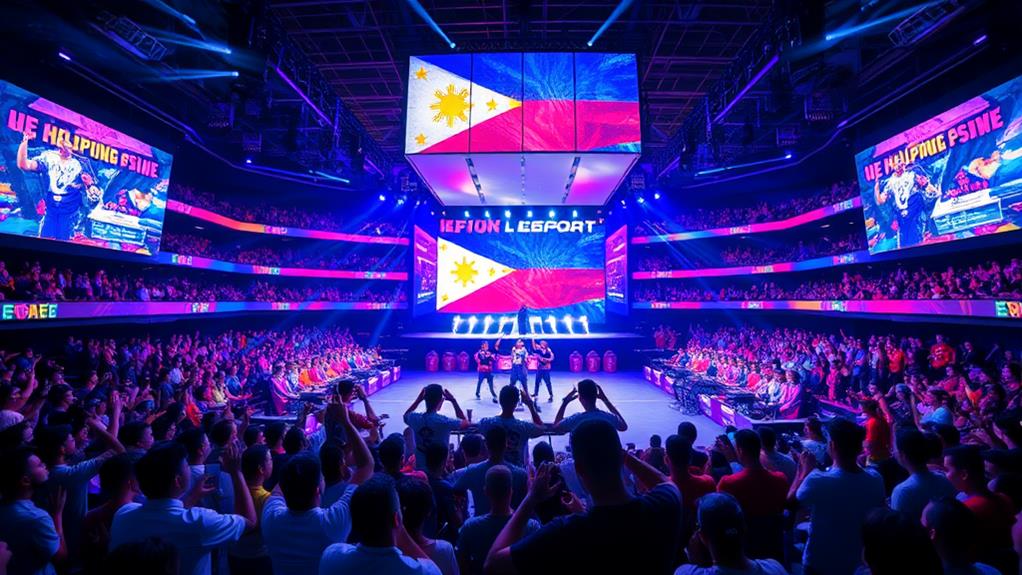
    With over 43 million active gamers, the burgeoning esports market signals a fresh avenue for investment and engagement.

    Basketball's Role in National Identity

    Basketball is an integral part of Filipino identity, transcending mere sport to become a cherished cultural phenomenon. With over 75% of Filipinos identifying as fans, it's clear that basketball isn't just a pastime; it's a unifying force that fosters community engagement.

    The Philippine Basketball Association (PBA), established in 1975 as Asia's first professional league, highlights the sport's prominence and serves as a platform for local talent.

    The NBA brand's near-universal awareness in the Philippines, approaching 99%, demonstrates the sport's immense popularity and influence on local culture.

    Grassroots initiatives and community events nurture local talent and create shared experiences that resonate deeply with Filipinos. Basketball embodies values like teamwork and resilience, reflecting a national identity that thrives on unity and passion.

    In the realm of sports, basketball stands as a vital pillar, connecting generations and inspiring hope for a brighter future in Philippine sports.

    The Philippines' commitment to basketball is further showcased through upcoming events, like the hosting of the FIBA Basketball World Cup 2023 group phase, promising to elevate its profile even higher.

    Achievements of Filipino Athletes

    filipino athletes remarkable accomplishments

    Filipino athletes have consistently showcased their remarkable talent and determination on both regional and global stages.

    Their achievements reflect not just individual brilliance but also the strength of grassroots programs that nurture young talent across the nation.

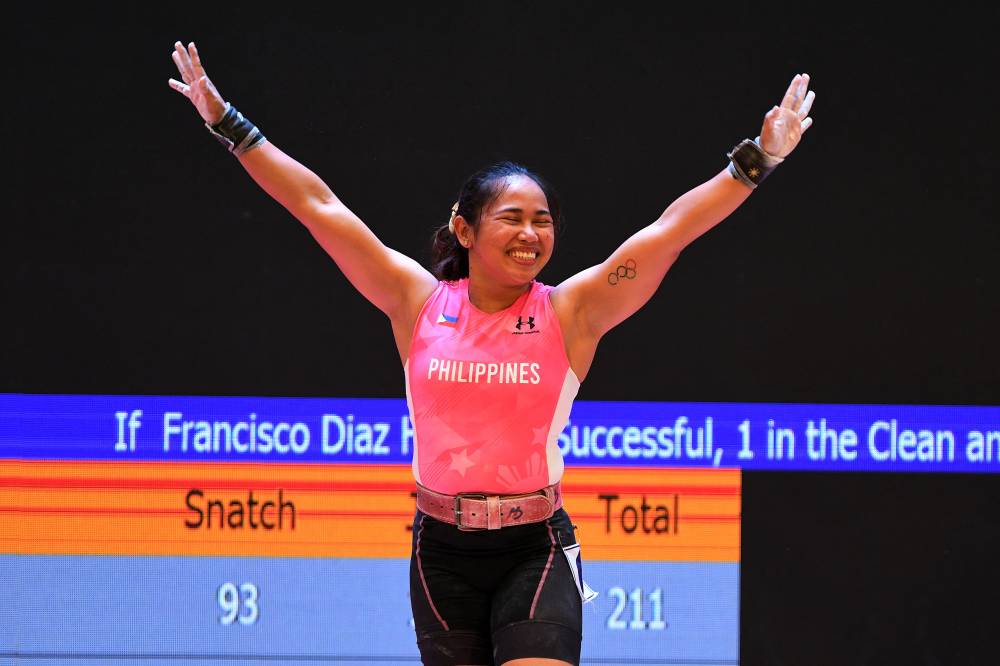
    For instance, at the Tokyo 2020 Olympics, the Philippines celebrated its historic success with four medals, including the groundbreaking gold medal in weightlifting by Hidilyn Diaz. This achievement marked a significant milestone, inspiring future generations to pursue sports.

    The Philippines ranked 4th in the medal standings at the SEA Games 2021, demonstrating the nation's growing competitiveness in regional sports.

    The women's football team made headlines by qualifying for the 2023 FIFA World Cup, signaling an important shift in the recognition and development of women's sports.

    Boxing remains a proud tradition, with Filipino boxers earning multiple world championship titles, further cementing the country's reputation in the sport.

    As you look at these achievements, it's clear that the dedication and hard work of Filipino athletes, combined with supportive grassroots initiatives, lay a solid foundation for future success in sports.

    Esports Growth and Opportunities

    The Philippines is Emerging as a Significant Player in the Global Esports Scene

    The country has a thriving esports industry, driven by a large and dedicated community of over 43 million active gamers. This has led to a 12.9% year-over-year increase in esports growth since 2017, making it an attractive market for investment.

    Several Factors are Contributing to this Rapid Growth

    Major international tournaments are being held in the Philippines, boosting its reputation in the global esports arena.

    Local esports organizations are emerging, providing a platform for talented gamers to gain recognition.

    Increasing sponsorships are offering financial support and resources to gamers and teams.

    Strong community engagement is also driving growth, with fans passionately supporting their favorite players and teams.

    This Growth Presents Lucrative Opportunities for Gamers and Investors

    The mobile gaming market in the Philippines is projected to reach $1.5 billion by 2025, making it an attractive market for investment.

    With the esports industry in the Philippines continuing to grow, gamers and investors alike can benefit from this trend.

    Infrastructure Needs and Development

    essential growth and improvement

    Building a robust sports infrastructure is crucial for the Philippines to unlock its full athletic potential. The government's increased budget for sports development highlights the need for more stadiums and parks, which can significantly enhance community engagement in sports activities.

    Investment in grassroots development and regional training centers is vital for nurturing young talent.

    Understanding the current landscape requires examining the following infrastructure needs:

    Advanced Training Academies: Provide athletes access to essential resources, such as expert coaches, modern equipment, and sports science facilities.

    Improved Sports Facilities: Ensure adequate venues for training and competition, including stadiums, tracks, and fields that meet international standards.

    Public-Private Partnerships: Fuel funding for grassroots programs by collaborating with private organizations to support sports development initiatives.

    Government Funding Initiatives: Increase support through PAGCOR and PCSO revenues, allocating a significant portion of the budget to sports development projects.

    The recent Supreme Court ruling significantly boosts funding for infrastructure development, but the pressing need for advanced training academies remains.

    By fostering public-private partnerships, the Philippines can enhance its overall sports infrastructure, ensuring that aspiring athletes have the resources they need to succeed.

    Addressing these infrastructure needs will pave the way for a brighter future in Philippine sports.

    Technology's Impact on Sports

    Technology is transforming the sports landscape in the Philippines by driving innovation, performance, and engagement. This shift is evident in training methods and competitive environments, where athletes are leveraging technology to enhance their skills.

    Data analytics plays a crucial role in refining performance and preventing injuries. For instance, athletes can analyze their game footage to identify areas for improvement and track their progress over time.

    Wearable technology is another key aspect, providing real-time feedback during training. Devices such as heart rate monitors and GPS trackers help athletes monitor their health metrics and optimize their performance.

    The growth of esports is a significant indicator of technology's impact on sports. The rapid expansion of the sector demonstrates its ability to engage younger audiences and provide new opportunities for athletes and fans alike.

    Virtual events have also become increasingly important, particularly during the pandemic. Online competitions have enabled sports to continue despite physical distancing measures, ensuring that athletes can still compete and fans can still engage with their favorite sports.

    Investing in technology for sports delivery is essential to appeal to the digitally savvy youth demographic and enhance training experiences.

    Community Engagement in Sports

    building connections through sports

    Community engagement in sports is vital for building unity and inclusivity in the Philippines. By participating in local initiatives, individuals help strengthen community ties and promote inclusivity.

    For instance, grassroots programs are essential for developing young talent, especially since many aspiring athletes lack access to resources and platforms to nurture their skills.

    Supporting community events and partnerships enhances fan engagement and creates supportive environments for athletes. This focus on community engagement emphasizes the importance of mental health and well-being, reminding us that sports can be a vital outlet for stress relief and social connection.

    The rise of virtual events has also helped maintain connections among sports participants, providing alternative avenues for competition during disruptions like the pandemic.

    Investment in community sports facilities, such as parks and training centers, is crucial. These facilities not only promote physical activity but also create numerous opportunities for residents to engage in sports, ultimately enriching the community and fostering a love for athleticism.

    How Can Developing Well-Rounded Individuals in Sports and Education Help Shape the Future of Philippine Sports?

    Developing well-rounded individuals in sports and education in the philippines can greatly impact the future of Philippine sports. By providing opportunities for young athletes to excel both academically and athletically, we can potentially produce more well-rounded and disciplined athletes who can represent the country on the international stage.

    Investment Importance and Strategies

    Investment in Philippine sports is crucial for creating a thriving athletic ecosystem that can succeed locally and internationally. With the Supreme Court ruling mandating increased remittances to the Philippine Sports Commission, an additional P19.5 billion is expected by year-end, highlighting the importance of investing in infrastructure and athlete development.

    Effective Coaching is Key. To improve athlete performance, allocate funds to enhance coaching quality, bridging existing gaps in athlete training. This can be achieved by providing coaching certifications, workshops, and training programs for local coaches.

    Grassroots Initiatives Drive Talent Development. Invest in local talent development to create pathways for young athletes. For instance, the proposed National Academy of Sports can provide training facilities, coaching, and mentorship to young athletes, helping them develop their skills and reach their full potential.

    Public-Private Partnerships Ensure Equitable Access. Collaborate with private sector stakeholders and local governments to ensure equal access to facilities and resources. This partnership can lead to the development of more sports facilities, equipment, and training programs, benefiting athletes from all backgrounds.

    Promoting Sports Engagement Fosters a New Generation of Champions. Increase funding for community sports programs to cultivate a new generation of enthusiasts and champions. This can be achieved by supporting school sports programs, community leagues, and sports clinics, making sports more accessible and enjoyable for all.

    Future Trends in Sports Participation

    evolving sports engagement patterns

    The Philippines' youthful demographic is driving a significant shift in sports participation. With an average age under 25, the nation's 110 million people are increasingly engaging in various sports and esports activities.

    The upcoming FIBA Basketball World Cup 2023 will amplify this trend. Over 75% of Filipinos are already passionate basketball fans, making the event a catalyst for further growth.

    Community events and inclusive programs are fostering a more diverse sports culture. At the grassroots level, initiatives like these are enhancing local engagement and encouraging participation among underrepresented groups.

    For instance, programs that provide access to sports facilities and training for disadvantaged youth are helping to bridge the gap.

    Technology will redefine training experiences. The use of virtual reality and data analytics will make sports more appealing to the digitally savvy youth.

    For example, virtual reality can simulate game scenarios, allowing athletes to practice and improve their skills in a more immersive and engaging way.

    Government support and strategic investments in sports infrastructure are crucial to sustaining these trends. By overcoming existing challenges, the Philippines can cultivate a thriving sports ecosystem that empowers young athletes and nurtures their talents.

    Investments in modern sports facilities, for instance, can provide athletes with access to better training equipment and conditions.

    The future of sports participation in the Philippines looks bright. With a focus on community development and embracing technology, the nation can unlock opportunities for growth and empower its young athletes to succeed.

    Questions and Answers

    What Are the Philippine Sports Issues and Controversies?

    Corruption Scandals Hinder Philippine Sports Development

    Philippine sports have been significantly impacted by corruption scandals. Delayed funding from PAGCOR and PCSO has left many sports federations struggling to nurture talent. For instance, the Philippine Olympic Committee (POC) has experienced delayed funding from PAGCOR, which has limited its ability to support athletes and teams.

    Furthermore, the lack of transparency in fund allocation raises concerns about accountability. This lack of transparency has led to questions about how funds are being used and whether they're being utilized effectively to support athletes.

    Consequences of Corruption Scandals

    These corruption scandals have far-reaching consequences. They hinder athlete development by limiting access to resources and support.

    Additionally, they deter youth participation in sports, as young athletes may be discouraged by the lack of opportunities and support. It's essential for stakeholders to address these challenges to foster a healthier sports environment that supports the growth and development of athletes.

    What Is the Importance of Sport in the Philippines?

    Sports play a vital role in shaping the cultural identity of the Philippines. They bring people together, fostering national pride and a sense of community.

    For instance, the achievements of Filipino athletes like Hidilyn Diaz, who won the country's first Olympic gold medal, inspire citizens and promote social cohesion.

    Sports also contribute to the holistic development of Filipino youth. They offer a platform for self-expression, teamwork, and physical activity.

    By participating in sports, young Filipinos can develop important life skills like discipline, perseverance, and communication.

    Moreover, sports help cultivate a vibrant local culture that values health and well-being. They promote physical activity, which is essential for maintaining a healthy lifestyle.

    In the Philippines, sports events and activities bring people together, encouraging them to adopt healthy habits and lifestyles.

    What Is the Philippines Most Successful Sport?

    Basketball is the Philippines' most successful sport. This is evident in the country's vibrant basketball culture, which is deeply ingrained in every level of society.

    From local barangay courts to the prestigious Philippine Basketball Association (PBA), basketball has become an integral part of Filipino life.

    The sport enjoys nearly 99% brand awareness of the NBA, indicating its immense popularity among Filipinos.

    This widespread enthusiasm fuels a strong sense of community spirit, as fans passionately support their teams.

    Basketball not only dominates the sports scene in the Philippines but also serves as a unifying force, instilling pride and identity among its people.

    What Is the #1 Sport in the Philippines?

    Basketball is the #1 sport in the Philippines. This is evident in the overwhelming popularity of the game, with over 75% of Filipinos identifying as fans.

    The Philippine Basketball Association (PBA) provides a platform for local talent to shine, while the NBA enjoys widespread recognition in the country.

    The excitement surrounding international basketball events, such as the FIBA Basketball World Cup 2023, further demonstrates the significant impact of basketball on Filipino culture.

  • Sports Tourism in the Philippines: Attracting Visitors and Boosting the Economy

    Sports Tourism in the Philippines: Attracting Visitors and Boosting the Economy

    Sports tourism in the Philippines is a growing industry that attracts international visitors and contributes significantly to the country's economy. The country's reputation as a premier sports destination is enhanced by hosting major events like the Southeast Asian Games (SEA Games) and the FIBA World Cup. These events not only generate revenue for local businesses but also create jobs and foster community pride.

    Investments in sports infrastructure have improved facilities, making it easier to host international competitions. For example, the Philippine Arena, a state-of-the-art sports venue, has hosted several international events, including the 2019 SEA Games.

    Furthermore, a focus on sustainable practices ensures minimal environmental impact, making sports tourism a more responsible and eco-friendly sector.

    This dynamic sector continues to evolve, offering exciting opportunities for growth and community engagement. The development of new sports facilities and the hosting of more international events are expected to create more jobs and stimulate local economies.

    As the sports tourism industry in the Philippines grows, it is likely to have a positive impact on the country's economy and communities.

    Definition of Sports Tourism

    travel for sporting events

    Sports tourism is a unique experience that combines travel with sporting events, generating significant economic impact and promoting community engagement.

    When people travel to participate in or watch sporting events, they create a boost in local economies. For instance, attending major events like the SEA Games or the FIBA World Cup increases spending on accommodations, food, and entertainment.

    In 2021, sports tourism generated over $90 billion in the U.S. alone, and approximately $600 billion globally.

    Positioning a destination as a sports tourism hub, like the Philippines in Asia, attracts international visitors and showcases its culture and hospitality through diverse sporting events.

    This not only generates revenue but also promotes physical activity among visitors, encouraging a healthier lifestyle. Local participation in events fosters community engagement, generating pride and unity among citizens.

    By understanding the definition of sports tourism, it's clear that it plays a dual role as a catalyst for economic growth and a promoter of community spirit.

    Current Trends in Sports Tourism

    The Philippines is emerging as a premier sports tourism destination. The country's successful hosting of prominent international sports events, such as the Southeast Asian Games and the FIBA World Cup, has significantly boosted tourist numbers and showcased its capabilities on the global stage.

    Infrastructure improvements and partnerships are key to the country's success. Local governments are actively engaging in infrastructure development and forming partnerships with the Philippine Sports Commission to enhance accessibility and community involvement in sports events. This proactive approach not only elevates the experience for visitors but also fosters a sense of pride among locals.

    The Philippine Sports Tourism Awards promotes excellence in the sector. The awards recognize over 50 enterprises and host cities for their excellence, promoting professionalism within the sector.

    This focus on sports tourism as a vital contributor to the overall tourism industry emphasizes its potential for economic impact.

    Sports tourism is driving sustainable growth in the Philippines' tourism landscape. By showcasing local culture and hospitality through sporting events, the country isn't just attracting visitors; it's paving the way for sustainable growth.

    In 2024, the Philippines will host 17 IRONMAN races, attracting thousands of participants and fans, further solidifying its status as a sports tourism hub.

    Economic Impact on Local Communities

    community economic development effects

    Sports tourism has a profound economic impact on local communities in the Philippines. It attracts thousands of visitors, generating substantial spending in host cities and benefiting local businesses, including restaurants and hotels.

    Infrastructure investments are crucial for hosting sports events. Local governments invest in improving sports facilities, such as baseball diamonds and football pitches, to enhance their capacity to host events. This not only fosters growth but also engages local residents in meaningful ways.

    Sports tourism creates jobs and stimulates local economies. The youth sports sector alone contributes over 635,000 jobs and brings in an estimated $12.9 billion in tax revenue.

    The recognition of locations like Clark Freeport Zone through the Philippine Sports Tourism Awards highlights the direct impact of sports tourism on job creation.

    The economic benefits of sports tourism are sustainable and long-lasting. By creating jobs and stimulating local businesses, sports tourism lays the groundwork for sustainable growth and development.

    Embracing this potential can lead to a flourishing sports tourism landscape, benefiting everyone involved.

    Key Sports Events in the Philippines

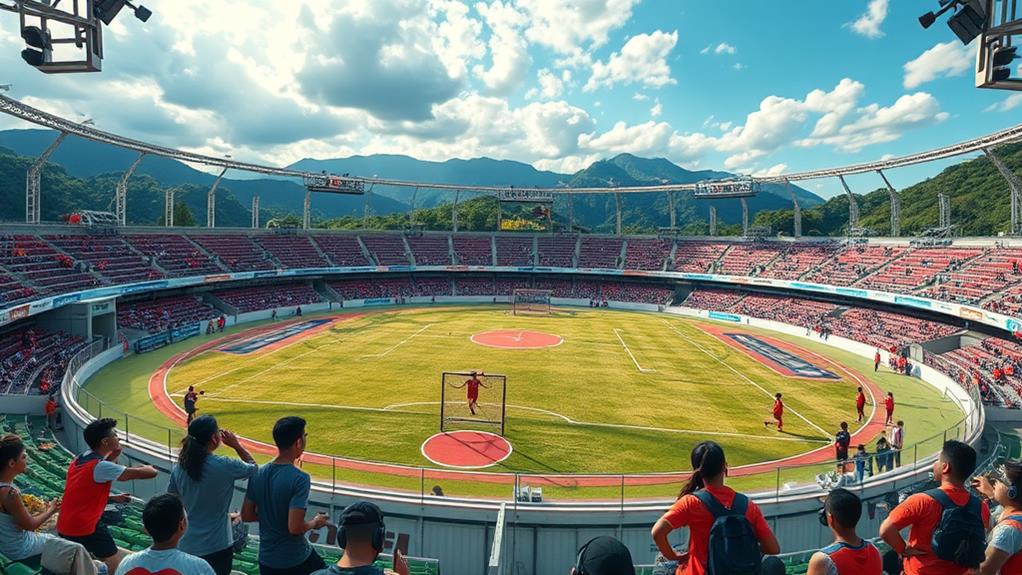
    The Philippines is a thriving sports tourism destination, largely shaped by various key sporting events that attract athletes and spectators from around the world.

    The SEA Games and FIBA World Cup have significantly boosted tourist arrivals, showcasing the nation as a competitive sports destination. These events create a vibrant atmosphere that enhances the local economy while promoting national pride.

    In 2024, the Philippines will host over 17 IRONMAN races, bringing together thousands of local and international athletes and solidifying its reputation in the sports tourism sector.

    The Philippine Sports Tourism Awards recognize over 50 enterprises and host cities for their contributions to this growing industry.

    Events like the Panagbenga Festival in Baguio City combine local culture with sports, enhancing the tourism experience and driving economic growth through sports-related activities.

    By positioning itself as an Asian hub for triathlon events, the Philippines capitalizes on its stunning natural landscapes and rich sports culture, attracting global participants and reinforcing its status within the international sports tourism arena.

    Community Engagement Through Sports

    sports driven community involvement

    Community Engagement Through Sports

    Sports have become a vital force for community development and pride in the Philippines, fostering connections among locals while enhancing tourism. Hosting significant sports events, such as the SEA Games and the FIBA World Cup, attracts visitors and invigorates local communities.

    Youth Involvement is a key aspect of community engagement through sports. Public sporting facilities encourage young people to participate in various sports, such as basketball and volleyball. For example, the Dumaguete City government, under Mayor Felipe A. Remollo, has developed sports facilities that provide opportunities for local youth to engage in sports activities.

    Community engagement through sports also provides an Economic Boost. Hosting events generates revenue for local businesses and creates jobs. For instance, the 2019 SEA Games generated an estimated PHP 10 billion in revenue for the Philippines.

    Infrastructure Development is another benefit of community engagement through sports. Improved facilities enhance the overall quality of life in communities. The Philippine government has invested in building modern sports facilities, such as the Philippine Sports Stadium, to host international events.

    Community engagement through sports also promotes Skill Development. Local youth can hone their athletic skills, fostering future champions. The Philippine Sports Commission provides training programs for young athletes, helping them to develop their skills and compete at the international level.

    Finally, community engagement through sports brings Recognition to local initiatives. Awards like the Philippine Sports Tourism Awards highlight successful local initiatives, encouraging other communities to follow their example.

    Through these efforts, community engagement through sports cultivates a sense of belonging and lays the groundwork for sustainable tourism, making sports a cornerstone of local identity and pride.

    Sustainable Practices in Sports Tourism

    Sustainable Practices in Sports Tourism

    Environmental Sustainability

    Incorporating sustainable practices into sports tourism safeguards the environment for future generations. Eco-friendly venues reduce waste and resource use, enhancing the visitor experience while minimizing environmental impact.

    For instance, using energy-efficient lighting and recycling programs in stadiums reduces carbon emissions and conserves natural resources.

    Cultural Preservation and Community Involvement

    Engaging local communities in sports tourism initiatives fosters cultural preservation and offers opportunities for community involvement, enriching the overall experience for visitors.

    Community engagement initiatives provide authentic cultural experiences, allowing visitors to immerse themselves in local traditions. This can be achieved through partnerships with local organizations, supporting community-led initiatives, and promoting local artisans.

    Conservation and Partnerships

    Partnerships with conservation organizations protect biodiversity and ecosystems, offering unique, eco-conscious tourism activities.

    These collaborations promote responsible tourism practices, ensuring the preservation of natural habitats and ecosystems. For example, partnering with conservation groups to develop eco-friendly trails or wildlife watching tours supports conservation efforts while providing visitors with unique experiences.

    Wellness Tourism and Economic Benefits

    The emphasis on wellness tourism within sports events promotes healthy lifestyles while minimizing carbon footprints associated with travel.

    Strategic planning that focuses on sustainability maximizes long-term economic benefits for local communities, aligning with multiple Sustainable Development Goals (SDGs).

    Infrastructure Development for Sports

    sports infrastructure development initiative

    Investing in sports infrastructure is crucial for the Philippines to become a premier destination for sports tourism. The government's commitment to infrastructure development has led to significant enhancements in local facilities, largely funded by resources like the Hotel Occupancy Tax.

    Enhanced facilities accommodate various sports events and foster community engagement. For instance, the construction of baseball diamonds and football pitches in Clark has provided a platform for both local and international teams to train and compete.

    Moreover, the collaboration between the Department of Tourism and local governments ensures that these facilities meet international standards.

    Hosting major events attracts tourists and supports local businesses. The Philippines has successfully hosted major events like the SEA Games and FIBA World Cup, drawing in tourists and generating revenue for local businesses.

    Facilities like the Clark Freeport Zone have become popular attractions, further boosting the local economy. By supporting local businesses during sports events, the government promotes sustainable economic growth.

    Opportunities for Investment

    Investment Opportunities in Sports Tourism

    The Philippines offers a lucrative landscape for investment in sports tourism, driven by the government's proactive approach to infrastructure development and event promotion.

    Government Support and Funding Mechanisms

    The government provides funding mechanisms such as the Hotel Occupancy Tax and municipal bonds to support the development of sports facilities.

    These investments not only enhance local sports infrastructure but also attract major events that drive significant tourism.

    Incentives for Excellence

    The Philippine Sports Tourism Awards (PSTA) incentivize excellence in the sector, encouraging innovative projects that elevate the country's profile in the global sports arena.

    Successful initiatives like the SEA Games and IRONMAN races have demonstrated a direct correlation between sports tourism and increased local spending.

    Regional Growth and Community Engagement

    Regions like Clark are experiencing improvements in facilities such as baseball diamonds and football pitches, expanding opportunities for community engagement and economic growth.

    With the government's support and growing interest in sports tourism, now is the perfect time to explore investment opportunities that can benefit both investors and the overall economic landscape of the Philippines.

    Future of Sports Tourism in the Philippines

    philippines sports tourism potential

    The Philippines is poised for a thriving sports tourism industry. The government's commitment to promoting sports tourism as a strategy for economic growth will enhance the country's appeal to international visitors. Hosting prestigious events like the SEA Games and FIBA World Cup has already boosted tourist arrivals and elevated local economies.

    Several factors will fuel the growth of sports tourism:

    Investment in improved sports facilities will provide world-class infrastructure for international events. For instance, the country will host multiple IRONMAN races and regional events in 2024, attracting top athletes and spectators.

    Recognition through the Philippine Sports Tourism Awards will acknowledge excellence in sports tourism, encouraging innovation and improvement.

    Enhanced infrastructure supporting community engagement will foster a culture of sports participation and appreciation.

    Focused marketing strategies targeting international athletes and tourists will promote the Philippines as a premier sports tourism destination.

    These developments won't only showcase the nation's sporting potential but also create substantial economic impact, benefiting local businesses and communities.

    The future of sports tourism in the Philippines looks bright, promising increased visitor influx and long-term economic benefits for the country.

    Questions and Answers

    What Are the Benefits of Sports Tourism in Philippines?

    Sports tourism in the Philippines combines adventure and cultural exchange, offering a unique travel experience. This blend of activities allows you to engage in thrilling sports like surfing and diving while immersing yourself in local traditions and festivals.

    For instance, you can explore the annual Sinulog Festival in Cebu, which showcases the country's rich cultural heritage.

    This experience fosters community connections and local pride. By participating in sports tourism, you contribute to the growth of local businesses, creating jobs and boosting infrastructure.

    For example, the surfing industry in Siargao Island has generated employment opportunities for local residents and stimulated the construction of new accommodations and amenities.

    Sports tourism also has significant economic benefits. The influx of visitors leads to increased revenue, which in turn, boosts the local economy.

    In 2020, the Philippine sports tourism industry generated approximately PHP 24.2 billion (around USD 480 million) in revenue. By participating in sports tourism, you contribute to a vibrant economy while enjoying unforgettable adventures and cultural experiences.

    How Tourism Contributes to the Economy in the Philippines?

    Tourism stimulates economic growth in the Philippines by generating revenue and creating jobs. When tourists visit, they support local businesses, such as hotels, restaurants, and souvenir shops, which in turn create employment opportunities for Filipinos.

    For instance, in 2020, the tourism industry employed around 5.7 million people, contributing to 13.5% of the country's total employment.

    Infrastructure development is also driven by tourism. As tourist numbers increase, the government invests in building better roads, airports, and amenities to accommodate visitors. This infrastructure development not only enhances the tourist experience but also attracts investors and stimulates economic growth.

    For example, the upgrade of the Clark International Airport has increased its capacity to handle more flights and passengers, making it easier for tourists to access popular destinations.

    The growth of tourism creates a sustainable cycle. Improved infrastructure, such as better roads and amenities, further encourages tourism, which in turn generates more revenue and creates more jobs.

    This cycle enriches the economy continuously, making tourism a vital contributor to the country's economic development.

    What Is the Economic Impact of Sports Tourism?

    Sports tourism has a significant impact on local economies.

    It generates revenue through visitor spending on accommodations, dining, and local attractions. For instance, when a major sporting event comes to town, local hotels and restaurants experience a surge in bookings and sales. This increased revenue has a ripple effect, boosting revenue for local businesses and enhancing community engagement.

    As visitor spending increases, jobs in hospitality and event management expand, leading to a healthier economy.

    For example, when a region hosts a major tournament, it may need to hire additional staff to manage the event, from ticketing and security to concessions and transportation.

    Improved infrastructure and facilities also become more appealing to potential visitors, ensuring sustained economic benefits.

    How Do Sporting Events Boost the Local Economy?

    Sporting events significantly boost the local economy. This is because they attract thousands of visitors who spend money on accommodations, meals, and entertainment. For instance, a major football championship can draw in over 50,000 spectators, resulting in a significant influx of cash for local hotels, restaurants, and entertainment venues.

    This influx of cash supports local businesses and creates jobs, which has a lasting impact on the community.

    Moreover, hosting major sporting events often leads to investments in improved infrastructure, such as upgraded stadiums, transportation systems, and communication networks.

    These infrastructure improvements provide long-term benefits to the community, even after the event has concluded. For example, a city that hosts the Olympics may build a new state-of-the-art stadium, which can then be used for future events, attracting more visitors and generating additional revenue.

  • The Role of Sports in Promoting National Unity and Pride

    The Role of Sports in Promoting National Unity and Pride

    Sports unify people across different backgrounds through shared experiences. When a team wins, people celebrate together, reinforcing their bonds and collective identity. For example, during the 2018 FIFA World Cup, people from different racial and ethnic groups in France came together to cheer on their national team, fostering a sense of unity and national pride.

    Major international sports events symbolize cultural values and historical narratives. The 1995 Rugby World Cup in South Africa, for instance, marked a significant moment in the country's transition to democracy, demonstrating the power of sports to bring people together and promote national unity.

    Local sports clubs strengthen community identity, while global competitions elevate national pride. The presence of local sports clubs in neighborhoods helps to build a sense of community, as people from the same area come together to support their team.

    On a larger scale, international competitions like the Olympics allow countries to showcase their athletic achievements and promote national pride.

    The relationship between sports and nationalism can be complex, influencing societal cohesiveness. While sports have the power to unite people, they can also be used to divide and exclude others.

    It is essential to recognize both the positive and negative impacts of sports on national unity and pride.

    The Impact of Sports on National Identity

    sports shaping national identity

    Sports play a crucial role in shaping national identity. When national teams compete internationally, they ignite a sense of national pride that transcends political and socioeconomic divides. This collective pride is evident in the celebrations that erupt after a hard-fought victory, fostering unity among citizens and strengthening national bonds.

    Sports embody a nation's cultural values and historical narratives. They reinforce a shared identity through performances that resonate deeply with the populace. For example, South Africa's 1995 Rugby World Cup victory symbolized a new era of unity following apartheid, demonstrating how success in sports can elevate national identity.

    Major sporting events provide platforms for nations to showcase their culture and values, enhancing their global image. The 2008 Beijing Olympics, for instance, allowed China to display its rich cultural heritage and values to a global audience.

    This visibility instills a sense of belonging among citizens, prompting increased civic engagement as they rally behind their athletes. As citizens come together to support their team, they contribute to social cohesion, reinforcing the idea that sports are vital threads in the tapestry of national identity.

    Sports as a Unifying Force

    Sports Unite People Across Differences

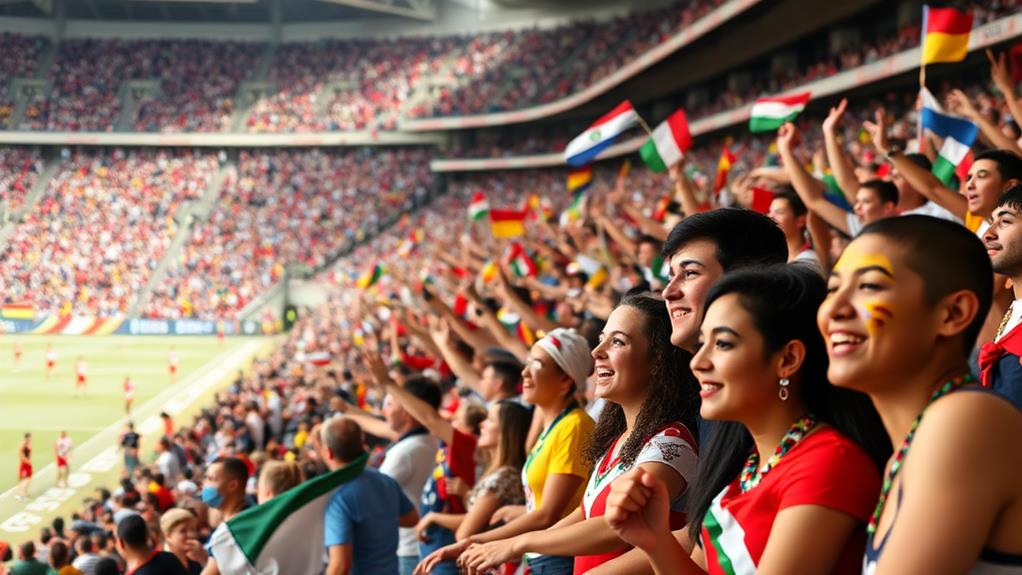
    Sports have the power to bring people together, fostering a sense of solidarity that transcends individual differences. International sporting events, like the FIFA World Cup and the Olympics, become platforms for national pride, where citizens celebrate their athletes' achievements and share a collective identity.

    The impact of sports on unity is evident in various events:

    Event Impact on Unity
    1995 Rugby World Cup United diverse ethnic groups in South Africa
    2008 Beijing Olympics Promoted statehood and national image
    FIFA World Cup Celebrated national achievements globally
    Local Sports Events Encouraged collaboration among communities
    Paralympics Highlighted inclusivity and diversity

    These events demonstrate how sports can break down barriers between communities, fostering a sense of belonging. The shared experience of cheering for a national team can bridge political and socioeconomic divides, uniting people in collective celebrations.

    Role of Clubs in Community Identity

    clubs shape community identity

    Clubs play a significant role in shaping community identity by reflecting the values, history, and aspirations of their local populations.

    Athletic Bilbao's policy of fielding only Basque players, for instance, reinforces Basque nationalism and fosters pride within the community.

    Similarly, the Old Firm derby in Glasgow highlights the deep-rooted Catholic and Protestant ties, showcasing how local clubs can mirror historical rivalries and social divisions.

    FC Barcelona, known as "Barça," serves as a potent symbol of Catalonian pride, with its motto "Més que un club" emphasizing its integral role in the region's cultural landscape.

    NK Dinamo Zagreb and Red Star Belgrade represent Croatian and Serbian nationalism, respectively, embodying the ethnic tensions that shape their communities.

    The Montreal Canadiens stand as a significant representation of Francophone identity in Quebec, with their storied history and rivalries enhancing the cultural fabric of French-speaking Canadians.

    In essence, local clubs aren't just about sport; they forge community identity, bridging unity amid social divisions, and fostering a sense of belonging that transcends mere athletic competition.

    How does Sportsmanship and Fair Play Contribute to National Unity and Pride in Sports?

    Sportsmanship is the cornerstone of fair play in sports. The importance of sportsmanship lies in its ability to cultivate national unity and pride in sports. When athletes uphold fair play, it fosters a sense of camaraderie and respect among competitors, ultimately contributing to a strong and unified national sports community.

    Global Sporting Events and National Pride

    Global Sporting Events Unite Nations

    Local sports clubs play a vital role in community identity, but global sporting events like the FIFA World Cup and the Olympic Games take national pride to a whole new level. These events unite citizens in support of their teams, transcending socio-political differences and fostering national solidarity.

    The FIFA World Cup is a prime example of this phenomenon. 80% of participants reported feeling a strong sense of national pride during the tournament. This is evident in the 1995 Rugby World Cup in South Africa, where the national team's victory became a cornerstone for collective identity, bridging ethnic divides and promoting national unity.

    The Olympic Games also serve as a platform for countries to showcase their cultural heritage. Athletes' achievements are celebrated as national milestones, highlighting the country's cultural identity. The 2008 Beijing Olympics, for instance, showcased China's rich cultural heritage to the world.

    Global sporting events have a profound impact on national pride:

    Event Key Impact Example
    FIFA World Cup Surge in national pride 1995 Rugby World Cup, SA
    Olympic Games Showcase of cultural identity 2008 Beijing Olympics
    Global Competitions Fostering national solidarity Various international events

    In essence, global sporting events celebrate athleticism while strengthening national bonds.

    Challenges of Nationalism in Sports

    nationalism s impact on sports

    Nationalism in sports can be a double-edged sword, fuelling both unity and conflict.

    While sports have the power to unite a nation, they can also be exploited for political gain, leading to tension and conflict. For instance, the intense cricket matches between India and Pakistan often spark unrest, overshadowing the importance of sports as a means of building relationships.

    Historical events have demonstrated how nationalism can disrupt international sporting events. The Olympic boycotts of 1980 and 1984 are prime examples of how nationalism can reflect broader geopolitical conflicts. Similarly, events like the Ashes series serve to intensify historical rivalries, with fans fostering a sense of superiority that can alienate rival supporters.

    Nationalism in sports can lead to the exclusion of minority groups. In Ireland, Gaelic sports have historically marginalized players from British origins.

    Even team sports can become battlegrounds for divisions, as seen in the Old Firm derby in Glasgow, where religious affiliations create intense community rivalries.

    Ultimately, nationalism in sports presents a duality that society must navigate carefully. While sports can promote unity, the challenges of nationalism often complicate this ideal, revealing a more complex reality.

    Questions and Answers

    What Is the Role of Sports in Unity?

    Sports foster unity by promoting community engagement and cultural exchange. When individuals participate in team sports, they share experiences that build social cohesion and create a collective identity.

    For instance, playing on a local soccer team can bring together people from different neighborhoods, fostering a sense of community and shared purpose.

    Team sports enhance emotional connections and strengthen local and national identity. As teammates work together towards a common goal, they develop strong bonds and a sense of belonging.

    This collective identity can also extend to national pride, as seen during international competitions like the Olympics or World Cup.

    Youth development through sports encourages global participation and collaboration. Programs like the Olympics' Youth Olympic Games or the FIFA World Youth Cup bring together young athletes from diverse backgrounds, allowing them to collaborate, learn from each other, and celebrate their achievements together.

    This helps strengthen bonds within communities and promotes global understanding.

    Sports ultimately strengthen community bonds and promote unity. By providing a platform for people to come together, share experiences, and celebrate achievements, sports play a crucial role in fostering unity and promoting social cohesion.

    What Is the Role of Games in National Unity?

    Games Foster National Unity

    Games play a vital role in fostering national unity by promoting community engagement and identity formation.

    They bring people together, encouraging cultural exchange and allowing diverse groups to connect through shared experiences, such as watching a national team compete in an international tournament.

    International Competitions Ignite Patriotism

    International competitions ignite patriotism, involving youth development and instilling values of teamwork and resilience.

    For example, the Olympics bring together athletes from different countries, promoting unity and national pride.

    Economic Impact and Health Benefits

    The economic impact of these events generates volunteer involvement and enhances social cohesion, all while offering health benefits that unite people in active participation and collective celebration.

    How Does Sport Unify Us?

    Sport Fosters Unity Through Shared Experiences

    Sport unifies us by creating shared experiences that bring people together, regardless of their individual differences. For instance, during international competitions, athletes and spectators from diverse backgrounds come together, promoting cross-cultural understanding and exchange. This shared experience strengthens community bonds and fosters a sense of togetherness.

    Emotional Connections and Inclusivity

    The emotional connection formed during games contributes to identity formation, as fans share joy and disappointment together.

    Healthy rivalry dynamics also promote inclusivity, as teams and fans from different backgrounds engage in respectful competition. This inclusivity factor helps break down social barriers, uniting people across different demographics.

    Youth Engagement and Sense of Belonging

    Youth engagement in sports plays a crucial role in nurturing future generations' sense of belonging. As young athletes participate in team sports, they develop a sense of identity and belonging, which is essential for their social and emotional development.

    Historical Significance and Unity

    The historical significance of sporting events strengthens ties among people, showcasing sport's unique ability to bring us together.

    For example, the Olympic Games have a long history of promoting international unity and understanding, bridging cultural and national divides.

    What Is the Relationship Between Sport and Peace?

    Sport plays a vital role in promoting peace by resolving conflicts and integrating societies. Through community engagement in sports, cultural exchange is fostered, enhancing international diplomacy.

    For instance, the Olympic Truce Foundation brings together nations to promote peaceful resolution of conflicts during the Olympic Games.

    Sport empowers youth and promotes gender equality, creating opportunities for all. The United Nations uses sports to engage youth in peacebuilding efforts, providing a platform for their voices to be heard.

    Additionally, organizations like Women Win promote gender equality through sports, empowering girls and women worldwide.

    Sports contribute to health promotion and economic development, providing educational opportunities for marginalized groups. The World Health Organization uses sports to promote physical activity, reducing the risk of chronic diseases.

    Furthermore, sports tourism generates revenue, creating jobs and stimulating local economies.

    By participating in sports, individuals help build bridges, reduce stereotypes, and nurture understanding, making a significant impact on peacebuilding efforts. Sports have the power to bring people together, fostering a sense of community and mutual respect.

  • Sports and Education in the Philippines: Developing Well-Rounded Individuals

    Sports and Education in the Philippines: Developing Well-Rounded Individuals

    Combining sports with education is crucial in the Philippines for developing well-rounded individuals. Engaging in physical activities has been proven to boost mental health, enhance concentration, and even improve academic performance. For instance, a study found that students who participated in sports had higher attendance rates and better grades compared to those who didn't.

    Unfortunately, most Filipino adolescents do not meet the recommended daily activity levels. According to the World Health Organization, only 15.4% of adolescents in the Philippines engage in at least 60 minutes of moderate to vigorous physical activity per day.

    Government initiatives and schools are working to address this issue. The Philippine government has implemented programs to integrate effective physical education into schools, while many schools offer a range of sports activities to encourage student participation.

    However, challenges persist. Insufficient facilities and limited data hinder the progress of these initiatives. For example, many public schools lack adequate sports facilities, making it difficult to implement comprehensive physical education programs.

    Investing in infrastructure and promoting collaboration are key to addressing these challenges. By providing better facilities and encouraging partnerships between schools, governments, and private organizations, we can inspire healthier lifestyles and better academic outcomes for Filipino youth.

    Importance of Sports in Education

    enhancing learning through athletics

    Sports are essential in education as they shape well-rounded individuals. Engaging in sports promotes physical activity, enhances mental well-being, and is vital for adolescent development. This importance is recognized by the Schools Physical Education and Sports Development Act of 1969, which emphasizes incorporating sports into educational programs to ensure students' overall growth.

    Participating in sports improves academic performance. Research shows that students who engage in sports tend to have better concentration and higher grades.

    However, the 2022 Philippine Report Card on Physical Activity reveals a concerning fact: only 15.4% of adolescents meet recommended activity levels. This highlights the need for comprehensive sports programs in Philippine schools to fill this significant gap.

    Current Physical Activity Status

    Physical Activity Status Among Filipino Youth is Alarming

    The 2022 Philippine Report Card on Physical Activity gave an overall grade of F for physical activity levels among children and adolescents, indicating a critical need for improvement.

    Low Physical Activity Levels

    Only 15.4% of adolescents meet the recommended 60 minutes of moderate-to-vigorous physical activity daily. This is a significant concern, as regular physical activity is essential for a healthy lifestyle.

    Inadequate Active Transportation

    The report assigned a grade of D for active transportation, with just 40% of adolescents in Cebu walking to school and less than 1% biking. This highlights the need to promote alternative modes of transportation that encourage physical activity.

    Excessive Sedentary Behavior

    48% of adolescents watch TV for two or more hours daily, earning a grade of B for sedentary behavior. Reducing screen time is crucial to fostering a healthier lifestyle.

    Insufficient Data on Organized Sports

    There is insufficient data on organized sports and other physical activities, creating gaps in understanding youth behaviors. This lack of data hinders the development of effective strategies to promote physical activity among Filipino youth.

    Addressing the Challenges

    It is essential to address these challenges to foster a well-rounded education.

    Overview of Educational Programs

    comprehensive educational program summary

    Physical Education in the Philippine Educational System

    The Philippine educational system has made significant efforts to integrate sports and fitness into the curriculum, recognizing the crucial role of physical education in youth development.

    Republic Act No. 5708 encourages schools to focus on athletic development, ensuring students engage in various sports activities.

    Department of Education's Sports Programs

    The Department of Education oversees educational programs designed to develop skills in a range of sports, including:

    • Aquatics: Swimming and lifesaving
    • Athletics: Track and field skills
    • Martial Arts: Self-defense techniques

    These programs combine theoretical knowledge with practical training, preparing students for competitive environments.

    Supporting Infrastructure and Resources

    Adequate training facilities and resources are provided to promote sustained engagement in physical activities.

    Financial provisions from Republic Act No. 5708 ensure ongoing sports development, enabling students to thrive in a well-rounded educational experience.

    Government Initiatives and Policies

    Government Support for Sports in Education

    The Philippine government has implemented various initiatives and policies to promote physical activity among youth through sports integration in education.

    The Schools Physical Education and Sports Development Act (Republic Act No. 5708) mandates the Department of Education to develop physical education programs in schools, ensuring effective planning, adequate facilities, and sustained financing.

    National Policies Promoting Active Lifestyles

    The 2022 Philippine Report Card on Physical Activity identified ten national policies that support active lifestyles among children, earning a grade of B for government initiatives.

    These policies focus on:

    Financial Sustainability: Financial provisions ensure that unexpended balances support ongoing sports development.

    Long-term Impact: A focus on sustainability ensures long-term effects on youth physical activity.

    Accountability: There's a call for stronger implementation and accountability mechanisms to ensure policy effectiveness.

    Effective Program Translation: The need for better translation of policies into effective programs is recognized.

    How Does the Palarong Pambansa Contribute to the Development of Well-Rounded Individuals in the Philippines?

    The Palarong Pambansa is an avenue where young filipino athletes showcase their skills and sportsmanship. This annual event promotes physical fitness, camaraderie, and teamwork among participants. Through sports, the Palarong Pambansa contributes to the holistic development of well-rounded individuals in the Philippines, nurturing both their athletic and personal growth.

    Challenges in Implementation

    implementation hurdles and obstacles

    Challenges in Implementing Sports and Physical Education Initiatives in the Philippines

    The Philippines faces significant obstacles in implementing effective sports and physical education initiatives. 84.5% of adolescents aren't sufficiently active, with only 15.4% meeting the recommended 60 minutes of physical activity daily, according to the 2022 Philippine Report Card on Physical Activity. This highlights the urgent need for improved programs to engage youth in physical activity.

    Lack of data on key indicators, such as Organized Sport and Active Play, hinders efforts to understand and address factors influencing physical activity levels.

    Although government policies received a grade of B, their impact is often diminished by ineffective implementation and lack of accountability.

    The absence of collaboration among various sectors and inadequate national surveillance mechanisms further complicate the landscape. These challenges hinder effective sports development and meaningful physical education.

    To overcome these hurdles, it's essential to foster partnerships, enhance data collection, and ensure policies translate into actions, paving the way for a healthier, more active generation.

    Future Directions for Improvement

    To create a more active and engaged youth population in the Philippines, strengthening government policies is crucial to support active lifestyles among adolescents. These policies must be effectively implemented and monitored to ensure their success.

    Enhanced collaboration among government bodies, schools, and community organizations is necessary to create comprehensive programs that increase opportunities for physical activity. For instance, schools can partner with local sports clubs to provide after-school sports programs, while community organizations can offer free fitness classes in public spaces.

    Establishing national surveillance mechanisms is vital for consistent data collection and monitoring of youth physical activity trends. This data can inform necessary policy adjustments, such as identifying areas with low physical activity rates and allocating resources to implement programs that promote physical activity.

    Addressing barriers like limited access to organized sports and active transportation is essential to make it easier for young people to engage in physical activity. For example, the government can invest in building bike lanes and pedestrian-friendly roads to encourage active transportation, while schools can offer sports programs that cater to different skill levels and abilities.

    Questions and Answers

    Why Is Sports Important in the Philippines?

    Sports Foster a Culture of Physical Fitness and Health

    In the Philippines, sports play a vital role in promoting physical fitness and health benefits.

    Regular physical activity helps reduce the risk of chronic diseases, such as heart disease and diabetes. By engaging in sports, individuals develop discipline skills, which translate to other areas of life, including academics and personal relationships.

    Sports Promote Youth Development and National Pride

    Participating in sports enhances youth development by building character, teaching valuable life skills, and providing opportunities for socialization.

    The Philippines' athletic achievements, such as winning medals in international competitions, inspire national pride and unity. This pride motivates the country to continue investing in sports programs, which ultimately benefits the nation as a whole.

    Sports Strengthen Community Bonds

    Community engagement in physical activities strengthens social bonds and fosters a sense of community.

    Local sports events and programs bring people together, promoting social integration and a healthier, more united society. By embracing sports, the Philippines can build stronger, more cohesive communities that benefit everyone.

    What Are the Specific Sports Developed in the Philippines?

    Traditional Sports

    The Philippines has a rich heritage of traditional sports that continue to thrive. Arnis, a form of martial arts, is the national sport, emphasizing hand-to-hand combat and stick fighting.

    Sipa, a game similar to sepak takraw, is another traditional sport that involves hitting a ball with the feet.

    Modern Sports

    Modern sports have also gained popularity in the Philippines. Basketball is a highly popular sport, with a professional league and a strong following.

    Volleyball is another favorite, with both indoor and beach variations being played.

    Football, although not as popular as basketball, has a growing fan base and a professional league.

    Martial Arts and Combat Sports

    Martial arts and combat sports are also prominent in the Philippines. Judo and Taekwondo are Olympic sports that have produced Filipino medalists.

    Boxing is another popular combat sport, with world-renowned boxers like Manny Pacquiao.

    Emerging Sports

    New and emerging sports are also gaining traction in the Philippines. Esports, or competitive video gaming, has a growing following and has been included in several international competitions.

    Obstacle course racing and trail running are also becoming popular, reflecting the nation's growing interest in outdoor activities and sports tourism.

    What Is the Purpose of Physical Education in the Philippines?

    The purpose of physical education in the Philippines is to foster holistic development through curriculum integration. This integration enables students to develop essential skills, values, and attitudes that benefit their overall well-being.

    Physical education emphasizes skill development, teamwork, and character building, which enhances social interaction and youth engagement. By participating in physical activities, students experience health benefits that contribute to lifelong fitness, ultimately improving their academic performance.

    Additionally, physical education highlights the cultural significance of sports, ensuring students appreciate both the physical and mental aspects of well-being, setting the foundation for a healthier lifestyle.

    How Did the Foundation of Physical Education and Sports in the Philippines Start?

    The Philippine government initiated physical education and sports programs to enhance youth development. In the early years, educational policies were shaped by cultural values that emphasized community engagement and collective responsibility.

    The first curriculum developments in physical education were influenced by American and Asian models, which introduced new sports and games to the country.

    Sports organizations played a crucial role in promoting participation and development. The Philippine Amateur Athletic Federation (PAAF), established in 1911, was one of the first organizations to oversee and govern sports in the country.

    The PAAF organized national competitions, trained athletes, and developed coaches, which helped to raise the profile of sports in the Philippines.

    Despite funding challenges and limited resources, the Philippines continued to participate in international competitions, such as the Southeast Asian Games and the Asian Games.

    International competitions motivated students to engage in physical activities and develop a healthy lifestyle, which benefited both individuals and society as a whole.

  • The Palarong Pambansa: Showcasing Young Filipino Athletes

    The Palarong Pambansa: Showcasing Young Filipino Athletes

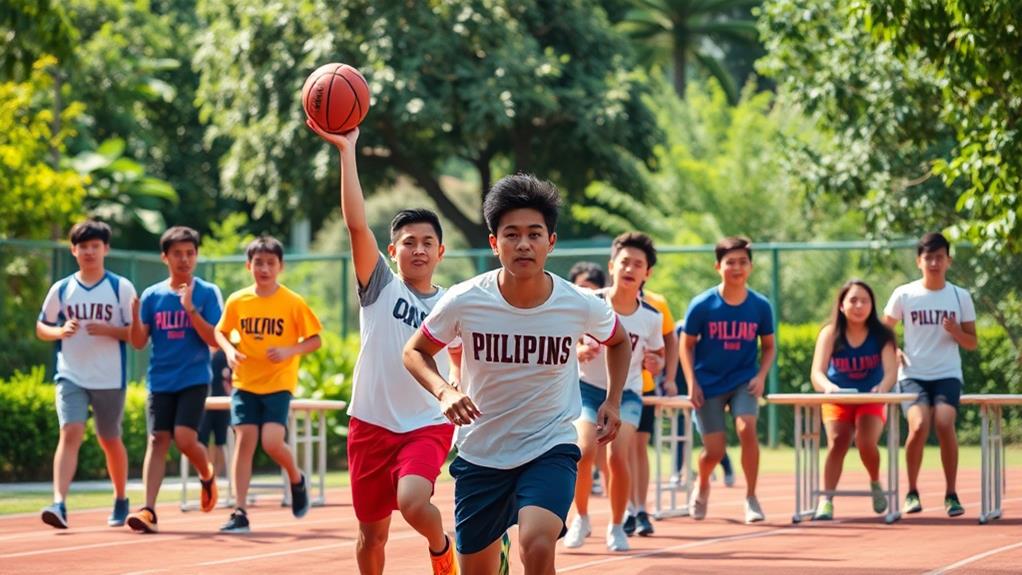
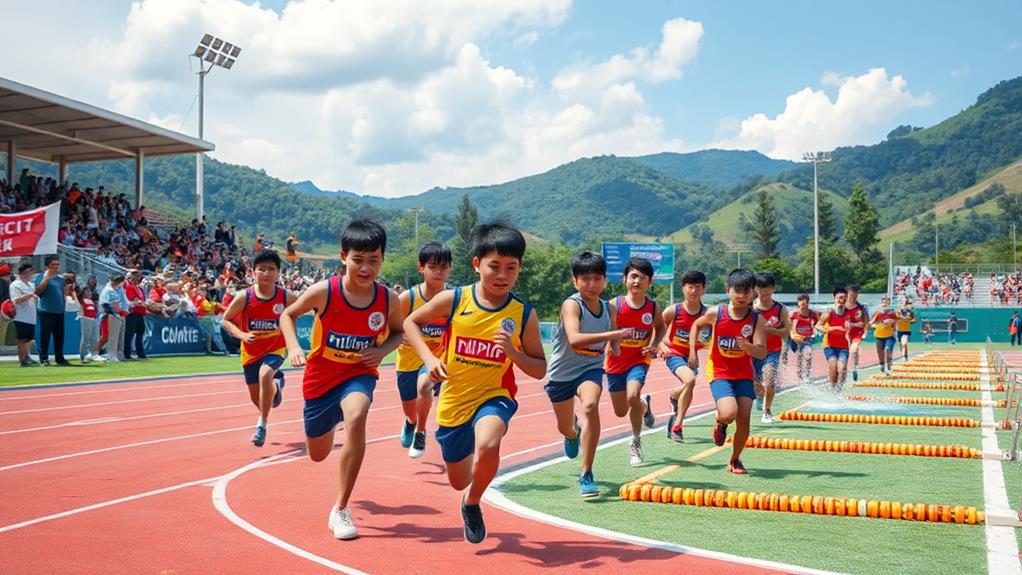
    The Palarong Pambansa is the premier national sporting event in the Philippines, showcasing the talents of around 12,000 young Filipino athletes. This annual celebration highlights over 22 sports, including traditional favorites and exciting new additions like dance sports.

    Established in 1948, the Palarong Pambansa plays a vital role in promoting sportsmanship and inclusivity, thereby enhancing national pride.

    The event's primary objective is to nurture athletic skills, but it also places great emphasis on personal growth and character development.

    By participating in this event, young athletes are inspired to excel and strive for excellence in Filipino sports.

    As a result, the Palarong Pambansa has become a breeding ground for future generations of Filipino athletes, inspiring them to reach greater heights.

    Overview of Palarong Pambansa

    national sports competitions overview

    The Palarong Pambansa is an annual multi-sport event that showcases the talents of young Filipino athletes and promotes a spirit of competition and camaraderie.

    This year's event, held from July 11 to 15 in Cebu City, will gather around 12,000 participants, including athletes, coaches, and officials.

    The event features competitions across 22 regular sports, a demonstration sport, and four Para Games.

    For the first time, dance sports will be included as a regular event, marking a historic moment.

    In 2024, the Palarong Pambansa emphasizes inclusivity by welcoming athletes from the National Academy of Sports and Philippine Schools Overseas for the first time.

    With the theme "Beyond Sports," the event aims to promote holistic development among young athletes, highlighting the importance of not just athletic skills, but also personal growth and community engagement.

    The Palarong Pambansa goes beyond mere competition, fostering unity and collaboration among participants and their communities.

    The event plays a significant role in shaping the future of sports in the Philippines and nurturing the next generation of leaders.

    Historical Significance of the Event

    Palarong Pambansa: A Cornerstone of Athletic Development in the Philippines

    Established in 1948, Palarong Pambansa is a national sports event that has become a vital platform for young Filipino athletes to showcase their talents.

    This event holds historical significance as it promotes sports development across the nation and champions inclusivity and diversity.

    The event features competitions in 22 traditional sports, one demonstration sport, and four Para Games, ensuring that every athlete has a chance to participate.

    With around 12,000 participants over the years, Palarong Pambansa has fostered a strong sense of community and national pride.

    The event encourages youth participation, allowing young athletes to compete at a high level and discover their potential. For instance, the upcoming 2024 edition will introduce athletes from the National Academy of Sports and Philippine Schools Overseas, marking a significant expansion of representation.

    Palarong Pambansa has historically played a crucial role in identifying and nurturing future leaders in various athletic disciplines. By promoting sports development and inclusivity, it not only enriches the lives of young athletes but also strengthens the fabric of Filipino culture, ensuring that the spirit of competition and camaraderie thrives for generations to come.

    Celebrating Filipino Talent

    honoring filipino artistic excellence

    The Palarong Pambansa truly embodies the spirit of Filipino talent by serving as a platform for young athletes to showcase their diverse abilities.

    This prestigious event is more than just a competition; it's a celebration of sportsmanship and holistic athlete development. With around 12,000 participants expected, the Palarong Pambansa highlights the importance of fostering an environment where athletes can grow and thrive.

    The diversity of sports is a key element that showcases Filipino talent. The event features 22 regular sports, a demonstration sport, and four Para Games, providing a wide range of opportunities for athletes to shine.

    Inclusion is another important aspect, as the Palarong Pambansa welcomes inaugural contenders from the National Academy of Sports and Philippine Schools Overseas, promoting equal opportunities for all.

    Community engagement is essential in inspiring pride in Filipino athletes. The GalingDITO campaign emphasizes local talent, encouraging communities to support and celebrate their athletes.

    The Palarong Pambansa also focuses on the future, recognizing and nurturing the potential of young athletes to inspire future generations.

    This year's theme, "Beyond Sports," reinforces the idea that the Palarong Pambansa is about more than just competition; it's a platform for unity, growth, and showcasing the best of Cebu City Sports.

    Ultimately, it's an opportunity for young athletes to shine and for the nation to celebrate its vibrant talent pool.

    Community Engagement and Impact

    Community Engagement and Impact

    During the Palarong Pambansa, community engagement is crucial in fostering unity and pride among participants and local residents. The event brings together approximately 13,000 delegates, including young athletes from 17 regions, creating an atmosphere that encourages inclusivity and support.

    Local businesses in Cebu City benefit significantly from the influx of tourists, stimulating the economy and promoting grassroots sports initiatives.

    Volunteerism is essential, as residents actively participate in supporting the athletes, enhancing the overall spirit of the games. The Palarong Pambansa isn't just a sports event but a cultural celebration, showcasing the rich heritage and exceptional Filipino talent.

    Health and wellness initiatives are highlighted, promoting active lifestyles among both participants and locals.

    Engagement activities, such as DITO's GalingDITO booths and fan meets, strengthen community ties, allowing everyone to connect over shared experiences.

    How are Young Female Athletes Featured in the Palarong Pambansa?

    Young female athletes are gaining recognition in the Palarong Pambansa, reflecting the rise of female athletes in sports. They are showcased in various events such as track and field, swimming, and basketball, highlighting their incredible talent and perseverance. The Palarong Pambansa provides a platform for them to shine and inspire others.

    Highlights of the 2024 Event

    2024 event highlights overview

    Palarong Pambansa 2024: A Celebration of Youth Talent and Sportsmanship

    The Palarong Pambansa 2024, scheduled to take place from July 11 to 15, 2024, in Cebu City, promises to be a dynamic showcase of talent and camaraderie among young athletes.

    This year's event will feature around 13,000 participants across 35 competitive games, including traditional sports and four Para Games.

    Expanding Representation

    The event will debut new athlete groups, including participants from the National Academy of Sports and Philippine Schools Overseas, expanding representation and promoting diversity.

    Promoting Filipino Talent

    The GalingDITO Campaign, co-presented by DITO Telecommunity, aims to promote Filipino talent and excellence in sports.

    This initiative will highlight the country's rich sporting heritage and encourage young athletes to strive for excellence.

    Engaging the Community

    A fan meet with the popular Pinoy pop group ALAMAT on July 7, 2024, at SM City Cebu will energize local support and promote community engagement.

    This event will bring together athletes, fans, and families, fostering a sense of unity and excitement.

    Cultivating Sportsmanship

    The Palarong Pambansa 2024 aims to cultivate not just competition, but also integrity, teamwork, and respect among young athletes.

    By emphasizing sportsmanship, the event seeks to develop well-rounded athletes who value fair play and camaraderie.

    The Palarong Pambansa 2024 is poised to inspire and uplift Filipino talent, making it a must-see event this July in Cebu City.

    Inspiring Future Generations

    Inspiring Future Generations

    The Palarong Pambansa is a premier sporting event that brings together thousands of young athletes to showcase their talents and chase their dreams.

    Approximately 12,000 participants from various regions gather to promote Filipino talent and foster a culture of sportsmanship and teamwork.

    Beyond Winning: Holistic Athlete Development

    The Palarong Pambansa is more than just a competition; it's about developing athletes holistically.

    The 2024 theme, "Beyond Sports," emphasizes personal growth and community engagement, encouraging young athletes to strive for excellence both on and off the field.

    For instance, participants can draw inspiration from athletes like Ruffamae Bibat and the Eastern Visayas softball team, who exemplify resilience and dedication in their pursuits.

    Questions and Answers

    Who Are the Famous Filipino Athletes?

    Manny Pacquiao and Hidilyn Diaz are iconic Filipino athletes who've inspired national pride and empowered the youth through coaching programs.

    These sports legends have motivated young athletes to pursue their dreams, showcasing the country's grassroots development in sports.

    Filipino Olympians have excelled in international competitions, demonstrating the effectiveness of athletic scholarships and a vibrant sports media that supports aspiring athletes.

    For instance, Hidilyn Diaz's gold medal win in the 2020 Tokyo Olympics is a testament to the country's investment in sports development.

    Organizations offer athletic scholarships to nurture young talent, providing opportunities for aspiring athletes to hone their skills and compete at the international level.

    This support system enables Filipino athletes to reach their full potential and bring pride to the nation.

  • Traditional Filipino Games: Sungka, Patintero, Sipa – Keeping Culture Alive

    Traditional Filipino Games: Sungka, Patintero, Sipa – Keeping Culture Alive

    Traditional Filipino games preserve cultural heritage. These games, such as Sungka, Patintero, and Sipa, foster community bonding and enhance social interaction among people of all ages, bridging the gap between generations. Furthermore, these traditional Filipino games are not just a form of entertainment, but also a way of preserving the legacy of kampilan, the traditional Filipino sword. Through these games, the values and skills necessary for the use of kampilan are passed down from one generation to the next, ensuring that this important aspect of Filipino heritage continues to thrive. Additionally, the popularity of these games also serves as a means of promoting cultural pride and identity among the Filipino people.

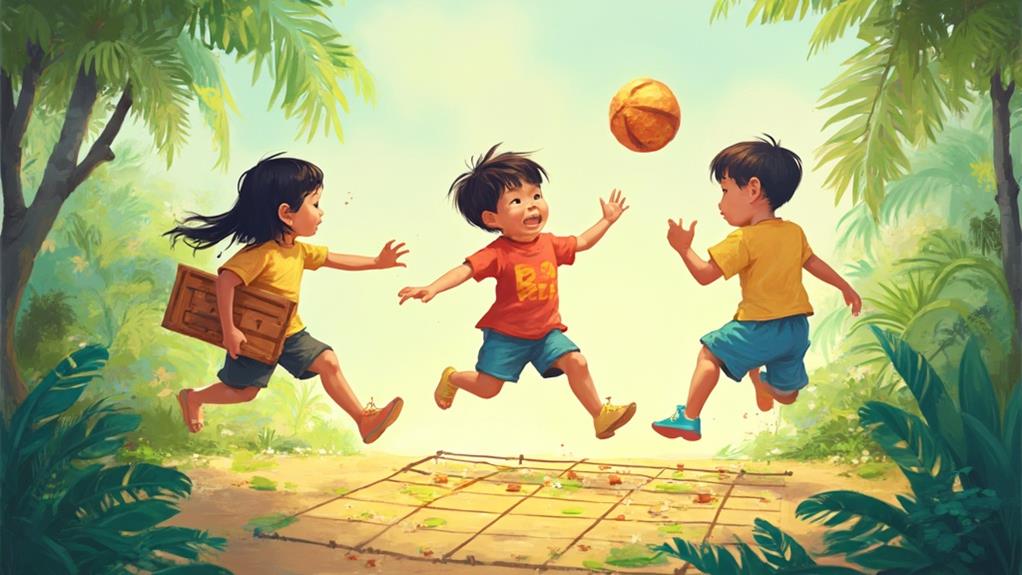
    Sungka promotes strategic thinking, while Patintero encourages teamwork, making these games both entertaining and enriching.

    Regional variations of these games reflect local traditions, adding to their cultural significance.

    However, urbanization and digital entertainment pose a threat to their relevance.

    Community advocacy and events are crucial in keeping these games alive, ensuring that a vital part of Filipino cultural identity remains vibrant and cherished.

    Cultural Importance of Traditional Games

    heritage through traditional games

    Traditional Filipino games are a vital part of the country's cultural heritage. These games, such as Sungka, Patintero, and Sipa, embody values that connect generations and communities, fostering community bonding and social interaction. By engaging in these games, players reinforce connections with one another and instill pride in their heritage.

    These games promote teamwork and resourcefulness. They often utilize locally sourced materials, reflecting the creativity inherent in Filipino culture and emphasizing the importance of indigenous practices passed down through generations.

    Events like Palaro ng Lahi ensure these games remain celebrated and relevant in today's society.

    Participating in traditional games contributes to physical fitness and cognitive development for children. The blend of physical activity and strategic thinking in games like Patintero and Sipa sharpens children's skills, making these games an essential aspect of holistic childhood development.

    By embracing these games, Filipinos are preserving a rich tapestry of storytelling and folklore, ensuring the vibrancy of Filipino culture continues to thrive.

    Overview of Popular Games

    Traditional Filipino games are more than just entertainment; they foster community bonding and showcase cultural identity.

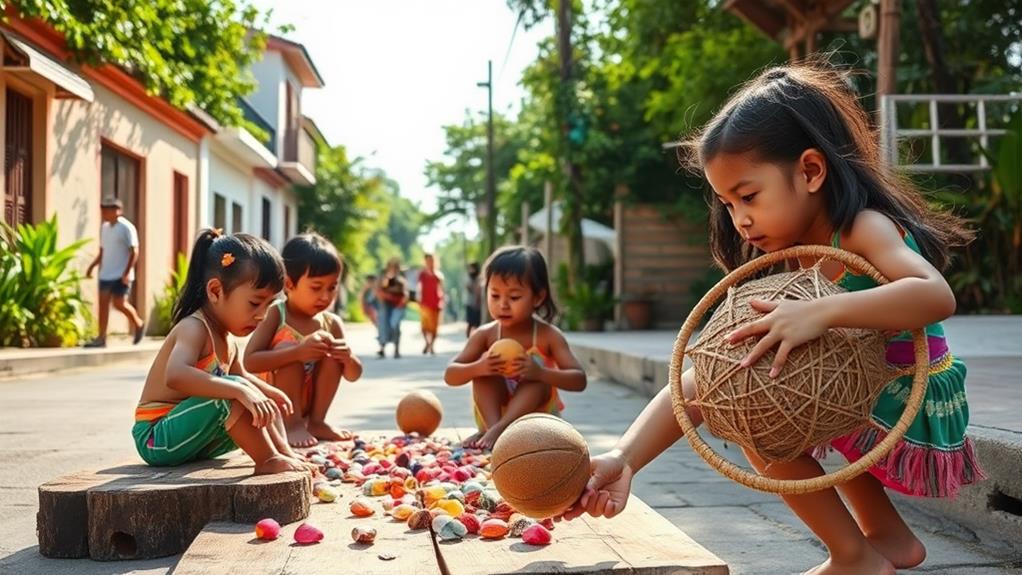
    Sungka, a popular traditional game, requires strategic thinking as players maneuver shells or seeds across a wooden board to outsmart their opponents. This game embodies critical thinking and problem-solving skills.

    Patintero, another well-known game, emphasizes teamwork as players navigate designated lines while avoiding tags. This game fosters camaraderie and communication among participants.

    Sipa, a fast-paced game, showcases agility and coordination as players kick a rattan ball to keep it airborne. This game demonstrates quick reflexes and spatial awareness.

    What's remarkable about these traditional games is that they utilize simple, locally available materials, highlighting the ingenuity and resourcefulness inherent in Filipino culture.

    They reinforce cultural identity and create shared experiences that bond communities together. By participating in these games, players are preserving an important aspect of heritage, ensuring that the spirit of Filipino culture thrives across generations.

    Mechanics of Key Games

    game design fundamentals explained

    Traditional Filipino games embody strategic depth and social dynamics.

    In Sungka, a two-player game, strategy is key as players manipulate 49 shells across a board with 14 holes. To win, players must select holes to maximize their captures while anticipating their opponent's moves.

    Teamwork and agility are essential in Patintero.

    In this game, teams plot their approach to cross designated lines without being tagged by defenders. Success depends on devising clever maneuvers and coordinating with teammates to outsmart the opposing side.

    Sipa showcases agility and coordination.

    Players keep a washer or rattan ball airborne using their feet, displaying skill and competing with friends. Each kick requires precision, and maintaining control fosters a sense of friendly rivalry.

    The mechanics of these games reflect cultural values, emphasizing strategy, teamwork, and social interaction.

    Each game contributes to the rich tapestry of Filipino culture, embodying the essence of traditional Filipino games.

    Physical Activity and Social Interaction

    Filipino Games: Boosting Physical Fitness and Social Interaction

    Engaging in traditional Filipino games like Sungka, Patintero, and Sipa offers a unique combination of physical activity and social benefits. By participating in these games, individuals can enhance their physical fitness levels while fostering meaningful connections within their community.

    Benefits of Filipino Games

    Game Benefits
    Sungka Promotes social engagement and strategy
    Patintero Enhances communication and teamwork
    Sipa Improves coordination and community bonding

    Patintero: A Game of Strategy and Communication

    In Patintero, players must strategize and communicate effectively to succeed. This not only keeps players physically active but also promotes social interaction among teammates. Effective communication is key to winning the game, as players need to work together to outmaneuver their opponents.

    Sungka: Fostering Social Engagement

    Sungka encourages social gatherings, allowing players to share experiences and create lasting relationships. The game's social nature strengthens community bonds, as players often gather to play and socialize.

    Sipa: Building Community Bonds

    Sipa, often played in public spaces, cultivates community bonding by bringing people together to enjoy the challenge and excitement of the game. Playing Sipa in public spaces promotes a sense of community, as players and spectators alike come together to enjoy the game.

    The Communal Nature of Filipino Games

    The communal nature of these Filipino games reinforces cultural values, creating a sense of belonging that transcends mere competition. By engaging in these activities, individuals participate in a vital tradition that strengthens community ties and celebrates their shared heritage.

    Unique Regional Variations

    cultural distinctions across regions

    Regional Variations Enrich Traditional Filipino Games

    Traditional Filipino games are more than just physical activities and social interactions; they also showcase the country's rich cultural diversity.

    Each game adapts to its local context, creating unique regional variations that reflect community dynamics.

    Take Sungka, a popular counting game, for example. In certain regions, boards are crafted from different materials like seashells or stones, altering the gameplay experience.

    Patintero, a classic tag game, varies widely across regions. Local rules dictate the number of players, specific strategies for crossing lines, and even distinct tagging styles.

    In Sipa, a game similar to badminton, adaptations involve different types of balls or shuttlecocks, such as rattan or rubber, influencing play style and skill development.

    Games like Agawan Base emphasize local preferences through regional rules that change base locations and tagging methods.

    Even game names can differ, as Tumbang Preso might be called presohan in some areas, showcasing linguistic diversity.

    These regional variations not only enrich the cultural tapestry but also strengthen community bonds through shared yet unique experiences.

    Modern Challenges and Advocacy

    Traditional Filipino games face significant modern challenges that threaten their survival.

    These challenges manifest in several ways:

    • Urbanization and lifestyle changes have led to decreased outdoor play, as children spend more time indoors and in front of screens.
    • Digital entertainment competes for children's attention, distracting them from traditional games and outdoor activities.
    • Limited awareness of cultural heritage among younger generations means they may not understand the significance of these games.
    • Inadequate community spaces make it difficult for traditional games to thrive.

    Organizations like the Magna Kultura Foundation are working to combat these issues.

    They advocate for the integration of traditional games into educational programs and community events, ensuring that kids understand their cultural significance.

    For example, the Palaro ng Lahi initiative, launched in 1984, emphasizes the importance of these games in physical education, helping to revitalize interest in outdoor play.

    Social media campaigns and local festivals also play a crucial role.

    They foster a sense of pride in Filipino culture, encouraging more families to participate in traditional activities.

    Skill Development Through Play

    learning skills via play

    Traditional Filipino games are valuable tools for skill development. Playtime isn't just for entertainment; it's an opportunity to hone critical thinking skills, foster collaboration, and improve physical fitness.

    Critical thinking skills are developed through games like Sungka. When playing Sungka, you strategize to capture the most seeds, honing your analytical abilities essential for problem-solving in various aspects of life.

    Teamwork and collaboration are fostered through games like Patintero. In Patintero, you coordinate with teammates to navigate obstacles and avoid being tagged, strengthening your collaboration skills and teaching you the importance of communication and cooperation.

    Physical fitness and motor skills are improved through games like Sipa. Mastering Sipa, where you keep a rattan ball airborne, challenges your agility and coordination, improving your overall physical fitness.

    Similarly, playing Piko cultivates precision and spatial awareness, as you learn to toss your cue ball accurately onto designated squares.

    Emotional intelligence is developed through social interactions and shared experiences. Through these traditional games, you build relationships, developing emotional intelligence and shaping well-rounded individuals.

    How Does Traditional Filipino Games Compare to Mobile Legends: Bang Bang in terms of Keeping Culture Alive?

    Traditional Filipino games hold a significant place in Filipino culture, fostering values of teamwork, resilience, and sportsmanship. On the other hand, the impact of mobile legends on filipino gamers has introduced a new form of entertainment, possibly impacting the popularity of traditional games. However, both play a role in preserving the country’s rich cultural heritage.

    How Are Traditional Filipino Games Like Sungka and Patintero Connected to Philippine Mats and Weaving Traditions?

    Traditional Filipino games such as Sungka and Patintero are deeply connected to Philippine mats and weaving traditions. These games are often played on intricately woven mats, showcasing the skill and artistry of Filipino weavers. The intricate patterns of philippine mats are a reflection of the rich cultural heritage of the Philippines.

    Games for All Ages

    Traditional Filipino games like Sungka, Patintero, and Sipa bring people together across generations, creating a vibrant tapestry of community interaction. These games aren't limited to children; they foster intergenerational bonding, allowing everyone to participate and enjoy.

    Inclusivity is a key factor in their widespread appeal. These games welcome participants of varying ages, ensuring everyone can join in the fun. For example, Sungka can be played by both children and adults, promoting a sense of community and togetherness.

    Games like Sungka enhance critical thinking and mathematical skills, making them intellectually engaging for both kids and adults. This is because Sungka requires players to strategize and think critically to win.

    Patintero promotes cooperation, making it a hit during community gatherings, where teamwork becomes essential. Players must work together to block their opponents, developing essential communication and collaboration skills.

    Sipa encourages fitness and agility, appealing to families who enjoy active play. This traditional game involves hitting a ball with the feet, promoting physical activity and coordination.

    These games serve as more than just entertainment; they preserve cultural heritage by imparting values and customs. As you gather with friends and family to play, you're not only having fun but also keeping your community's rich traditions alive.

    Traditional Filipino games like these create lasting connections, bridging the gap between young and old while celebrating a shared cultural legacy.

    Efforts in Cultural Preservation

    cultural heritage conservation initiatives

    Efforts to preserve traditional Filipino games have gained significant momentum in recent years. Organizations like the Magna Kultura Foundation are leading this movement by promoting these games through community events and educational initiatives.

    For instance, they focus on preserving games such as Sungka, Patintero, and Sipa, ensuring they remain vibrant and relevant.

    The Palaro ng Lahi initiative integrates traditional games into physical education programs. Launched in 1984, this initiative fosters heritage awareness among youth.

    Local governments collaborate with cultural organizations to hold festivals and tournaments, celebrating these games and encouraging intergenerational participation.

    Schools are incorporating traditional Filipino games into their curricula. This approach reinforces the importance of cultural heritage while promoting physical activity.

    Additionally, digital platforms and social media campaigns enhance accessibility, modernizing traditional gameplay and reaching a wider audience.

    By participating in these activities, individuals contribute to the ongoing narrative of Filipino culture, ensuring its legacy thrives for future generations.

    Questions and Answers

    What Is the Cultural Significance of Sungka?

    Sungka's cultural significance stems from its unique blend of history and community engagement. The game has been a part of Filipino traditions for centuries, bringing people together and fostering social connections.

    As a game that encourages strategic thinking, sungka helps develop critical thinking skills and problem-solving abilities.

    Sungka reflects cultural heritage by showcasing historical origins and modern adaptations. The game's evolution over time demonstrates the dynamic nature of Filipino culture, adapting to changing times while preserving its roots.

    Through sungka, players learn about their cultural history and its significance in modern times.

    Sungka serves as a tool for skill development and educational benefits. The game teaches various math concepts, such as counting, addition, and subtraction, in an engaging and enjoyable way.

    Playing sungka helps children develop their math skills, making it an effective educational tool.

    Sungka fosters social interactions and community building. The game is often played in groups, promoting social bonding and friendly competition.

    Through sungka, players develop essential social skills, such as communication, teamwork, and sportsmanship.

    What Is the Traditional Game Sungka in the Philippines?

    What Is Sungka?

    Sungka is a traditional Filipino game played on a wooden board with two rows of holes filled with pebbles or shells.

    Objective and Strategies

    The objective of Sungka is to outsmart your opponent by developing strategies to collect more pebbles or shells than them.

    To achieve this, players must follow specific rules and think analytically to win.

    History and Popularity

    Sungka has a rich history and variations that have made it popular across different ages.

    It fosters community spirit through tournaments, connecting people to a vibrant cultural legacy shared by many players.

    Cognitive Benefits

    Engaging with Sungka not only sharpens analytical skills but also promotes strategic thinking and problem-solving abilities.

    What Is the Traditional Filipino Game Patintero?

    Patintero is a traditional Filipino game that emphasizes community engagement and strategy.

    In this game, players navigate lines while avoiding defenders, utilizing clever strategies to outsmart their opponents. The game requires players to think critically and make quick decisions to win.

    Patintero has a rich history, with various adaptations and rules that enhance its popularity at local tournaments.

    The game is often played in local communities, with each region having its own unique rules and variations. This adaptability has contributed to the game's enduring popularity.

    The equipment required to play Patintero is simple, often just chalk or string.

    The minimal equipment needed makes it accessible to people of all ages and backgrounds, allowing anyone to participate and enjoy the game.

    Playing Patintero has several benefits, including improved physical fitness and teamwork.

    The game requires players to be physically active, promoting overall fitness and health.

    Additionally, Patintero encourages teamwork and communication among players, fostering social bonds and camaraderie.

    What Are the Traditional Filipino Games or Indigenous Games in the Philippines Commonly?

    Traditional Filipino games offer a diverse range of activities that promote physical and mental skills.

    One popular game is Luksong Baka, where players take turns jumping over each other, promoting agility and coordination.

    Another game, Tumbang Preso, requires players to knock down a can with a slipper, developing hand-eye coordination and throwing skills.

    Games that challenge agility and strategy include Piko and Agawan Base.

    Piko Game requires players to hop on one foot while moving around a series of squares drawn on the ground, testing their balance and agility.

    Agawan Base, on the other hand, is a tag game that requires strategy and quick thinking to capture the opposing team's base.

    Games that focus on flexibility and coordination include Chinese Garter and Luksong Tinik.

    Chinese Garter involves players jumping over a garter while performing different movements, such as skipping and hopping.

    Luksong Tinik, a variation of tag, requires players to jump over a "tinik" (a small obstacle) while chasing each other.

    Other traditional Filipino games include Sipa Ball, Bati Cobra, and Pabitin Festival.

    Sipa Ball is a game that showcases coordination and throwing skills, where players hit a ball with their feet or knees.

    Bati Cobra adds excitement with its fast-paced gameplay, where players try to hit a ball with a long stick.

    Pabitin Festival is a festive celebration that features various games and activities, including Sipa Rung, a game that requires agility and coordination to hit a ball with a long stick.

  • Traditional Filipino Games: Sungka, Patintero, Sipa

    Traditional Filipino Games: Sungka, Patintero, Sipa

    Traditional Filipino games like Sungka, Patintero, and Sipa are important parts of the country's cultural heritage. These games have been passed down through generations, teaching cultural values and preserving cultural identity. They also educate children about history and folklore, and bridge generational gaps.

    Sungka is a game that requires strategy and critical thinking. Players must think carefully about their moves to win, making it an excellent way to develop problem-solving skills.

    In Sungka, players move stones or shells around a board, trying to capture more pieces than their opponent. This game is often played by adults and children together, promoting family bonding and social interaction.

    Patintero is a high-energy game that requires teamwork and quick thinking. Players must work together to tag each other while avoiding being tagged themselves.

    In Patintero, two teams of players stand in lines, trying to tag each other while avoiding being tagged themselves. This game is an excellent way to promote physical fitness and coordination.

    Sipa is a game that requires agility and coordination. Players must hit a small object with their feet, similar to hacky sack.

    In Sipa, players hit a small rattan ball with their feet, trying to keep it in the air as long as possible. This game is an excellent way to promote physical fitness and hand-eye coordination.

    These traditional Filipino games continue to play a vital role in community bonding and cultural expression. They bring people together, promote social interaction, and preserve cultural heritage.

    By playing these games, people can learn about Filipino culture and history, and develop important skills like critical thinking and teamwork.

    Cultural Significance of Games

    Traditional Filipino games hold significant cultural value. These games, such as Sungka, Patintero, and Sipa, are more than just entertainment; they play a crucial role in instilling cultural values and promoting a sense of community among players.

    The blend of indigenous and colonial influences in these games showcases the diversity and richness of Filipino heritage.

    Engaging in traditional games helps children learn about their history and folklore, which helps preserve cultural identity. For example, Sungka, a game of shells, teaches children about the importance of strategy and critical thinking.

    Social interaction fostered by these games encourages teamwork and cooperation, essential skills for community building. In Patintero, a game of tag, children learn to work together to outmaneuver their opponents.

    Traditional games serve as a bridge between generations, allowing elders to pass down cultural knowledge and practices to the youth. This transmission of cultural values helps to preserve cultural knowledge and traditions.

    In conclusion, traditional Filipino games aren't just fun activities, but also a means of transmitting cultural values and preserving cultural knowledge.

    Types of Traditional Filipino Games

    Traditional Filipino games can be categorized into three main types: Larong Bahay, Street Games, and Festival Games. These categories reflect distinct social contexts and play environments.

    Larong Bahay refers to indoor games played at home, often requiring minimal equipment. Sungka, a popular Filipino board game, is an example of a Larong Bahay game. It involves moving stones or beads around a wooden board, requiring strategy and skill.

    Street Games are outdoor games played in public spaces, such as streets, parks, or playgrounds. Patintero, a high-energy game, is a classic example of a Street Game. It involves two teams trying to outmaneuver each other, with one team attempting to cross the opponent's territory without getting caught.

    Festival Games are played during local festivities and cultural events. These games often involve community participation and showcase Filipino culture. Examples of Festival Games include Pinoy Henyo, a guessing game, and Trip to Jerusalem, a musical chair game.

    Game Classification Systems

    Traditional Filipino games can be categorized into three main classification systems, each reflecting the country's diverse cultural heritage and offering unique gameplay experiences.

    Larong Bahay games are typically played indoors and require strategy and skill. Examples of these games include Sungka and Dama, which involve clever thinking and problem-solving, making them a great way to develop critical thinking.

    Street Games are played outdoors and emphasize physical activity, teamwork, and community interaction. Examples of these games include Patintero and Luksong Tinik, which promote social bonding and physical fitness by utilizing available materials.

    Festival Games are often played during local fiestas and celebrations, highlighting cultural traditions and community spirit. Examples of these games include Palo Sebo and Tug of War, which showcase the cultural significance of traditional Filipino games.

    Outdoor Play Variations

    Beyond indoor games, traditional Filipino outdoor play variations offer a unique brand of excitement and entertainment.

    These games often involve team dynamics, requiring players to work together and think strategically.

    Patintero is a notable example, where players must cross lines while avoiding being tagged by defenders, promoting agility and quick thinking.

    Another example is Sipa, the national sport, which involves kicking a washer or rattan ball to keep it airborne, emphasizing agility and coordination in a competitive setting.

    Tumbang Preso is another outdoor game that incorporates elements of strategy and physical skill, where players hit a tin can with slippers while racing to a designated base.

    Luksong Tinik requires players to jump over obstacles created by others, promoting physical fitness and teamwork.

    Even Sungka, typically played indoors, can be adapted for outdoor settings, where players capture more seeds than the opponent using strategic placement and moves.

    Sungka: Game Mechanics and Strategies

    sungka gameplay strategies explained

    Game Overview

    The Sungka board consists of a wooden slate with 14 holes, divided into two rows of seven holes called "bahay." The game starts with 49 small pebbles or shells distributed evenly between the two rows. The objective is to capture more seeds than your opponent by strategically moving them around the board.

    Game Mechanics

    The game is played in turns, with each player scooping seeds from one hole and distributing them counter-clockwise. The goal is to land the last seed in your bahay, which allows you to capture the seeds in that hole. The game ends when all seeds are captured.

    Strategies

    To win, anticipate your opponent's next move and calculate your moves to land in your bahay. Adapt your strategy based on your opponent's moves, and use critical thinking to outmaneuver them.

    Regularly playing Sungka enhances mathematical skills, such as counting and basic arithmetic.

    Gameplay and Benefits

    Sungka is typically played by two players but can be adapted for more players, making it an excellent addition to family gatherings or community events.

    Playing Sungka develops critical thinking and mathematical skills, making it an engaging and educational traditional Filipino game.

    Patintero: Game Overview and Variations

    Patintero: A Traditional Filipino Game of Strategy and Speed

    In Patintero, two teams compete in a classic Filipino outdoor game that requires speed, strategy, and cunning. The game takes place on a rectangular grid marked on the ground, with two parallel lines serving as the boundary for the defenders.

    Key Skills for Success

    To succeed in Patintero, players must employ various tactics to evade tagging, including:

    Feints and Misdirection: Quick movements are used to deceive opponents and create opportunities to cross the grid. For example, a player might pretend to move in one direction, then suddenly change course to evade a defender.

    Teamwork and Communication: Players must coordinate with their teammates to distract opponents and create openings. This can be achieved by having one player create a diversion while another player makes a break for the other side of the grid.

    Adapting to Variations: Players must be prepared to adjust their strategy based on local rules and modifications that can alter gameplay dynamics. For instance, some variations may allow players to use obstacles to evade tagging, while others may have additional rules for scoring points.

    Benefits of Playing Patintero

    Playing Patintero develops essential skills like teamwork, communication, and physical fitness, making it an integral part of Filipino cultural heritage.

    This outdoor game has been enjoyed by Filipino children for generations, promoting a sense of community and camaraderie.

    Sipa: History and Cultural Impact

    sipa s historical cultural significance

    Sipa's Rich Cultural Heritage

    Sipa, a traditional Filipino game, holds a special place in the country's cultural heritage. Its origins date back to pre-colonial times, showcasing the Filipino community's creativity in utilizing available materials for play, such as using a washer or rattan ball.

    Reflecting Cultural Heritage and History

    Sipa reflects the country's rich cultural heritage and history of indigenous games. The game emphasizes agility and coordination through kicking, promoting physical fitness and overall well-being.

    Fostering Community and Social Interaction

    Engaging in Sipa fosters a sense of community as players engage in teamwork and shared experiences, enriching their understanding of cultural expression.

    The game encourages social interaction and teamwork, making it a popular choice among children and communities during outdoor gatherings.

    Preserving Cultural Significance

    Sipa's cultural impact is further solidified by its adaptation into various formats, including competitive tournaments, which help preserve its cultural significance and promote physical fitness among the youth.

    Traditional Games for Physical Fitness

    Traditional Filipino Games for Physical Fitness

    Engaging in traditional Filipino games like Sungka, Patintero, Sipa, and Luksong Tinik is a fun and interactive way to improve physical fitness. These games require strategic movements, hand-eye coordination, and cardiovascular endurance, making them an excellent way to celebrate cultural heritage and promote a sense of community among participants.

    Improved Physical Fitness

    Traditional Filipino games can improve physical fitness in three ways:

    1. Enhanced Coordination and Agility

    Games like Patintero and Sungka require quick reflexes and rapid movements, which can improve hand-eye coordination and agility. For instance, Patintero involves dodging and catching balls, enhancing reaction time and fine motor skills.

    2. Increased Cardiovascular Endurance

    Outdoor games like Luksong Tinik and Sipa involve running, jumping, and kicking, which can boost cardiovascular endurance and overall fitness level. Luksong Tinik, for example, requires players to jump over a series of lines, increasing heart rate and improving cardiovascular health.

    3. Improved Lower Body Strength

    Playing Sipa, which involves kicking a washer, can strengthen lower body muscles, including legs and glutes. Regularly playing Sipa can lead to improved muscle tone and overall lower body strength.

    Social Benefits

    These traditional games promote teamwork and cooperation, encouraging players to work together to achieve a common goal.

    This social aspect can motivate individuals to engage in physical activity more regularly, leading to a healthier lifestyle. By playing together, individuals can develop a sense of camaraderie and accountability, making physical fitness more enjoyable and sustainable.

    Strategy and Guessing Games

    tactical play and prediction

    Traditional Filipino strategy and guessing games require skill, wit, and social interaction, providing entertainment and reflecting the country's rich cultural heritage. Pitik-Bulag is a classic example, where players must use keen observation and deduction to identify who flicked them. In this game, players are blindfolded and must rely on their sense of touch to figure out who touched them, promoting social interaction and clever guessing techniques.

    In contrast, games like Bulong-Pari emphasize teamwork and clever tactics. In this game, one player whispers a message to another, and the other players must work together to uncover the identity of the whispered player. This game requires strategic thinking, effective communication, and problem-solving skills.

    Guessing Techniques

    Traditional Filipino games often involve guessing techniques, which challenge players to think critically and strategically. These games require players to think on their feet, making them an excellent way to develop problem-solving skills and reflexes.

    To excel in these games, players must employ various guessing techniques. Observation is one technique, where players pay attention to subtle cues, like body language and tone of voice, to gain an advantage. For example, in Patay Patayan, players observe their opponents' reactions to guess who's the "killer".

    Deductive reasoning is another technique, where players use logic to eliminate possibilities and narrow down options. In Pitik-Bulag, players use deductive reasoning to figure out who's the "stone" by process of elimination.

    Pattern recognition is also essential, where players identify patterns in their opponents' behavior to anticipate their next move. In Jack n Poy, players recognize patterns in their opponents' throwing styles to guess where the ball will land.

    Games like Agawan Base and Langit-Lupa also require strategy and guessing, as players must navigate to safety while avoiding being tagged by their opponents.

    Bulong-Pari Strategies

    Bulong-Pari Strategies

    Effective Communication is Key

    In the traditional Filipino guessing game Bulong-Pari, strategic thinking and clever communication between teammates are essential to win. To succeed, teammates must decide how to convey hints and interpret the clues given by each other.

    Balancing Information Sharing

    When playing Bulong-Pari, it is crucial to balance the level of information shared with your team against the risk of revealing too much to the opposing team.

    Employing Clever Strategies

    To outsmart opponents, players can employ various strategies, including:

    Strategy Description Effectiveness
    Bluffing Mislead the opposing team by providing false clues High
    Code Breaking Use patterns and associations to decipher clues Medium
    Elimination Systematically eliminate possibilities to narrow down options Low

    Benefits of Playing Bulong-Pari

    Bulong-Pari is an excellent way to foster social interaction, enhance cognitive skills, and promote strategic thinking.

    Teks Game Variations

    The Teks Game, a traditional Filipino card game, offers various modifications that cater to different player preferences and skill levels.

    Scoring System Variations alter the game's pace and strategy. Assigning different point values to cards or areas of the playing surface is one way to change the scoring system. For example, players can assign higher points to rare cards or specific areas of the playing surface.

    Card Combination Variations introduce new challenges and opportunities. Using multiple decks, removing certain cards, or introducing special "wild" cards are ways to experiment with different card combinations. This variation encourages strategic thinking and adaptability.

    Gameplay Variations change the environment and rules of the game. Playing the game outdoors, like Sipa, or modifying rules to promote hand-eye coordination and quick thinking are examples of gameplay variations. These variations promote social interaction, creativity, and quick thinking.

    These variations enhance the Teks Game experience by promoting strategic thinking, social interaction, and creativity among players.

    Tag and Team-Based Games

    Traditional Filipino games promote physical activity, strategy, and social interaction. These tag and team-based games are often played during community gatherings and festivities, showcasing the vibrant culture of the Philippines.

    Patintero is a team-based game that requires strategy and quick thinking. In this game, one team tries to block the other from crossing their lines while avoiding being tagged.

    Agawan Base is a popular tag game that demands agility and clever tactics. Players exchange places and must avoid being tagged by the opposing team while trying to secure their base.

    Luksong Tinik requires agility and jumping skills. In this game, players must jump over a base formed by two players' feet and hands, increasing in difficulty as more players join in.

    Lagundi promotes agility and quick reflexes. This team-based tag game involves passing a ball to touch opponents' heads.

    Langit-Lupa requires speed and strategy. Players can run on the ground or climb over objects to avoid being tagged, with the tagger limited to tagging those on the ground only.

    These tag and team-based games offer numerous benefits. They're an excellent way to stay active, develop teamwork skills, and have fun with friends and family.

    What is the significance of traditional Filipino games to the culture, similar to the impact Manny Pacquiao has had on Filipino culture through boxing?

    Traditional Filipino games hold a special place in the culture, reflecting the community spirit and values of Filipinos. Similarly, manny pacquiao’s boxing legacy has had a profound impact, inspiring and uniting people across the nation. Both showcase the resilience and unity that are deeply rooted in Filipino culture.

    Outdoor and Target Games

    recreational sports and activities

    Filipino Outdoor and Target Games: Building Skills and Community

    Traditional Filipino outdoor and target games, like Kalahoyo and Siklot, are designed to develop essential skills such as accuracy and hand-eye coordination using simple materials like stones and holes.

    These games require physical activity, strategic thinking, and teamwork to achieve a common goal, reflecting cultural practices and values.

    Popular Outdoor and Target Games in the Philippines

    Tumbang Preso is a game that promotes teamwork and strategy, where players need to knock down a tin can with slippers while trying to reach a designated base.

    Luksong Tinik is another popular game that involves jumping over a base formed by two players' feet and hands, increasing in difficulty as you advance.

    Palosebo, a popular festival game, challenges players to climb a greased bamboo pole to reach a prize, showcasing physical strength and agility.

    Games like Tinikling, which involves dancing between clapping bamboo poles, require coordination and rhythm to avoid getting caught, thus enhancing physical fitness and social interaction.

    These traditional Filipino games provide entertainment while developing important skills that benefit many areas of life.

    Preserving Cultural Heritage Through Play

    Traditional Filipino games preserve cultural heritage through play. These games impart cultural values, foster community, and promote collaborative play. By participating in these games, you promote cultural expression through movement, reflecting the diverse influences of Filipino history.

    Games like Sungka, which uses native materials like shells or pebbles, encourage resourcefulness and creativity. This links players to their cultural heritage and preserves indigenous practices and storytelling, often accompanied by songs and local lore, enhancing cultural identity.

    Traditional games provide opportunities for social interaction and teamwork, crucial for developing socio-emotional skills in Filipino children. They reinforce community bonds, helping to ensure that these practices remain relevant for future generations, and that the cultural heritage of the Filipino people continues to thrive.

    Conclusion

    Traditional Filipino games hold significant cultural value. Beyond entertainment, games like Sungka, Patintero, and Sipa embody cultural values, social norms, and historical context. Sungka, for instance, promotes strategic thinking and math skills, as players move stones or beads around a wooden board, requiring calculation and problem-solving. Patintero, on the other hand, emphasizes teamwork and communication, as two teams of players try to outmaneuver each other, highlighting the importance of cooperation and coordination. Sipa, a traditional Filipino game similar to sepak takraw, values physical fitness and agility, as players hit a rattan ball with their feet, promoting physical activity and coordination. By engaging with these games, individuals not only have fun but also preserve cultural heritage and foster a deeper understanding of the Filipino identity.

  • Other Popular Sports in the Philippines: Volleyball, Football, Etc

    Other Popular Sports in the Philippines: Volleyball, Football, Etc

    Other popular sports in the Philippines have gained significant traction in recent years.

    Volleyball has become a leading sport, especially among women. The sport has evolved with prominent players and collegiate leagues promoting teamwork and physical fitness.

    Football’s popularity surged after the women’s team qualified for the FIFA Women’s World Cup 2023. This achievement ignited national pride and interest in the sport.

    Traditional Filipino sports like Arnis, Dumog, and Sipa hold cultural value and foster community bonding.

    These sports have been part of the country’s heritage and continue to be played and enjoyed by many Filipinos.

    Volleyball’s Rise to Popularity

    Volleyball’s Rise to Popularity in the Philippines

    Volleyball’s popularity in the Philippines began in 1910 and has since evolved into one of the country’s most popular sports, particularly among women.

    This growing interest in volleyball parallels the increasing appreciation for cultural activities, such as traditional Philippine folk dances, which also foster teamwork and community engagement.

    The Philippine National Volleyball Federation oversees the sport, organizing major events like the University Athletic Association of the Philippines (UAAP) and National Collegiate Athletic Association (NCAA) volleyball tournaments.

    These tournaments draw large crowds and viewership.

    The women’s team has significantly contributed to the sport’s growing popularity, especially after their qualification for the 2023 FIVB Volleyball World Championship.

    Household names like Alyssa Valdez and Jaja Santiago have contributed to the sport’s visibility and popularity through their performances and social media presence.

    With a growing number of recreational leagues and grassroots programs, volleyball is increasingly seen as a means to promote physical fitness and teamwork among the youth in the country.

    Volleyball has become an integral part of the country’s sporting landscape.

    Football’s Growing Fan Base

    Football’s popularity is surging in the Philippines, with its fan base growing rapidly across the country. This significant shift in interest can be attributed to the national women’s team’s historic qualification for the FIFA Women’s World Cup in 2023, which sparked nationwide enthusiasm for the sport.

    Football is fostering a sense of community among fans and players alike, similar to cultural events like the Kadayawan Festival, which celebrates unity and cultural heritage.

    Youth engagement programs and grassroots initiatives are taking root, ensuring football’s long-term presence in the Philippines’ sports scene.

    Rise of Football Fans

    Rise of Football Fans in the Philippines

    The Philippines is experiencing a rapid growth in football popularity, driven by a combination of local and international factors. One significant contributor to this growth is the historic achievement of the national women’s team qualifying for the FIFA Women’s World Cup 2023, sparking interest and pride among Filipinos.

    National Team’s Success

    The women’s team’s achievement has encouraged more people to follow the sport. This success has instilled a sense of national pride, motivating fans to support the team and increasing interest in the sport.

    Philippine Football League (PFL)

    Established in 2017, the PFL has created a more structured and professional landscape, drawing in local fans and increasing participation at the grassroots level.

    This has led to a more organized and competitive league, which has attracted more fans and encouraged youth engagement.

    International Influence

    The global popularity of football, combined with the influence of international leagues and tournaments, has contributed to the growing fan base in the Philippines.

    International competitions, such as the English Premier League and the UEFA Champions League, have increased football’s exposure and appeal to Filipino audiences.

    Youth Engagement and Social Media

    Grassroots programs and leagues have encouraged youth engagement, while social media and digital platforms have expanded football’s reach, enabling fans to connect with international teams and access live match coverage.

    This has made it easier for fans to follow their favorite teams and players, increasing their enthusiasm for the sport.

    These factors have combined to create a vibrant football community in the Philippines, with a rapidly expanding fan base that’s eager to support local clubs and the national team.

    Growing Popularity Nationwide

    Football’s popularity has surged nationwide in the Philippines, driven by a significant increase in fan engagement and participation.

    The establishment of the Philippine Football League (PFL) in 2017 has fostered local talent and competition, contributing to this growth. Additionally, the Philippine women’s national football team’s historic qualification for the FIFA Women’s World Cup 2023 has boosted interest and support for the sport nationwide.

    Several factors have contributed to this surge in popularity. The PFL has led to local talent development and increased competition.

    Grassroots programs have increased youth participation, leading to a growing fan base. Moreover, the women’s national team’s historic World Cup qualification has boosted national interest.

    The growing fan base is reflected in increasing attendance at local matches and the rise of football academies, which aim to develop the skills of aspiring young athletes.

    Media coverage and sponsorship deals have also improved, with matches being broadcasted on various platforms, further engaging fans and elevating the profile of football in the Philippines.

    As a result, football fever is on the rise across the country.

    Youth Engagement Programs

    Youth engagement programs have been instrumental in cultivating a strong foundation for football in the Philippines. These initiatives have been crucial in promoting the sport among young people, fostering a growing fan base.

    Programs like the “Grassroots Football Program” introduce football to children in schools and communities, fostering a love for the game from an early age. This contributes to the growth of local talent and increased participation in competitive leagues and tournaments.

    The Department of Education has integrated football into its physical education curriculum, helping to cultivate skills and passion for the sport among students nationwide. This integration has played a significant role in promoting football among young people.

    The Philippine women’s national football team, known as the Malditas, qualified for the FIFA Women’s World Cup 2023, significantly inspiring youth participation and interest in football. This achievement has motivated young people to engage in the sport.

    Various football leagues and tournaments for youth, such as the Philippine Football Federation (PFF) Under-13 and Under-15 leagues, provide competitive opportunities for young players to develop their abilities and gain experience. These leagues have helped to increase youth participation in football.

    The Philippine Football League (PFL) provides a platform for local talent to shine, increasing the sport’s visibility and appeal to young fans. This platform has contributed to the growth of football’s popularity among young people.

    Traditional Filipino Sports Disciplines

    Traditional Filipino Sports Disciplines

    The Philippines boasts a rich cultural heritage, encompassing a diverse range of traditional sports disciplines that have been an integral part of the country’s identity for centuries.

    Martial Arts

    Arnis, recognized as the national martial art since 2009, is a traditional martial art that focuses on weapon-based combat, promoting Filipino heritage.

    Another traditional wrestling form, Dumog, emphasizes control and technique, utilizing various methods to pull and pin opponents in a display of skill.

    Festive Games

    In festive celebrations, participants engage in Palo-sebo, a climbing game where they attempt to scale a greasy bamboo pole to retrieve a reward bag at the top.

    Sikaran, originating from Rizal, is a unique martial arts discipline that utilizes kicking techniques, specifically targeting the opponent’s head with the Biakid kick.

    Traditional Games

    Sipa, a traditional game similar to sepak takraw, was played long before Spanish colonization. It involves kicking a metal washer or ball, showcasing agility and speed.

    These sports disciplines not only reflect the country’s history and culture but also highlight the Filipino people’s athleticism and competitive spirit.

    Notable Individual Sports Achievements

    The Philippines has a rich sports landscape marked by notable individual achievements.

    In boxing, Filipino champions like Manny Pacquiao and Nonito Donaire have symbolized bravery and resilience, bringing pride to the nation with their numerous championship titles.

    Figure skating has also seen significant milestones, with athletes like Michael Christian Martinez competing in the Winter Olympics and reflecting the rich cultural heritage of the Philippines.

    Rugby league has recently emerged as a new sport, further diversifying the country’s sports culture.

    Traditional practices like tattooing hold deep cultural significance, reminding us of the country’s rich history.

    These achievements haven’t only brought pride to the nation but have also inspired a new generation of athletes to strive for excellence.

    Boxing Champions’ Legacy

    The Philippines has a rich history of producing world-class boxing champions, leaving a lasting impact on the sport.

    The country has produced over 40 boxing world champions, with many more aspiring to follow in their footsteps. This impressive record is a testament to the nation’s boxing prowess.

    The Amateur Boxing Association of the Philippines plays a crucial role in governing amateur boxing and aims to secure the country’s first Olympic gold medal in the sport. This goal is a driving force behind the development of young Filipino boxers.

    Filipino boxers have made their mark on the international stage, sanctioned by the International Boxing Association (AIBA). This recognition has provided opportunities for Filipino boxers to compete against the best in the world.

    The legacy of Filipino boxing champions has significantly contributed to the sport’s popularity in the country, fostering national pride and inspiring a new generation of athletes.

    The achievements of champions like Manny Pacquiao and Nonito Donaire have cemented the Philippines’ reputation as a powerhouse in boxing, motivating others to strive for excellence.

    Figure Skating Milestones

    The Philippines has achieved significant milestones in figure skating, a winter sport.

    One notable achievement is Michael Christian Martinez becoming the first Southeast Asian figure skater to qualify for the Winter Olympics, competing in the 2014 Sochi Games.

    The Philippine Championship serves as the national competitive event for figure skating, showcasing the talent of local skaters and promoting the sport within the country.

    Despite limited ice skating rinks in the Philippines, primarily located in Metro Manila shopping malls, figure skating has grown as a niche sport.

    The opening of the first Olympic-sized ice rink at SM Mall of Asia has provided a venue for aspiring figure skaters to train and compete.

    Filipino figure skaters have participated in various international competitions, with athletes like Martinez inspiring a new generation of skaters in the country.

    Rugby League Emergence

    Rugby League Emergence in the Philippines

    By 2012, rugby league had finally arrived in the Philippines, marking the emergence of a new team sport in the country.

    The Philippine National Rugby League (PNRL) oversees the development and competitions of rugby league in the country.

    International Participation

    The national team, the Philippine Tamaraws, has been participating in international tournaments, showcasing local talent on the global stage. This exposure has helped to raise the profile of rugby league in the Philippines.

    Grassroots Development

    Grassroots initiatives and local leagues have contributed to the sport’s growth in schools and communities. These efforts have helped to increase participation and develop local talent.

    Support from the Philippine Rugby Football Union

    The Philippine Rugby Football Union (PRFU) supports the development of rugby league alongside rugby union, promoting both codes of the sport within the country. This support has been instrumental in the growth of rugby league in the Philippines.

    New Opportunities for Filipino Athletes

    Rugby league has been making strides in sport development, providing new opportunities for Filipino athletes to excel. The sport has opened doors for athletes to compete at the national and international levels.

    Dedication and Passion

    The sport’s emergence has been driven by the dedication and passion of its players, coaches, and fans. This enthusiasm has helped to create a strong foundation for the sport in the Philippines.

    Team Sports and Domestic Leagues

    competitive teamwork in leagues

    Domestic Leagues Drive Team Sports in the Philippines

    Team sports are a vital part of the Philippines’ sports landscape, and domestic leagues play a crucial role in fostering a strong following and nurturing local talent. Volleyball, Football, and Basketball are the most popular team sports in the country.

    League and Federation Overview

    Sport League/Federation Notable Achievements
    Volleyball Philippine National Volleyball Federation Collegiate competitions, national team tournaments
    Football Philippine Football League National women’s team qualified for FIFA Women’s World Cup 2023
    Basketball Philippine Basketball Association (PBA) Asia’s oldest professional league, Gilas Pilipinas men’s national team
    Basketball Gilas Pilipinas Competed in Summer Olympics since 1936, hosted FIBA World Cup 2023
    Multi-Sport Palarong Pambansa, Philippine National Games Promotes grassroots participation, talent development for youth and amateur athletes

    Contribution to the Country’s Sporting Culture

    These domestic competitions and leagues have contributed to the country’s rich sporting culture, providing opportunities for athletes to develop their skills and represent the Philippines on the international stage.

    International Sports Participation Highlights

    The Philippines has made significant strides in international sports participation.

    The country has qualified for the FIFA World Cup and competed in the AFC Asian Cup through its national football team, the Azkals. Additionally, the women’s team made history by qualifying for the FIFA Women’s World Cup in 2023.

    The Philippines has participated in the Asian Volleyball Championships and the FIVB Volleyball World Championship. Local clubs often represent the nation in these competitions.

    Gilas Pilipinas, the Philippine men’s national basketball team, has competed in multiple FIBA World Cup tournaments. The team consistently participates in the Southeast Asian Games.

    The Philippine Rugby Football Union governs a national team that competes in the Asia Rugby Championship and international tournaments like the Rugby World Cup.

    These achievements demonstrate the Philippines’ growing presence in international sports, showcasing the country’s athletic talent and dedication to various sports disciplines.

    Cultural Significance of Local Sports

    local sports cultural importance

    Local sports hold significant cultural value in the Philippines. Volleyball, Football, and Arnis are prominent examples of sports that are deeply rooted in the country’s heritage.

    Volleyball is a staple in local competitions, with leagues like the UAAP and NCAA drawing in massive crowds.

    Football has historical significance, with the Azkals representing the country in international competitions.

    Engaging in these sports promotes physical health, community, and social engagement. Traditional games like Sipa reflect the country’s rich cultural history and are often played during local festivals, fostering community bonding and social interaction.

    The integration of sports like Sepak Takraw into school curriculums highlights their cultural significance and promotes physical activity among youth.

    By embracing local sports, Filipinos celebrate their heritage. These sports are an integral part of the Philippines’ identity, shaping the nation’s character and values.

    Prominent Filipino Athletes and Their Impact

    Filipino athletes have made a significant impact in international competitions, inspiring a nation with their remarkable achievements.

    The passion for sports in the Philippines is deeply rooted in cultural traditions. Sports have become an integral part of Filipino culture, just like folk music. This passion has led to the emergence of notable athletes who’ve brought pride to the Philippines.

    Alyssa Valdez, a volleyball sensation, has significantly elevated the popularity of women’s volleyball in the country. Her exceptional skills and leadership in local and international tournaments have made her a household name.

    Eugene Amano, a notable football player, has contributed to the growth of football in the Philippines. His experience playing in the NFL has inspired many young athletes to pursue the sport.

    Carlos Yulo, a rising star in gymnastics, has made history by winning multiple medals in World Cup Series and Championships. His achievements have showcased the potential of Filipino athletes in international competitions.

    Hidilyn Diaz, a weightlifter, made headlines as the first Filipino to win an Olympic gold medal in 2020. Her victory has inspired a new generation of athletes to strive for excellence in sports.

    These athletes haven’t only excelled in their respective sports but have also inspired a nation, paving the way for future generations to follow in their footsteps.

    Other Popular Sports in the Philippines

    basketball volleyball boxing soccer

    Volleyball’s Rich History

    Volleyball has been a popular sport in the Philippines since 1910. In collegiate leagues like the UAAP and NCAA, community engagement and teamwork are at the forefront. These leagues have played a significant role in promoting volleyball in the country.

    Celebrating Filipino Culture

    Traditional Filipino culture is often celebrated through various forms of artistic expression, including traditional dances. These dances enhance community spirit and involvement, showcasing the country’s rich cultural heritage.

    Football’s Rise to Prominence

    Football is gaining traction in the Philippines, with the women’s national team making history by qualifying for the FIFA Women’s World Cup 2023. This achievement has increased interest and participation in the sport.

    Sepak Takraw: A Unique Sport

    Sepak Takraw, a traditional sport that combines elements of kicking and volleyball, is recognized for its skill and agility. The Philippines actively participates in international competitions governed by the International Sepaktakraw Federation.

    Athletics: A Rich History

    Athletics is ranked as the eighth most popular sport in the Philippines, with a rich history of notable athletes like Lydia de Vega contributing to the country’s track and field accomplishments on the international stage.

    Promoting Community Engagement

    The Philippine Sports Commission continues to support these sports, promoting community engagement and national team development.

    As a result, these sports have become an integral part of the country’s sporting landscape, with many Filipinos participating in local and international competitions.

    Conclusion

    The Philippines has a diverse sports landscape with various disciplines gaining popularity. Volleyball has surged in popularity, with the Philippine Super Liga and the Premier Volleyball League drawing in large crowds and television audiences. Football, on the other hand, has a growing fan base, with the Philippines Football League and the national team competing in international tournaments.

    Traditional sports like arnis, a martial art that is the national sport of the Philippines, and sepak takraw, a Southeast Asian game that combines elements of volleyball and soccer, still thrive in the country. Filipino athletes have also made their mark in international competitions, with boxer Manny Pacquiao and golfer Yuka Saso being notable examples. These athletes inspire the next generation, highlighting the importance of sports in Filipino society. Sports play a vital role in the country, promoting community and competition.

  • Hidilyn Diaz: The First Filipina Olympic Gold Medalist

    Hidilyn Diaz: The First Filipina Olympic Gold Medalist

    Hidilyn Diaz is a trailblazing weightlifter who made history as the first Filipina Olympic gold medalist.

    Born in Zamboanga City, Philippines, in 1991, she began her competitive career at the age of 13. Through her hard work and dedication, she rose to prominence, representing the Philippines in multiple Olympic Games.

    Her perseverance paid off at the Tokyo 2020 Olympics, where she secured the Philippines’ first Olympic gold medal in the women’s 55kg weightlifting category.

    She achieved this remarkable feat with a total lift of 224 kg, breaking records and inspiring a nation.

    Early Life and Career

    Early Life and Career

    Hidilyn Diaz was born in 1991 in Zamboanga City, Philippines, as the fifth of six children. Her cousin, Allen Jayfrus Diaz, introduced her to weightlifting, sparking her interest in the sport. She began training using makeshift equipment.

    At 13, Diaz competed in the 2002 Batang Pinoy, marking the start of her competitive career. She joined the national weightlifting team, and her dedication paid off.

    While pursuing her passion for weightlifting, she also pursued her education, earning a business management degree from De La Salle-College of Saint Benilde in July 2023.

    Diaz’s early life and career were filled with hard work and determination, laying the foundation for her future success in the Olympic Games.

    She even enlisted in the Philippine Air Force in 2013, rising to the rank of Staff Sergeant following her Olympic success.

    Her early life and career set the stage for her historic achievement as the first Filipina Olympic gold medalist.

    Road to Olympic Gold

    Hidilyn Diaz’s Olympic journey began at a young age, when she started competing in weightlifting at the 2002 Batang Pinoy.

    At 13, she joined the national team, marking the start of her professional career.

    Filipino folk music has played a significant role in Hidilyn’s journey, serving as a form of resistance and expression of national pride throughout history, especially during challenging times.

    This mirrors Hidilyn’s own dedication and resilience in the face of adversity.

    Hidilyn made her Olympic debut at the 2008 Beijing Olympics, becoming the first female weightlifter from the Philippines to compete.

    Throughout her career, she faced numerous challenges, including Covid-19 disruptions that forced her to adapt her training methods.

    Despite these obstacles, she maintained her performance levels, ultimately achieving her goal of winning an Olympic gold medal.

    Olympic Journey Begins

    Hidilyn Diaz’s Olympic Journey Begins

    Hidilyn Diaz’s path to becoming the first Filipina Olympic gold medalist started when she joined the national weightlifting team at 13 years old, following her competition in the 2002 Batang Pinoy.

    This marked the beginning of her Olympic journey.

    Diaz’s Olympic Debut

    In 2008, Hidilyn Diaz made her Olympic debut at the Beijing Olympics, becoming the first female weightlifter to represent the Philippines. She achieved a total lift of 192 kg.

    This wasn’t her only Olympic appearance.

    Consecutive Olympic Appearances

    In 2012, Hidilyn Diaz competed in her second Olympics at the London Games, where she served as the flagbearer for the Philippines.

    This made her the first Filipina to compete in two consecutive Olympic Games.

    Early Life Lessons

    Hidilyn Diaz’s early life lessons played a significant role in shaping her future as an elite athlete. At 13, she joined the national weightlifting team, marking the beginning of her competitive career. This early exposure sparked her journey towards becoming an Olympic gold medalist.

    Diaz’s early life was filled with determination and resilience. She started training with makeshift equipment and learned the basics of weightlifting from her cousins and local programs. Her strong faith also played a crucial role, often wearing a Miraculous Medal during competitions.

    These early life lessons taught her the importance of mental and spiritual strength.

    Diaz earned a sports scholarship at Zamboanga A.E. Colleges and later graduated from De La Salle-College of Saint Benilde in 2023 with a business management degree.

    Gold Medal Pursuit

    Hidilyn Diaz Makes History at the Tokyo 2020 Olympics

    Hidilyn Diaz stepped onto the Tokyo 2020 Olympics stage, determined to make history in the women’s 55kg weightlifting category.

    She faced fierce competition from top athletes Liao Qiuyun and Zulfiya Chinshanlo, but her skill and determination propelled her to the top.

    Diaz’s Total Lift of 224 kg Secures the Philippines’ First Olympic Gold

    With a total lift of 224 kg, Diaz won the first-ever Olympic gold medal for the Philippines, ending the country’s 20-year Olympic medal drought.

    Her remarkable achievement was made possible by her adaptability during the COVID-19 lockdowns, where she used makeshift equipment to maintain her training regimen. This resilience paid off, and her emotional win was celebrated nationwide.

    Diaz Becomes a Symbol of National Pride

    Diaz’s historic win made her a symbol of national pride and a source of inspiration for future athletes in the Philippines.

    Her determination and skill have set a new standard for Filipino athletes, proving that with hard work and perseverance, anything is possible.

    Weightlifting Achievements

    Hidilyn Diaz’s Olympic Medal Journey

    Hidilyn Diaz’s journey to Olympic gold is marked by significant milestones.

    She transitioned from the 53 kg to the 55 kg weight class. This transition showcases her dedication and skill, much like Philippine folk dances.

    Her Record-Breaking Gold Medal Performance

    Diaz’s hard work and determination culminated in a record-breaking gold medal performance at the Tokyo 2020 Olympics.

    Olympic Medal Journey

    Hidilyn Diaz: A Trailblazing Olympic Champion

    Hidilyn Diaz made history by becoming the first Filipina athlete to win an Olympic gold medal in the women’s 55kg weightlifting category at the Tokyo 2020 Olympics. She achieved this feat with a total lift of 224 kg, including a 127 kg lift in the clean and jerk, setting an Olympic record.

    Before her historic gold medal win, Diaz earned a silver medal at the 2016 Rio Olympics, becoming the first female weightlifter to represent the Philippines in two consecutive Olympic Games.

    Her journey to the top also included winning a gold medal in the women’s 53 kg category at the 2018 Asian Games and securing bronze medals at the 2017 and 2019 World Championships.

    Hidilyn Diaz’s remarkable achievement has inspired increased participation and interest in weightlifting across the Philippines, paving the way for a new generation of athletes.

    Weight Class Transition

    Hidilyn Diaz’s Weight Class Transition: A Testament to Resilience and Adaptability

    After making history as the first Filipina Olympic gold medalist, Hidilyn Diaz faced a new challenge: adapting to a higher weight class. This transition tested her resolve and pushed her to new heights.

    Competing at the Highest Level

    Hidilyn Diaz transitioned from the 55kg weight class to the 59kg weight class, competing in top-tier competitions like the Asian Games and World Championships.

    She placed 4th and 7th in these competitions, respectively, demonstrating her ability to continue performing at the highest level.

    Inspiring a New Generation

    Hidilyn Diaz’s resilience and determination inspired a new generation of Filipino weightlifters,

    leading to increased participation in the sport.

    Her journey showcased the importance of mental resilience and adaptability in competitive sports.

    Pushing Beyond One’s Comfort Zone

    Hidilyn Diaz’s experience serves as a testament to the challenges and rewards of pushing beyond one’s comfort zone.

    Her story demonstrates that even in the face of adversity, a strong work ethic and unwavering dedication can lead to continued success.

    Gold Medal Performance

    Hidilyn Diaz’s Historic Gold Medal Performance

    Diaz Ends the Philippines’ 97-Year Olympic Gold Medal Drought

    Hidilyn Diaz made history by winning the gold medal in the women’s 55kg category at the Tokyo 2020 Olympics, ending the Philippines’ 97-year Olympic gold medal drought.

    She achieved this feat by showcasing her exceptional strength and technique, earning her the top spot on the podium.

    Diaz’s Outstanding Performance

    Competing against elite athletes, including Liao Qiuyun from China and Zulfiya Chinshanlo from Kazakhstan, Diaz secured her victory with a total lift of 224 kg, setting an Olympic record with her clean and jerk lift of 127 kg.

    Impact on Philippine Weightlifting

    This historic feat not only marked Diaz as the first Filipino athlete to win an Olympic gold medal but also showcased the country’s potential in weightlifting on the global stage.

    Her gold medal performance has set new benchmarks for future Filipino athletes in weightlifting and has inspired increased interest in the sport within the Philippines, cementing her legacy as a pioneer in Philippine weightlifting.

    Media and Public Impact

    Media Coverage of Hidilyn Diaz’s Victory

    Hidilyn Diaz’s historic Olympic gold medal win received unprecedented media coverage in the Philippines and around the world. Every major news outlet in the Philippines and many globally clamored to tell her story, catapulting her to national hero status overnight. Her face was plastered on newspapers, magazines, and online news sites, solidifying her status as a national icon.

    The Significance of Media Coverage

    The media played a significant role in amplifying Diaz’s achievement. The celebration of her victory resonated with the same cultural pride that events like the Dinagyang Festival showcase, highlighting the national identity and heritage of Filipinos.

    Key Aspects of Media and Public Impact

    Extensive media coverage highlighted Diaz’s journey and the significance of her achievement for the Philippines. Major news outlets, including CNN, ABS-CBN, and GMA News, celebrated her victory, enhancing her public profile as a national hero and role model.

    The media spotlight on Diaz increased interest in weightlifting as a sport in the Philippines, inspiring a new generation of athletes. Documentaries and features were produced after her victory, showcasing her dedication and sacrifices, further amplifying her impact on sports culture.

    Social Media Response

    Social media buzz surrounding Diaz’s win reflected national pride, with many Filipinos expressing admiration for her accomplishments and contributions to the country’s sports history.

    Future Plans and Legacy

    vision for lasting impact

    Hidilyn Diaz’s Future Plans and Legacy

    Hidilyn Diaz is shifting her focus to nurturing the next generation of Filipino athletes and cementing her lasting legacy in the world of sports.

    She plans to develop local talent in weightlifting through the Hidilyn Diaz Weightlifting Academy after the Paris 2024 Olympics. This commitment is inspired by the spirit of unity and cultural pride seen in events like the Kadayawan Festival, where local talents showcase their heritage and skills.

    Diaz is dedicated to supporting aspiring athletes and building community through sports initiatives, encouraging discipline and hard work.

    Her legacy already includes inspiring a new generation of athletes in the Philippines, particularly young girls, to pursue sports with determination and resilience. She’ll continue to break records at the Southeast Asian Games while pursuing her competitive career post-Olympics.

    Diaz’s achievements have spurred increased investments in Philippine sports programs, highlighting the importance of her role in national sports development.

    Her future plans will undoubtedly have a lasting impact on the world of weightlifting and beyond.

    Reflections and Inspiration

    Hidilyn Diaz’s Olympic Gold Medal Victory Inspires a Nation

    Hidilyn Diaz’s remarkable journey to winning the Philippines’ first Olympic gold medal serves as a powerful catalyst for inspiration, propelling countless young athletes to pursue their dreams in sports.

    Her story embodies the values of perseverance and dedication that are deeply rooted in the Filipino identity.

    Reasons to Be Inspired

    Perseverance Through Challenges: Hidilyn Diaz’s perseverance through numerous challenges, including training disruptions due to the pandemic, is a testament to the importance of resilience and dedication.

    Strong Catholic Beliefs: Her vocal attribution of her success to her strong Catholic beliefs inspires many of her supporters and fans.

    Nurturing Local Talent: The establishment of the Hidilyn Diaz Weightlifting Academy aims to nurture and support local talent, fostering a new generation of athletes.

    Role Model and National Pride: Her story has been widely covered in media, showcasing her as a role model and emphasizing the impact of her achievement on national pride and sports development in the Philippines.

    Beacon of Inspiration: As the first Filipina to win an Olympic gold medal, Hidilyn Diaz’s achievement serves as a beacon of inspiration for many young athletes, encouraging them to chase their dreams and strive for excellence.

    Conclusion

    Hidilyn Diaz’s Historic Achievement

    Hidilyn Diaz is the first Filipina to win an Olympic gold medal. This historic feat was achieved in Tokyo 2020, where she competed in the women’s 55kg category of weightlifting.

    Inspiring a Nation

    Diaz’s gold medal has inspired a nation and broken barriers for Filipino athletes. Her success has motivated many young Filipinos to pursue their passion for sports, and her achievement has raised the country’s profile in the international sports community.

    The Key to Her Success

    Diaz’s perseverance, dedication, and passion for weightlifting were crucial to her success. She trained tirelessly for years, overcoming numerous challenges and setbacks to reach the top of her sport.

    A Lasting Legacy

    Hidilyn Diaz’s legacy will continue to motivate future generations of Filipino athletes. Her achievement will be remembered as a defining moment in Philippine sports history, inspiring others to strive for excellence.

  • Manny Pacquiao: The Filipino Boxing Icon

    Manny Pacquiao: The Filipino Boxing Icon

    Manny Pacquiao is a Filipino boxing icon who has rewritten the record books.

    Born in 1978 in the Philippines, Pacquiao faced poverty and homelessness before turning to boxing at 14.

    He has racked up an impressive professional record of 62 wins, 8 losses, and 2 draws, with 39 knockouts. Additionally, he has won world titles in eight different weight divisions.

    Pacquiao’s impact extends beyond the ring.

    He has had a successful entertainment career and stint in politics.

    However, controversies, criticism, and mixed public perceptions have also followed him.

    Early Life and Background

    Manny Pacquiao was born on December 17, 1978, in Kibawe, Bukidnon, Philippines, as Emmanuel Dapidran Pacquiao.

    Growing up in poverty, his parents separated during his childhood, forcing him to face harsh realities.

    At 14, Manny moved to Manila, where he experienced homelessness and worked as a construction worker to support himself.

    Despite these challenges, he didn’t let his circumstances define him. He demonstrated resilience and creativity, traits that helped him overcome obstacles.

    Manny dropped out of high school but later earned his diploma in 2007, demonstrating his commitment to education.

    Boxing was always on the horizon for him. He began his boxing career at a young age, lying about his age to secure a professional license, claiming to be 18 instead of 16.

    This bold move marked the beginning of his journey to becoming a world-renowned boxer.

    Boxing Career Overview

    Manny Pacquiao’s boxing career is a testament to his remarkable transformation from a troubled youth to a boxing legend. Stepping into the ring, he unleashed a ferocity that earned him a reputation as one of the greatest boxers of all time.

    His professional record boasts an impressive 62 wins, 8 losses, and 2 draws, with a staggering 39 knockouts.

    What sets him apart is his unprecedented achievement as the first boxer to win world titles in eight different weight divisions, accumulating a total of twelve major world titles throughout his career.

    Pacquiao’s remarkable skills have earned him recognition as the greatest southpaw fighter, and he’s been ranked number one in DAZN’s top 10 boxers of the last 30 years.

    As an eight-division world champion, Pacquiao’s boxing career has generated approximately $1.3 billion in revenue from pay-per-view bouts, making him one of the highest-grossing boxers in history.

    His most recent achievement saw him become the oldest welterweight champion at 40 years and 215 days, capturing the WBA title.

    Political Career and Advocacy

    public service and activism

    Manny Pacquiao’s political career began in 2010 when he became the representative of Sarangani.

    He served in this role until 2016, when he was elected as a senator, a position he held until 2022. Through his political journey, Pacquiao aimed to address various social issues in the Philippines.

    Some notable highlights of his political career and advocacy include:

    Pacquiao filed a total of 31 bills during the 17th Congress, although none of them passed beyond the committee level.

    One of his proposed bills was the establishment of a Philippine Boxing Commission, which aimed to promote sports and youth development.

    In 2021, Pacquiao declared his candidacy for President of the Philippines, but he lost the election to Bongbong Marcos.

    During the COVID-19 pandemic, Pacquiao facilitated the donation of 50,000 testing kits and other medical supplies, demonstrating his commitment to public service.

    How has Manny Pacquiao overcome challenges in his boxing career?

    Manny Pacquiao has demonstrated the resilience of filipino athletes by overcoming numerous challenges in his boxing career. From growing up in poverty to facing tough opponents in the ring, he has shown determination and perseverance. His ability to bounce back from setbacks showcases the resilience of Filipino athletes in the face of adversity.

    How has Manny Pacquiao impacted traditional Filipino sports and games?

    Manny Pacquiao’s influence on traditional filipino games is undeniable. As a national icon, his success has brought attention to these games, inspiring a new generation to embrace their cultural heritage. By showcasing his Filipino pride, Pacquiao has helped preserve and promote traditional Filipino games for future generations to enjoy.

    How Did Manny Pacquiao’s Filipino Heritage Influence His Boxing Career?

    Manny Pacquiao’s Filipino heritage played a significant role in shaping his boxing career. As a proud Filipino, Pacquiao’s fighting spirit and resilience can be traced back to the galleon trade connection philippines, which exposed the country to various cultures and influences. This historical link undoubtedly impacted Pacquiao’s mindset and determination in the ring.

    Entertainment Career and Impact

    Manny Pacquiao’s entertainment career extends beyond boxing, showcasing his creative side through various pursuits.

    In 2005, Pacquiao made his acting debut in the film “Lisensyadong Kamao” (Licensed Fist), which reflects the rich cultural heritage of the Philippines.

    Similarly, Original Pilipino Music (OPM) combines diverse influences to represent Filipino identity.

    Pacquiao is a talented musician, with multiple PARI-certified platinum music albums. One of his singles peaked at number 19 on Billboard’s Adult Contemporary chart. His musical talent is also featured in his entrance songs for boxing matches, including the popular hit “Para Sayo ang Laban Na To.”

    Pacquiao’s impact extends beyond sports, earning him a spot on *Time* magazine’s 100 most influential people in 2009. His cultural significance is further solidified by his appearance as a character in mobile games like *Mobile Legends: Bang Bang*.

    Through his entertainment career, Pacquiao continues to inspire and entertain fans worldwide.

    debate and disapproval issues

    Conclusion

    Manny Pacquiao’s journey showcases a multifaceted figure who has gone beyond the boxing ring. He has had a storied career, ventured into politics and entertainment, and demonstrated a commitment to advocacy. These accomplishments have solidified his status as a Filipino icon. Pacquiao’s journey from a young boy fighting his way out of poverty to a world-renowned athlete, politician, and entertainer has captured the hearts of people around the world. In addition to his boxing career, he also ventured into basketball and even took up coaching. His determination and drive have made him an inspiration to many, as he continues to make an impact in various arenas. In fact, he has even been compared to fellow Filipino icon Hidilyn Diaz, the famous olympic weightlifter. Pacquiao’s foray into politics has also allowed him to advocate for the role of sports in shaping the youth and promoting healthy lifestyles. His position as a Senator in the Philippines has given him a platform to champion various causes, including education and sports development. Through his various ventures, Pacquiao continues to exemplify the transformative power of sports and its ability to uplift individuals and communities.

    While controversies have surrounded him, Pacquiao’s impact on the sport and beyond is undeniable. His legacy is a testament to the power of perseverance and determination.