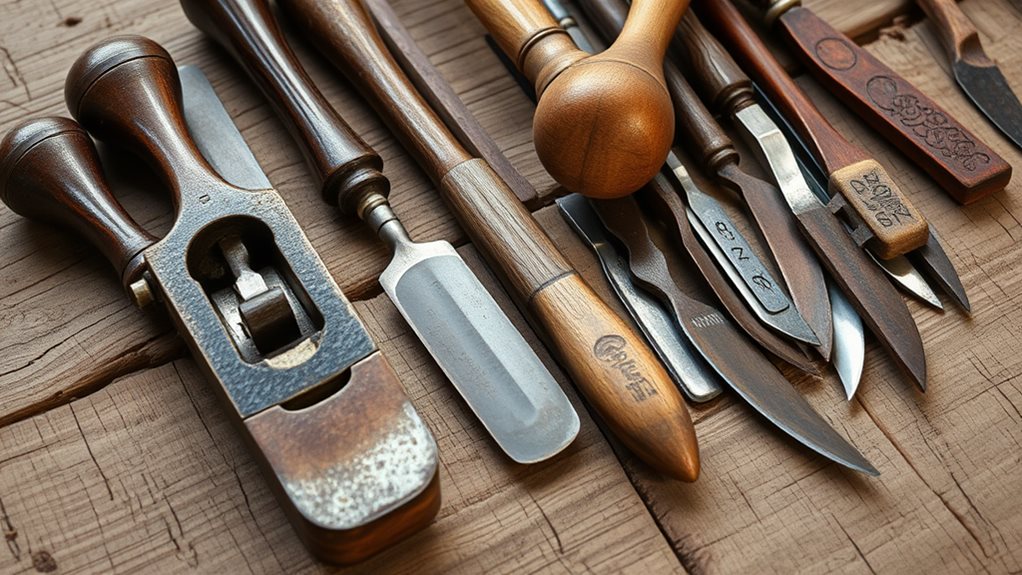
Tag: Filipino woodworking
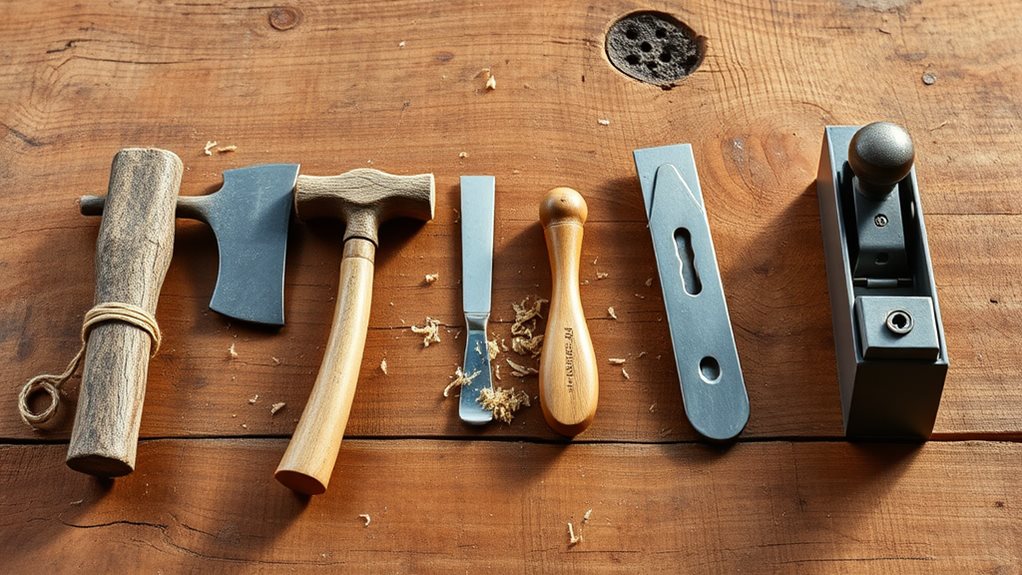
  • The Evolution of Tool Technology in Filipino Woodworking

    The Evolution of Tool Technology in Filipino Woodworking

    You'll discover that Filipino woodworking began in the Paleolithic era, using flake tools. Neolithic advancements introduced ground stone tools aiding early agriculture. The Metal Age revolutionized woodworking with copper, bronze, and iron implements. Notice indigenous designs like the bolo, panabas, and kampilan demonstrate sophisticated craftsmanship. Modern techniques use power tools and even engineered wood. Regional variations exist, each with cultural significance. Understand how tools embody cultural values and historical experiences in Filipino woodworking. Further exploration enriches your understanding.

    Paleolithic Beginnings: Stone Age Tools

    Early Filipinos employed flake tools crafted from stone and shell materials through striking methods for cutting and scraping in their Paleolithic beginnings. You'll find evidence of this early craftsmanship if you study tools from Tabon Caves, where they used red jasper, white chert, and andesite. Across regions like Cagayan Valley and Palawan, you see these early technological innovations. You shouldn't underestimate the importance of these tools; they improved hunting and gathering practices. You can see how the selection of chert and jasper showed resourcefulness. Moreover, denticulate tools illustrate an understanding of woodworking and hide processing needs. Burial practices also occurred during this period. You see these simple tools marking the starting point of Paleolithic technology, affecting society. Their resourcefulness aided survival and pushed technological progression.

    Neolithic Advancements: Ground Stone and Early Agriculture

    As we transition from the Paleolithic era, we see Neolithic advancements ushering in an era defined by ground stone tools and early agriculture.

    You'll notice that Neolithic tools, like polished adzes and axes, showcase advanced craftsmanship. These tools enabled more efficient cutting and shaping of wood, refining woodworking techniques. With the advent of polished stone, crafting intricate wooden structures and furniture became more achievable.

    Early agriculture, introduced around 2,200 BC, brought agricultural innovations and stable settlements. You can see how crops like rice and millet necessitated wooden tools for cultivation and storage. The woodworking traditions of the Ifugao and Kankana-ey groups involved creating adze-hewn deities, highlighting the continued importance of woodworking in agricultural societies.

    Agricultural practices influenced cultural evolution and woodworking, creating demand for wooden containers. Ground stone technology supported both agriculture and woodworking, reflecting the era's progress.

    Across regions, we find evolving woodworking styles adapting to both materials and techniques.

    Metal Age Revolution: Copper, Bronze, and Iron

    Around 500 BC to 1000 CE, metal's arrival ushered in a transformative era for Filipino woodworking. Copper, bronze, and iron tools revolutionized the scope and complexity of what you could achieve. Metalworking techniques enhanced tool durability and fostered craft specialization.

    Consider the historical significance of copper, being versatile yet softer, giving way to bronze, an alloy of copper and tin that made tools sharper. You'll see archaeological evidence of copper, then bronze's widespread usage. The Sa Huynh culture traded beads and bronze mirrors extensively with the Philippines during this period, influencing tool designs and availability.

    Then comes the Iron Age, around the 9th century, where iron tools were used for precision crafts. You'll notice that there's an improvement to societal and economic development.

    • Adzes used for shaping wood
    • Chisels for finer detail work
    • Knives for cutting and carving
    • Bronze axes for felling larger trees
    • Iron tools for heavy-duty woodworking

    Indigenous Designs: Bolo, Panabas, and Kampilan

    Consider the *panabas*: originating from Mindanao and used by groups like the Maranao, its curvature-edged sword displays traditional craftsmanship. The Maranao's avoidance of figural representations in their carvings, instead prioritizing de-natured natural forms, is mirrored in their weaponry designs.

    You'll notice the *kampilan*, traditionally linked to leadership, stood as a symbol of power.

    These weren't merely instruments of war but objects carrying deep cultural impact and showcasing that tools played dual roles as functional items and representations of status.

    Seeing how each design reflects its region shows the rich martial background of the Philippines.

    The Versatile Bolo: A Cultural Icon

    A central motif in Filipino tool technology is the bolo, a tool adapted for agriculture, combat, and cultural symbolization. You'll find its curved, single-edged blade, often forged from recycled steel, widened towards the tip, enhancing its chopping ability.

    Handle materials range from hardwood to carabao horn, reflecting agricultural adaptability and regional styles like the Itak and Pinuti showcase its versatility. The bolo is more than just a tool, it's a potent symbol deeply ingrained in Filipino culture. It's an enduring cultural icon. Various types exist, catering to the diverse needs of different ethnic groups.

    • Farmers harvesting rice with rhythmic swings
    • "Bolomen" fiercely defending their land
    • Arnis practitioners demonstrating precise strikes
    • Historical reenactments showing bolo wielders.
    • Modern blacksmiths forging new blades

    Its bolo symbolism permeates history, from its role in the Katipunan to its presence in WWII. Despite technological advancements, the bolo remains relevant, embodying resilience and self-reliance and you can see, it remains integral to the narrative of the Filipino people.

    Traditional Metalworking Techniques

    Beyond the bolo's iconic silhouette, you'll discover the intricate realm of traditional metalworking techniques that have shaped Filipino artistry and functionality for centuries.

    You'll find ancient influences blended with colonial impacts that underscore its cultural significance. Mastery takes generations, with artisans refining skills learned through cultural exchange. The Spanish colonial period's introduction of new techniques influenced many eras of craftsmanship, including the creation of ornate religious objects like candlesticks.

    Fire manipulation is key; you're using it to shape metals. Artisans rely on hand-forged tools—hammers, anvils, tongs—each crucial for precision crafting.

    You'll see designs incorporating nature-inspired and tribal symbols. Expect extensive physical labor, reflecting the dedication to traditional craftsmanship.

    Indigenous tribes, like the Igorots and Lumads, contribute unique techniques. Natural materials influence crafts, and regional specialties reflect local practices.

    Foreign influences blend with indigenous methods, enriching designs. Apprenticeships are preserving this vital knowledge.

    Contemporary metalworkers adapt to modernity while maintaining practices. You're witnessing sustainability, education, and artistic expression, all reinforcing its cultural icon status.

    Modern Woodworking: Power Tools and Machinery

    Transitioning to the modern era, we'll explore how power tools and machinery have revolutionized woodworking in the Philippines. Contemporary workshops integrate an array of electrically powered saws, drills, sanders, and lathes to enhance production speed, precision, and versatility in crafting furniture, structures, and artistic creations.

    Investing in power tool advancements marks a significant leap, enabling artisans to achieve woodworking efficiency previously unattainable.

    Consider these tools that have become commonplace:

    • Circular saws for straight cuts.
    • Router technology for intricate designs. The use of specialized router bits, such as straight, chamfer, and cove bits, allows for intricate designs and detailing.
    • Planers that ensure uniform wood thickness.
    • Jointers that create flat and square edges.
    • Miter saws designed for precise angled cuts.

    Power tools empower you with increased productivity. You can complete projects faster, with unmatched accuracy compared to hand tools.

    Safety features integrated into these tools reduce risks, while their reliability ensures that you get consistent results. Leading brands like SawStop and Festool are shaping your workshop's capabilities.

    Engineered Wood and Contemporary Practices

    You'll find engineered wood has become vital, reflecting contemporary woodworking's shift toward optimized resources and durability, offering a cost-effective alternative by efficiently utilizing wood and reducing waste, while resisting common issues like warping and shrinkage, due to compositional stability.

    Engineered wood benefits are realized through efficient manufacturing and increased lifespan compared to solid wood. Considering the commitment to sustainable practices at GRM Biowood Interiors Corporation, engineered wood aligns with green building initiatives.

    Contemporary woodworking practices now incorporate materials like Biowood, which offers termite, mold, and fire resistance, ensuring longevity.

    You'll see increased demand for eco-friendly options like PalmEco Board, sourced from palm fiber waste, leading to more durable and lower-maintenance woodworking applications. This commitment supports sustainable practices.

    Also, you should consider GRM's products, blending strength and aesthetics, alongside FSC-certified timber from sources like Filtra Timber.

    Technological advancements boost eco-friendliness and durability, reshaping contemporary woodworking practices for sustainable solutions in the Philippines.

    Regional Variations in Tool Design

    Consider these images:

    • The crescent-shaped *lukong* carving rounded edges on an Ifugao bulul.
    • A craftsman smoothing edges with an *uchip* after using chisels.
    • Someone using a *korikor* for basket weaving. *Simpa*, a flat-bladed chisel, is part of an apprentice's tool set.
    • A *panabas*, originally used as an agricultural tool.
    • An artisan hollowing a wooden bowl using a *chipya* chisel.

    You could also observe how modern woodworking adapts traditional methods, conserving original tools while also incorporating contemporary materials.

    Tools as Cultural Artefacts

    Tools transcend mere utility; they embody the cultural values, historical experiences, and artistic ingenuity of Filipino woodworking traditions.

    You'll find indigenous influences prevalent; wood served precolonial societies for religious and cultural practices. Consider how communities once revered trees—balete trees especially—and how only spiritual leaders interacted with their spirits. Spanish colonization impacted these beliefs, but indigenous communities persisted. Technological advancements now drive mechanization in the craft.

    The cultural significance of woodworking tools extends to tool symbolism, with many artisans using them to create religious artifacts expressing enduring spirituality.

    Paete's wood carving tradition exemplifies this; artisans use Narra and Kamagong to depict religious and secular themes, impacting the local economy.

    Though power tools' integration has transformed woodworking, blending old and new techniques preserves cultural heritage, demonstrating the vital role artisans' skills play in maintaining these traditions.

  • Traditional Woodworking Tools of Filipino Craftsmen

    Traditional Woodworking Tools of Filipino Craftsmen

    You'll find chisels crucial for shaping wood in Filipino woodworking. Paete artisans use these with mallets for precise details. Hand planes smooth surfaces for beauty and function. Sharpening methods involve whetstones, vital for maintaining tools. Craftspeople carefully maintain tools to prevent rust and cracking. You adapt these techniques to modern craft; combining artistry with efficiency. Cultural heritage comes alive through woodworking. To understand this creative blending, explore further.

    The Enduring Legacy of Filipino Wood Carving

    Wood carving in the Philippines predates Spanish colonization, with native Filipinos having initially created boats and spears adorned with ornamental patterns for delineating tribal hierarchies.

    You'll find the art flourished during Spanish rule, adapting to include religious statues, a fusion of indigenous artistry and European influence.

    You're seeing generational craftsmanship; techniques passed down connect present to past. Diverse themes span religious figures to daily-use objects. The carvings hold deep cultural symbolism, reflecting traditions and skill. Romblon woodcarvings are living expressions of culture, with their intricacy and beauty reflecting historical significance.

    Regional styles, like Romblon's intricate narra and molave designs, are distinct. Carvers use narra, molave, and kamagong for their durability.

    You're noticing nature motifs like leaves are integrated, showing the country's environment. Wood carvings you see embody Filipino culture.

    Wood carving remains vital, boosting local economies. It's a tourist draw, showcasing hands-on artistry.

    You see it's preserved through education, maintaining heritage. Contemporary adaptations meld tradition with modern innovation, securing its future.

    Paete: A Cradle of Carving Excellence

    Nestled along Laguna de Bay, Paete, Laguna, beckons as a testament to Filipino artistry, a cradle where the legacy of wood carving thrives; its origins, rooted in 1580 through Spanish friars Juan de Plasencia and Diego de Oropesa, evolved into a cultural identity so profound.

    You'll find the name "Paete" originates from "paet," a Tagalog word for chisel, reflecting the town's deep connection to this craft. Designated the "Carving Capital of the Philippines" in 2005, you witness firsthand what makes Paete exceptional.

    As you explore, you'll observe how the Paete heritage thrives through generations of artisans. Wandering through carving workshops, you'll encounter skilled hands shaping local wood—batikuling, Narra, Molave, and Kamagong—into religious statues and intricate murals, reflecting Filipino life.

    These masterpieces aren't confined locally, gracing churches and museums worldwide, including even the Vatican! The industry substantially supports the local economy, offering employment and global recognition.

    The Chisel: An Artisan's Trusty Companion

    Fundamental to traditional woodworking, the chisel is an artisan's trusted companion for shaping wood and creating joints.

    You'll discover that the chisel heavily relies on physical force, often with a mallet. Filipino craftsmen might use hand-forged or imported chisels, favoring carbon steel for lasting performance.

    Influenced by designs like the Japanese Oiire nomi, Filipino chisels use hardened steel edges and softer iron backs. This design allows for a hard cutting edge supported by a softer material.

    You'll see handles made from hardwoods –like Japanese white oak–, but modern synthetic alternatives exist.

    Chisel materials for edges include carbon steels such as Hitachi Blue. Decorative engravings, an artisan's signature, often decorate handles.

    Understanding chisel techniques involves mastering strokes and pressures, developing an intimate feel for the workpiece.

    Whether using an Oiire nomi for general tasks, a Shinogi nomi for fine work, or specialized types like fishtail or mortise chisels, you're adapting an array of tools and techniques.

    Hand Planes and Smoothing Techniques

    An array of hand planes are crucial tools you'll find in woodworking, used to shape and smooth surfaces by muscle power or motorized means. They feature a cutting edge and a body that guides over the wood. The sole keeps a constant cutting angle. For surfaces beyond power tools, hand planes are key. Smoothing planes remove minimal wood for finishing.

    Understanding the parts is essential. The mouth is where shavings pass. The frog adjusts the iron's angle. A lever cap secures the iron. You'll use the depth adjustment knob to control the cut. The sole maintains a flat cut.

    Japanese planes are pulled, not pushed. Small Japanese planes excel on curved surfaces. Ebony bodies and steel blades ensure durability. The style stresses precision. Modern planes can be also made from ductile iron providing both durability and rust resistance.

    With smoothing techniques, you're removing little material for a fine finish. Maintaining a sharp blade and adjusting the frog is vital. Light pressure prevents gouging. You can refine surfaces further with polishing. Inspect the wood often, avoiding over-planing.

    Filipino craftsmen likely use various planes for projects. Their precision demands hand planes for quality. These create detailed surfaces, enhancing beauty and function.

    The Significance of Mallets

    Smoothing surfaces with hand planes is an art, and your next tool of mastery should be the mallet. These tools are integral to Filipino woodworking, aren't they?

    From joiner's mallets with large, rectangular heads for heavy chisel work to carving mallets with smaller, cylindrical heads ideal for carving with gouges, mallet types vary to meet every need.

    You'll find mallets enable delicate adjustment of blades on traditional planes. You should consider them essential for assembling and disassembling joinery without marring your meticulously shaped wood.

    Crafted from hardwoods like ash or beech, mallets underscore a rich woodworking tradition across cultures. Some woodworkers choose hornbeam for their mallets due to its durability.

    Mallet maintenance shouldn't be taken lightly; a simple wax coating can protect the handle. Inspecting for cracks ensures durability.

    You'll learn that how you care for your mallet reflects respect for the craft. They're more than tools; they preserve culture.

    Measuring and Marking Tools

    Accuracy is paramount, and the precision found in metal rulers, particularly the metric ones, is favored within construction. You'll commonly encounter 6 to 12-inch steel rules, meter sticks, and folding rulers, ideal for length measurements and straight lines.

    For inner and outer dimensions, vernier calipers are crucial. You can find inside, outside, divider, and digital calipers, but you've got to handle them consistently for reliable measurements, especially ensuring your measuring techniques are sound. Digital calipers offer quick readings, improving workflow. Calipers with adjustable arms offer versatility in measuring a range of dimensions.

    Levels, critical for ensuring surfaces are perfectly horizontal or vertical, are also crucial; longer levels can enhance leveling accuracy.

    For woodworking, marking gauges are essential, allowing you to scribe lines parallel to edges. They're indispensable in joinery, guaranteeing that your cuts and fittings are precise. Gauges adjust easily, enabling you to mark lines at different distances, so that you can enjoy enhanced marking accuracy.

    Beyond these, plumb bobs, chalk line markers, scriber gauges, center punches, and marking knives expand the arsenal for diverse marking needs.

    Wood Turning Tools and Techniques

    Wood turning introduces a unique set of tools and techniques, distinct from general woodworking and oriented toward creating cylindrical or curved forms.

    Working with these tools requires precision to achieve clean cuts and smooth surfaces. You'll find roughing gouges shape a square blank into a round form efficiently.

    Then, you use spindle gouges for general turning between centers, while bowl gouges, often recommended for beginners, offer more control. Carbide tools, known for their ease of use, can be a great starting point due to their consistent performance.

    Parting tools precisely remove waste material, and skew chisels are essential to produce beads and flat surfaces on spindle projects.

    Material selection is also very important. Softwoods are beginner-friendly, while hardwoods suit elaborate projects. Exotic woods offer you unique aesthetics.

    Consider roughing as the initial shaping, and turning refines the form using various tool techniques.

    Facing cleans the wood, while beading creates rounded details, and fluting adds decorative grooves.

    Traditional Sharpening Methods

    Several time-honored approaches have kept craftsmen sharp and productive, including whetstones, hones, and rubstones, each integral in maintaining the keen edge essential for woodworking, whether you're in the Philippines utilizing local stones or elsewhere adopting methods refined over centuries. Whetstones need proper soaking to enhance sharpening effectiveness.

    You'll find that Filipino craftsmen often use whetstones for their abrasiveness, followed by hones for a finer edge. Rubstones, being coarser, are suitable for initial shaping.

    When sharpening, you're adopting specific sharpening techniques. Hollow grinding creates that characteristic hollow bevel. Craftsmen might add double bevels to enhance sharpness. Selecting appropriate sharpening angles, crucial for different wood types, demands practice.

    You've probably seen influence from other cultures in their adoption of certain sharpening techniques.

    Stone maintenance is critical. You must keep your stones clean and properly lubricated with oil or water.

    Tool Maintenance and Preservation

    Maintaining a sharp edge is one aspect, but proper tool care extends the life and utility of your woodworking implements, safeguarding your investment and preserving cultural heritage.

    For optimal tool longevity, choose the right tool for the job. Utilizing screwdrivers in risk-free operations prevents damage. It's essential you use each tool for its intended purpose. Hand tools are essential, so using the correct one will avoid damage.

    Prevent rust by keeping tools dry and clean. If they do get wet, disinfect and dry them. Coat them with rust inhibitors, especially for long-term storage, boosting tool longevity.

    For handle maintenance, use paste wax to prevent oxidation on your tools. Apply appropriate oils regularly to wood to prevent cracks.

    • Regularly inspect your tools for damage.
    • Implement preventative maintenance techniques.
    • Store everything properly in a toolbox, protecting them from the elements.

    Don't expose your tools to direct sunlight or moisture. Perform repairs promptly. Disassemble when necessary to clean moving parts.

    These maintenance techniques assure tool longevity, while you're preserving Filipino craftsmanship.

    Adapting Traditional Tools for Modern Craft

    As artisans transition into today's woodworking landscape, you'll find adapting traditional tools crucial for blending age-old artistry with current demands.

    Consider how integrating power tools boosts efficiency while retaining hand tool charm. Hybrid woodworking becomes key – you're combining the best of both worlds. You're also using Computer-Aided Design (CAD) to modernize planning. As power tools become more accessible, woodworkers in the Philippines can improve efficiency in their tasks.

    The craftsmanship evolution demands embracing advanced wood processing — you're discovering new material durability for products.

    You'll also see workshops that teach you new skills for adapting older tools. You'll notice programs are available to innovate and train in tool innovation, skills necessary for competition on a global scale.

    Think about the aesthetic diversity that modern materials provide, allowing you to craft new designs. Also, you're making sure to adhere to safety standards.

    The artisans blend old and new, to reach global markets and demand for unique crafts.